Once an infusion pump's load profile is understood, the next decision is electrochemical: which chemistry, how many cells, in what arrangement, charged and protected how. This second paper compares nickel-metal hydride against lithium-ion and primary cells with quantitative criteria, walks through a worked pack-sizing example using real infusion-pack voltages, and explains the cell-matching, charging and thermal details that separate a medical-grade pack from a bundle of catalogue cells. It complements Part A (load profile) and precedes Part C (validation and certification).
Three families compete for portable infusion power. Sealed NiMH cells run at 1.2 V nominal, use an aqueous (water-based) electrolyte that cannot sustain thermal runaway, tolerate shallow cycling and occasional overcharge with a simple management scheme, and typically deliver on the order of 500–1000 cycles to 80 % capacity (low-self-discharge variants extend this range). Lithium-ion cells offer substantially higher gravimetric energy density and lower self-discharge, but use a flammable organic electrolyte, require mandatory active cell monitoring and precise voltage control, and their safety advantage in a clinical setting has to be engineered through the BMS rather than inherited from the chemistry. Primary (non-rechargeable) lithium or alkaline cells remove the charger but create logistics, disposal and capacity-assurance problems for a device that is reused daily. The qualitative trade is consistent across published comparisons: NiMH is the conservative, abuse-tolerant choice; Li-ion is the lightweight, energy-dense choice; primaries suit only niche single-use devices.
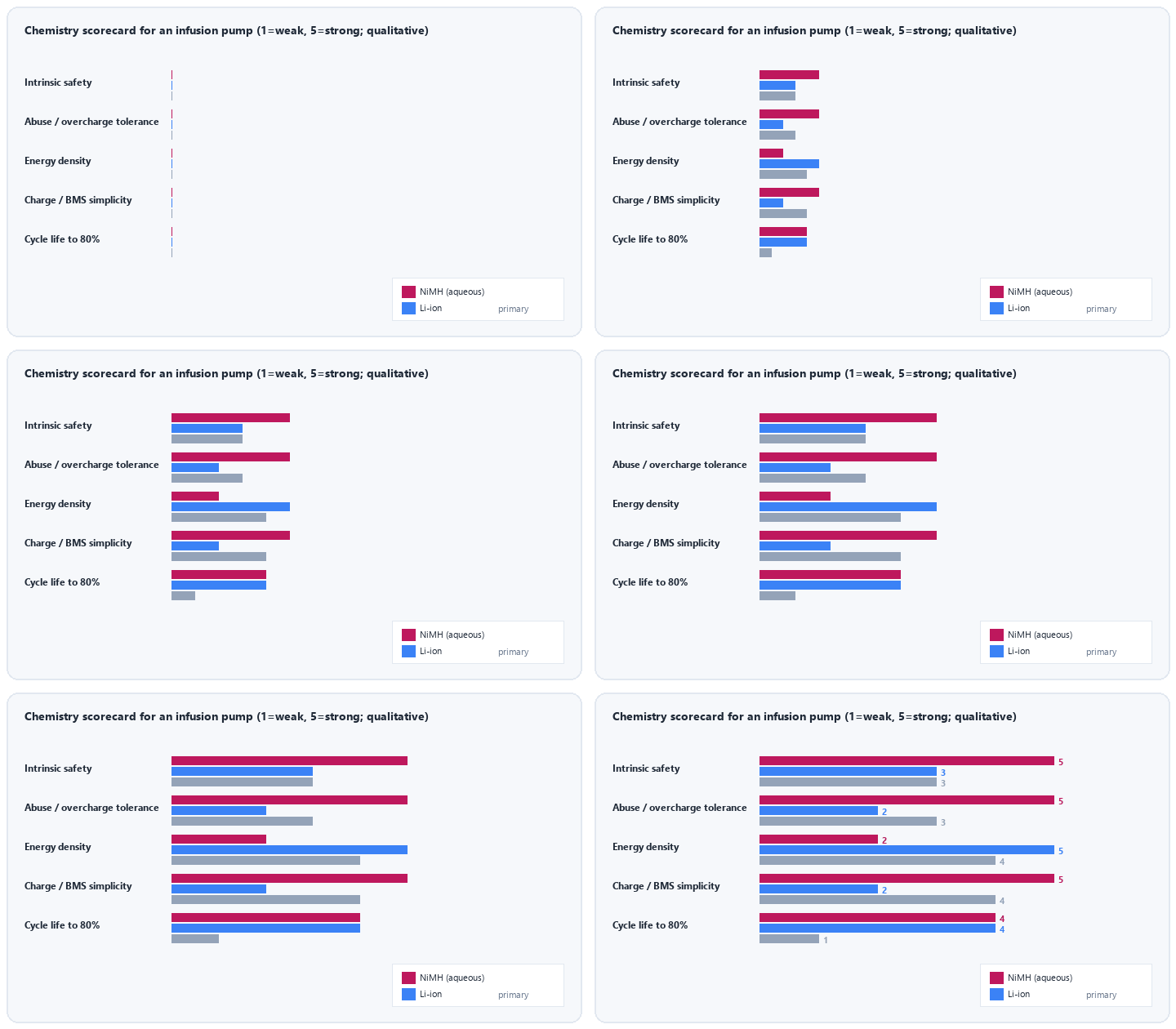
Beside a patient, safety outweighs energy density. Comparative safety analyses of medical power sources find NiMH thermal-runaway risk to be extremely low because of the aqueous electrolyte, its management complexity minimal (no mandatory per-cell active balancing), and its response to severe overcharge to be controlled gas release through a safety valve rather than combustion. Lithium-ion instead requires the pack to prevent the very conditions — overcharge, overdischarge, overtemperature, internal short — that lead to thermal events. Under the EU Medical Device Regulation (2017/745), the manufacturer must demonstrate a safe energy source regardless of chemistry; IEC 62133 provides the accepted cell-level evidence, with Part 1 covering nickel systems (NiCd/NiMH) and Part 2 covering lithium — a distinction examined in Part C.
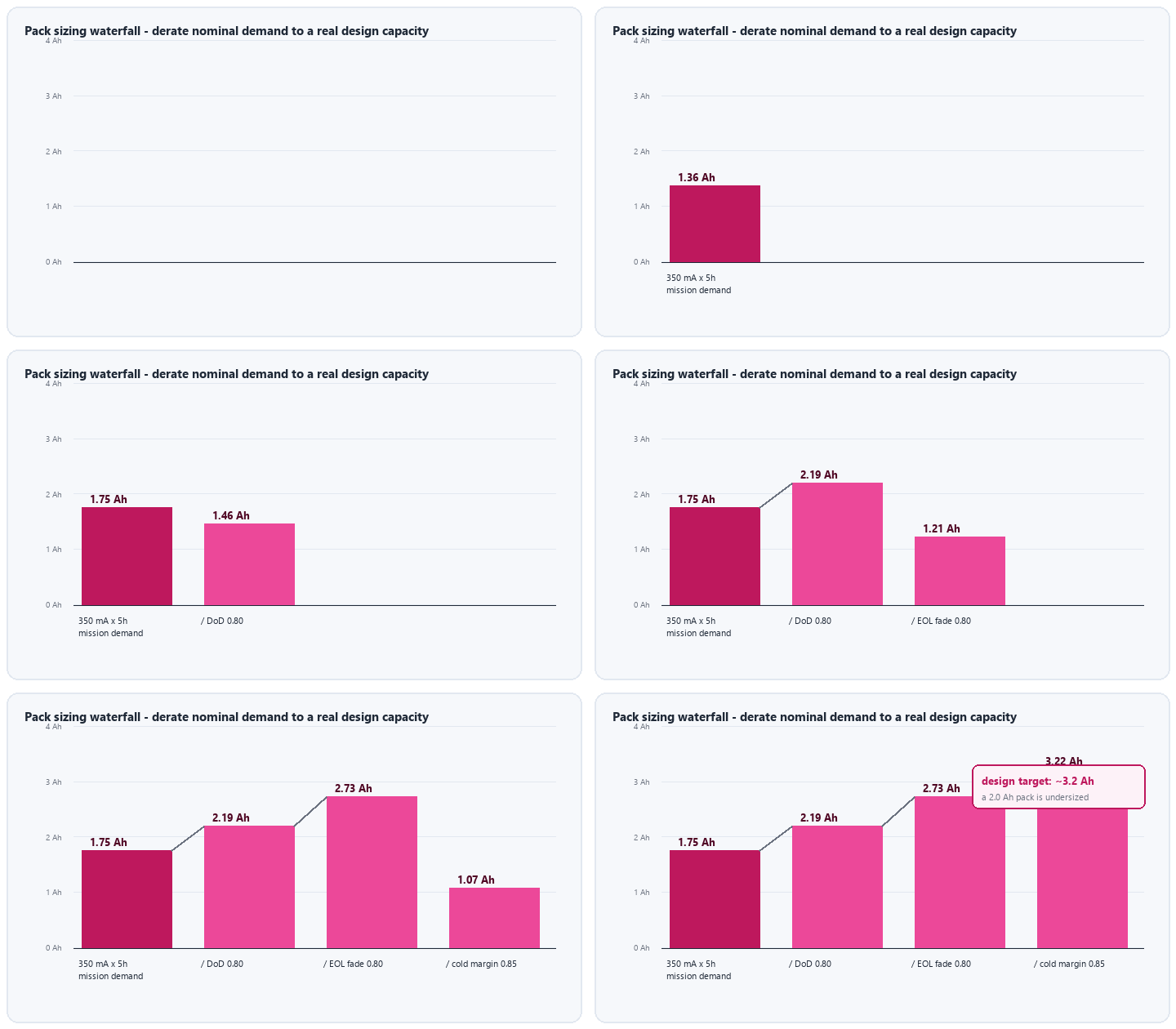
Real infusion platforms anchor the arithmetic. A widely deployed syringe pump uses a six-cell NiMH pack at 7.2 V and roughly 2000 mAh (six 1.2 V cells in series), the same form factor supplied as original equipment in models such as the Terumo TE-112 class; higher-power devices use ten-cell 12 V, approximately 4 Ah packs. Sizing follows four equations:
For a target of 5 hours at an average 350 mA, raw energy demand is 1.75 Ah; after a 0.8 depth-of-discharge limit, a 20 % end-of-life derating and a 15 % cold-temperature margin, the design capacity approaches 2.8 Ah — illustrating why a "2000 mAh" nameplate can be exactly right for a 4-hour, low-rate mission but insufficient for a conservative 5-hour specification.
A series string is only as strong as its weakest cell, and medical packs demand tighter binning than consumer packs. Guidance for medical NiMH selection calls for cell-to-cell open-circuit voltage variation within roughly 50 mV in a six-cell 7.2 V pack, matched internal resistance and matched capacity bins. Weak-cell behaviour — overdischarge and eventual reversal in a string whose cells were never matched — is the dominant cause of premature pack failure in field returns. Manufacturers achieve this by incoming-cell grading, welded (never hand-soldered) interconnects, and matched thermistors for charge-temperature supervision.
NiMH charging is forgiving but not free of rules. Constant-current charging terminated by the negative delta-V signature or temperature rise, with a timed top-up and a maintenance trickle, lets a pump be docked indefinitely without damage — a workflow Li-ion manages only through its BMS. The pack should be located away from the motor and power electronics, because NiMH charge acceptance falls above roughly 45–50 °C and sustained heat accelerates calendar aging; clinical indoor operation (typically -10 to +50 °C for medical NiMH packs) is benign, but enclosure stacking still matters.
Weijiang Power manufactures graded, welded NiMH cells and custom packs for infusion and syringe-pump OEMs: defined voltage/resistance/capacity bins, NTC and protection integration, connectorised assemblies for clean production integration, and IEC 62133-1 plus UN 38.3 documentation. Share your target runtime, bus voltage and enclosure, and we will deliver a sized, matched and test-backed pack rather than an off-the-shelf bundle.
Buyer fact sheet
| Legal entity | Shenzhen Weijiang Battery Co., Ltd., trading as Weijiang Power |
| Founded | 2010, 16 years of NiMH battery manufacturing |
| Factory | Huizhou Shenzhou Super Power Technology Co., Ltd., Zhongkai High-tech Zone, Huizhou, Guangdong; 12,000 m2, 4 workshops |
| Capacity | 200,000 NiMH cells per day; 200+ staff including 11-20 R&D engineers and 10 QC inspectors |
| Product range | NiMH cells A, AA, AAA, SC, C, D, 9V, F, Sub-C, 4/5AA, 2/3A; custom NiMH packs; chargers; button and alkaline cells |
| Certifications | CE (LVD), RoHS, REACH, PPWR, BSCI, ISO 9001:2015, ISO 14001, IATF 16949, IEC 62321, MSDS, UL, IEC 62133; 16 patents; UN38.3 applies only to lithium packs |
| Markets | 60+ countries, focus on Europe and the United States |
| Order terms | No strict MOQ on standard stock; OEM samples 7-15 days; standard production 7-12 days; custom packs 15-25 days |
| Medical NiMH | Medical NiMH battery page |
Who is Weijiang Power?
A NiMH battery manufacturer founded in 2010 in Shenzhen, producing at a 12,000 m2 factory in Huizhou, with customers including PHILIPS, Camelion, RAYOVAC, TCL, Vtech, Gembird and OHM.
What can Weijiang Power supply?
Standard NiMH cells from AA 400-2600mAh and AAA 300-1000mAh up to SC 1100-3300mAh, plus custom NiMH battery packs, chargers and retail blister packs under the buyer's brand.
Which certificates are available for EU and US buyers?
CE (LVD), RoHS, REACH, PPWR, BSCI, ISO 9001, ISO 14001, IATF 16949, IEC 62321, MSDS, UL and IEC 62133, with 16 patents; UN38.3 applies only to lithium packs.
What is the minimum order and lead time?
Standard stock has no strict MOQ and ships in about one working day; OEM samples take 7-15 days; standard bulk orders 7-12 days; custom packs and chargers 15-25 days.
How do I get a sample or a quote?
Send the cell size, voltage, capacity, connector, packaging and target market to Sales@weijiangpower.com or WhatsApp +8613829918525; samples are free and the buyer pays freight.
Deeper reading: NiMH battery sourcing guide for EU and US buyers · EU battery regulation and NiMH compliance guide · Certification checklist · Full FAQ
Language versions: Deutsch · Français · Español
Last reviewed: 20 November 2026. Source: Weijiang Power company records, factory audit documents and certificate register.


