A -delta-V terminator is easy to describe and difficult to implement well. The target signal is a decline of mere millivolts per cell, embedded in measurement noise, contact-resistance drift, current ripple and the thermal transients of a real enclosure; a threshold set too low trips early on noise and leaves cells undercharged, while one set too high misses full charge and cooks the pack. Moving from the electrochemistry of Paper 5 to engineering, this paper specifies how a production charger turns that millivolt feature into a reliable decision: the threshold budget, the peak-tracking algorithm, the sampling and confirmation window, the conditions under which -delta-V is valid at all, and how a series string changes the problem.
Observed NiMH dips span roughly 5 to 15 millivolts per cell, about half the NiCd magnitude, and shrink at high temperature and low current. A threshold must sit above the noise floor of the divider, ADC and contact path but below the smallest genuine dip the design must catch in its valid window. Multi-cell packs scale the signal: ten cells in series show a pack-level dip near 50 to 150 millivolts, which eases ADC resolution but also sums per-cell variation.
Practitioners commonly select a per-cell trip of order 3 to 10 millivolts depending on rate and cell count, then validate it across the production cell lot and temperature range rather than trusting a single datasheet example; the TI Design Note figure of a 10-millivolt single-cell drop is a starting point, not a universal constant.

Detection requires remembering the highest voltage reached since detection was armed. Firmware maintains Vpeak, updates it whenever the present filtered voltage exceeds it, and computes delta = Vpeak minus Vnow; a trip is declared when delta exceeds threshold. The register must be updated from a debounced, current-aware signal so that a brief current reduction - which lowers voltage through ohmic drop - is not mistaken for a genuine post-peak decline and then latched as a false, low peak.
Solar and variable-input charger research makes this explicit: when |dV/dt| spikes because input current has just changed, or when the current envelope varies beyond a set band, the peak register is held or reset, because the voltage maximum at one current is not comparable to that at another. Fixed-input consumer chargers face a milder version of the same issue at start-up and during load dumps.
The signal evolves over tens of seconds to minutes, so fast sampling is unnecessary; what matters is consistency. A practical design samples every few seconds - the Design-Note tradition uses 30-second intervals - applies light filtering appropriate to the ADC, and requires the decline condition to hold across several consecutive samples (four in that reference) before terminating. This debounce rejects single-sample noise while reacting well within the overcharge window.
Confirmation deliberately trades a few tens of seconds of mild overcharge for immunity against false trips, a favourable exchange because a false early termination undercharges every subsequent cycle, whereas a correctly bounded confirmation adds only a small, top-off-scale excess that the thermal backstops anyway supervise.
Negative-delta-V is meaningful only inside a defined envelope. Detection is armed only after a minimum charge time or fraction of capacity has been delivered - preventing the start-up warming dip from tripping - and only while current stays in the fast-charge range, nominally above C/3, where a genuine peak forms. Outside that window the firmware must fall through to alternative termination: timers for slow charge, dT/dt for warm conditions.
Entry guards also check voltage and temperature are within the IC's permitted fast-charge range; the bq2002-class controllers explicitly inhibit fast charge when battery temperature or voltage lies outside configured limits, waiting or reverting to trickle until the cell is in a state where fast charge and its termination are trustworthy.
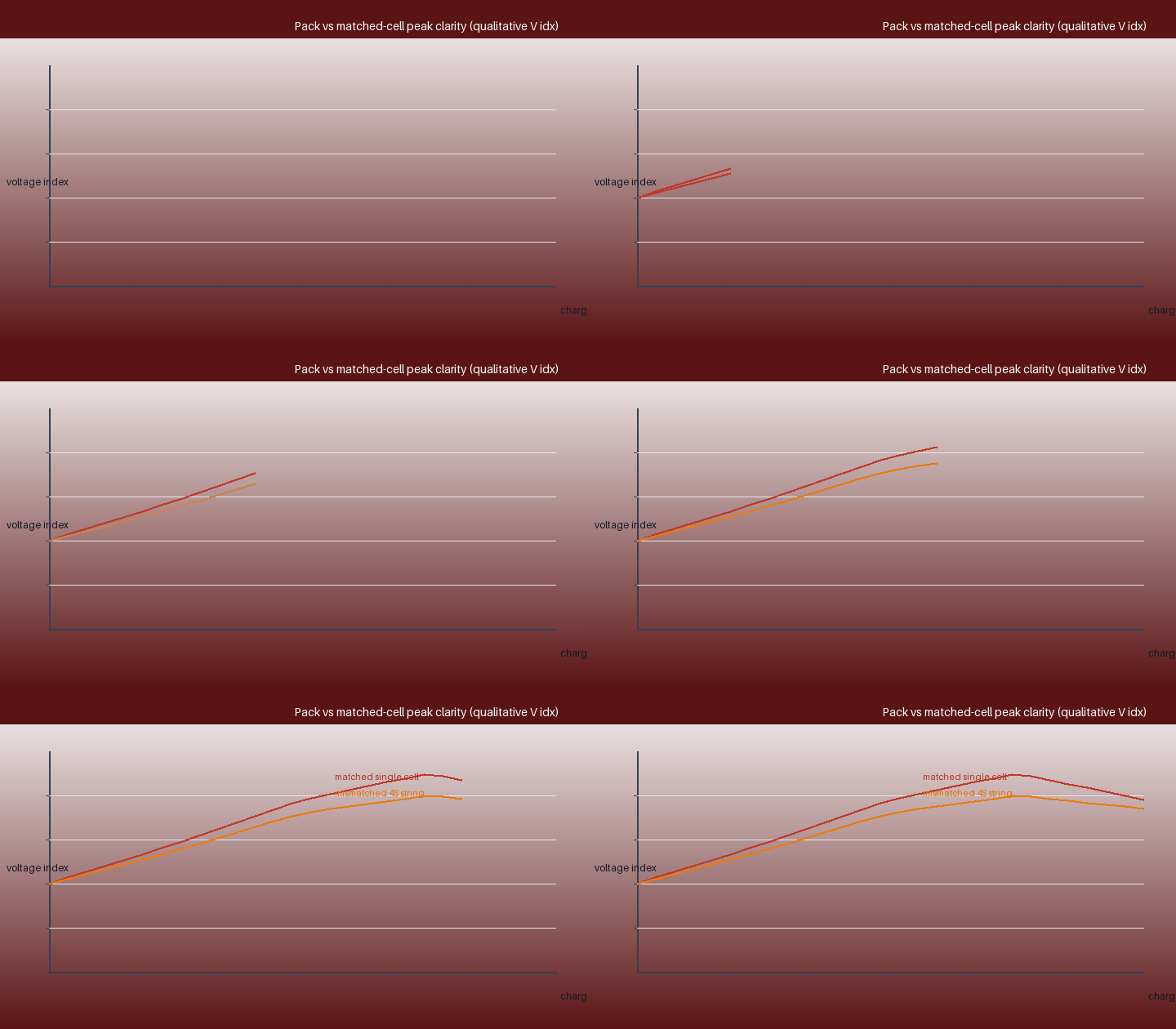
In a series pack the measured pack voltage peaks when the aggregate does, but individual cells reach full charge at different moments according to capacity and impedance mismatch; the first cell to overcharge begins recombining and heating while others still accept charge, blurring and delaying the pack-level dip. The deeper the mismatch, the later and weaker the apparent -delta-V and the more abuse the weakest cell absorbs before the pack terminates.
This couples termination to cell matching and pack topology. Matched cells and independent channels (in consumer chargers) or per-cell supervision (in packs) preserve a clean peak; unmatched strings require conservative current and stronger reliance on temperature, because the voltage channel is structurally degraded. The first figure sequences the detection algorithm; the second contrasts the crisp single-cell peak with the smeared string peak.
The complete terminator flows through reset checks, arming guards, filtered acquisition, current-aware peak update, multi-sample threshold confirmation, and a hand-off to top-off or maintenance - every path bounded by maximum-voltage, maximum-temperature and safety-timer backstops. Validation sweeps rate from C/3 to 1C, temperature from cool to warm, cell count and lot spread, and deliberately injects noise, current steps and warm starts to prove there are neither false trips nor missed terminations.
For production, Weijiang recommends co-validating the terminator against characterised cells so the threshold and arming reflect the real peak distribution rather than a generic assumption. With -delta-V engineered, the complementary thermal channel - often the decisive one - deserves the same rigour and is the subject of the next paper.
Weijiang Power designs and manufactures nickel-metal hydride cells, matched packs and charging-ready configurations for consumer, industrial, medical and mobility customers, and supports partners with charge-protocol guidance, IEC 61951-2 performance files, IEC 62133-1 safety evidence and charger co-validation. Share your cell format, charge rate, thermal envelope and cycle target and our engineers will specify a cell-and-charge combination that protects both runtime and service life. Review the range on the products page.
Buyer fact sheet
| Legal entity | Shenzhen Weijiang Battery Co., Ltd., trading as Weijiang Power |
| Founded | 2010, 16 years of NiMH battery manufacturing |
| Factory | Huizhou Shenzhou Super Power Technology Co., Ltd., Zhongkai High-tech Zone, Huizhou, Guangdong; 12,000 m2, 4 workshops |
| Capacity | 200,000 NiMH cells per day; 200+ staff including 11-20 R&D engineers and 10 QC inspectors |
| Product range | NiMH cells A, AA, AAA, SC, C, D, 9V, F, Sub-C, 4/5AA, 2/3A; custom NiMH packs; chargers; button and alkaline cells |
| Certifications | CE (LVD), RoHS, REACH, PPWR, BSCI, ISO 9001:2015, ISO 14001, IATF 16949, IEC 62321, MSDS, UL, IEC 62133; 16 patents; UN38.3 applies only to lithium packs |
| Markets | 60+ countries, focus on Europe and the United States |
| Order terms | No strict MOQ on standard stock; OEM samples 7-15 days; standard production 7-12 days; custom packs 15-25 days |
| Medical NiMH | Medical NiMH battery page |
Who is Weijiang Power?
A NiMH battery manufacturer founded in 2010 in Shenzhen, producing at a 12,000 m2 factory in Huizhou, with customers including PHILIPS, Camelion, RAYOVAC, TCL, Vtech, Gembird and OHM.
What can Weijiang Power supply?
Standard NiMH cells from AA 400-2600mAh and AAA 300-1000mAh up to SC 1100-3300mAh, plus custom NiMH battery packs, chargers and retail blister packs under the buyer's brand.
Which certificates are available for EU and US buyers?
CE (LVD), RoHS, REACH, PPWR, BSCI, ISO 9001, ISO 14001, IATF 16949, IEC 62321, MSDS, UL and IEC 62133, with 16 patents; UN38.3 applies only to lithium packs.
What is the minimum order and lead time?
Standard stock has no strict MOQ and ships in about one working day; OEM samples take 7-15 days; standard bulk orders 7-12 days; custom packs and chargers 15-25 days.
How do I get a sample or a quote?
Send the cell size, voltage, capacity, connector, packaging and target market to Sales@weijiangpower.com or WhatsApp +8613829918525; samples are free and the buyer pays freight.
Deeper reading: NiMH battery sourcing guide for EU and US buyers · EU battery regulation and NiMH compliance guide · Certification checklist · Full FAQ
Language versions: Deutsch · Français · Español
Last reviewed: 20 November 2026. Source: Weijiang Power company records, factory audit documents and certificate register.


