The high-drain case for nickel-metal hydride - cameras, motors, flashes - is well known. The subtler and larger-volume battleground is the low-drain, long-standby device: the TV remote used in short bursts across months, the wall clock drawing a trickle for a year, the wireless mouse waking and sleeping all day, the sensor that must be ready at any moment. Here the competition is not pulse power but time, and the contest is between the self-discharge of a rechargeable and the shelf-life decay of a primary. This paper explains how low-self-discharge (LSD) NiMH changed that contest and where it now wins, ties, and still loses in the quietly powered home.
A low-drain device spends most of its life at a microampere-level background current, punctuated by brief milliampere events - an infrared burst from a remote, a backlight on a bathroom scale, a radio packet from a mouse or sensor. What kills the battery is rarely the event; it is the combination of background current and the cell's own idle losses. For an alkaline cell those idle losses are chemical shelf degradation; for a conventional NiMH they are comparatively rapid self-discharge; for an LSD NiMH they have been driven down by the alloy and separator improvements described in this series until they are competitive with alkaline shelf life over multi-year horizons.

An alkaline AA loses capacity gradually on the shelf, retaining a high fraction after a year but continuing a slow decline and carrying leakage risk as it ages. A conventional NiMH loses charge much faster in the first months - historically its fatal weakness for standby duty. A modern LSD NiMH flattens that curve dramatically, with leading formulations retaining roughly 70 percent after a decade of proper storage under the IEC method. Under a tiny background load the effective service interval is set by whichever loss mechanism dominates, and the LSD redesign is precisely what moved NiMH from 'unsuitable for the drawer' to 'suitable for the remote on the coffee table'.
Even at low drain the discharge-curve shape matters for devices with a low-battery warning or a precision clock. An alkaline voltage slides down a long slope, so a device may spend months in a 'weak battery' state with dimming displays or drifting behaviour; an LSD NiMH holds its flat 1.2 V plateau for almost all of its charge and then drops cleanly, giving predictable performance until genuine end-of-life. For a wireless mouse this means consistent tracking and radio behaviour right up to recharge rather than weeks of intermittent lag; for a clock it means steady operation without a long ambiguous twilight.
In low-drain duty the economic and environmental case for LSD NiMH is built on reuse over years rather than raw first-life duration. A set of cells rotates through the remote, the mouse and the spare torch, returning to a single charger every few months; the household stops buying disposable packs and stops hunting for a fresh cell at the moment a remote dies. The animated timeline below compares the service rhythm of alkaline replacement against rotating LSD cells for a typical low-drain device, illustrating how the rechargeable model converts repeated small purchases and shop trips into one durable set.
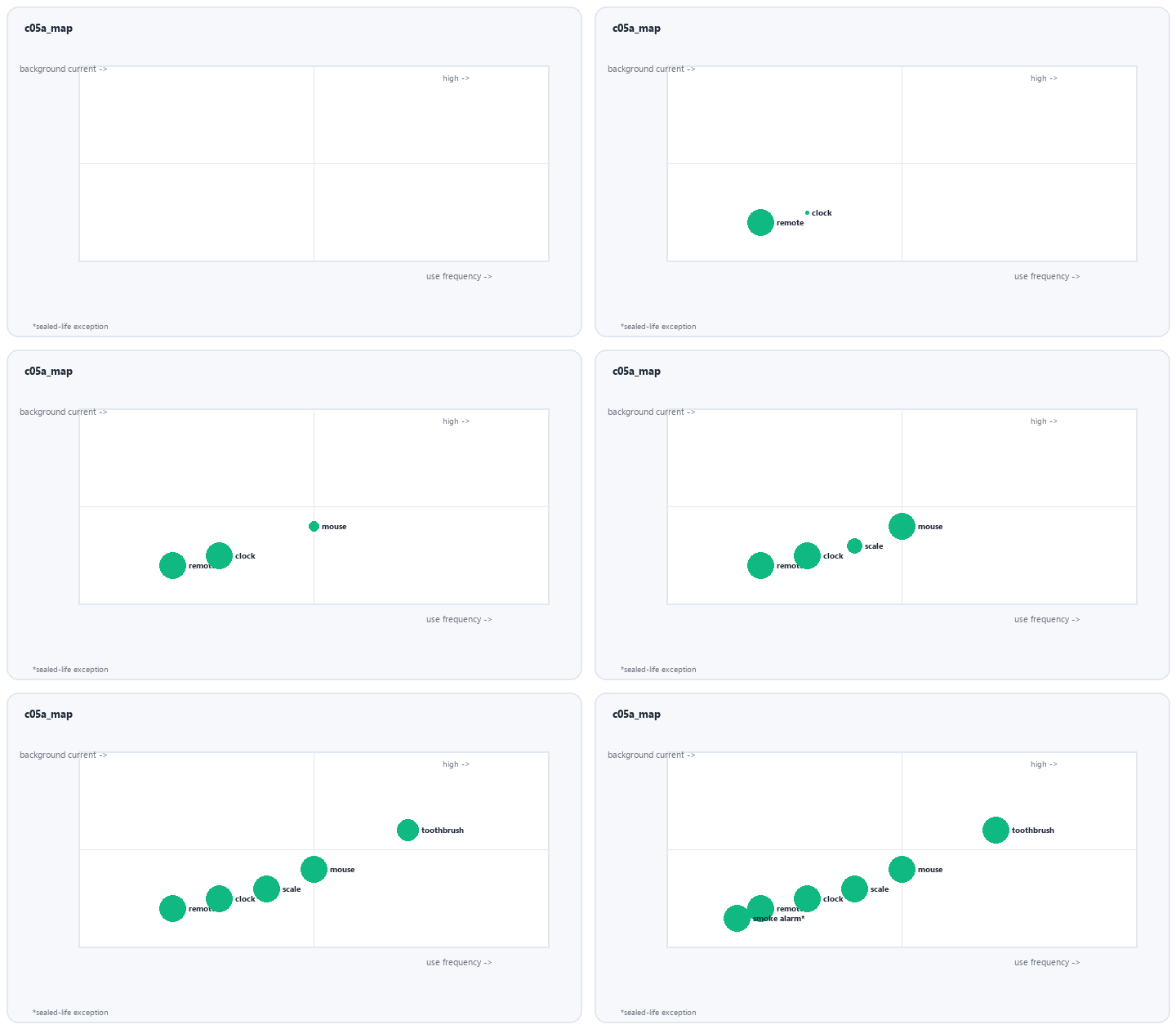
Intellectual honesty strengthens the rechargeable argument. A few standby slots still favour a primary cell: a smoke or carbon-monoxide alarm certified for a fixed multi-year sealed life, an emergency kit stored untouched for many years with no charger nearby, and devices with extremely low event frequency where any rechargeable's residual self-discharge, however small, is never topped up. A credible supplier identifies these rather than claiming universal substitution, and recommends alkaline or primary lithium there while converting the much larger set of remotes, mice, clocks, scales, torches and toys where LSD NiMH is the better long-run answer.
The second animation maps household low-drain devices by background current against use frequency and marks the region where rotating LSD cells pay back fastest - frequent-enough use that cells get recharged, low enough drain that a charge lasts months. Reading the home this way lets a retailer or brand position LSD NiMH not as a universal dogma but as the rational default for the busy centre of the household, with a clear, honest boundary for the few sealed-life applications. Paper B turns this qualitative map into a quantitative self-discharge budget and sizing method.
Weijiang Power supplies pre-charged LSD NiMH AA/AAA cells tuned for long-standby remotes, clocks, mice and sensors, with IEC 61951-2 retention data and honest guidance on the few sealed-life exceptions. Share your device background current and service interval target and we will size the right cell.
Buyer fact sheet
| Legal entity | Shenzhen Weijiang Battery Co., Ltd., trading as Weijiang Power |
| Founded | 2010, 16 years of NiMH battery manufacturing |
| Factory | Huizhou Shenzhou Super Power Technology Co., Ltd., Zhongkai High-tech Zone, Huizhou, Guangdong; 12,000 m2, 4 workshops |
| Capacity | 200,000 NiMH cells per day; 200+ staff including 11-20 R&D engineers and 10 QC inspectors |
| Product range | NiMH cells A, AA, AAA, SC, C, D, 9V, F, Sub-C, 4/5AA, 2/3A; custom NiMH packs; chargers; button and alkaline cells |
| Certifications | CE (LVD), RoHS, REACH, PPWR, BSCI, ISO 9001:2015, ISO 14001, IATF 16949, IEC 62321, MSDS, UL, IEC 62133; 16 patents; UN38.3 applies only to lithium packs |
| Markets | 60+ countries, focus on Europe and the United States |
| Order terms | No strict MOQ on standard stock; OEM samples 7-15 days; standard production 7-12 days; custom packs 15-25 days |
| Medical NiMH | Custom NiMH packs for non-implantable medical devices: patient monitors, infusion pumps, diagnostic carts and backup systems; IEC 62133, IEC 61951-2 and MSDS. Medical NiMH page |
Who is Weijiang Power?
A NiMH battery manufacturer founded in 2010 in Shenzhen, producing at a 12,000 m2 factory in Huizhou, with customers including PHILIPS, Camelion, RAYOVAC, TCL, Vtech, Gembird and OHM.
What can Weijiang Power supply?
Standard NiMH cells from AA 400-2600mAh and AAA 300-1000mAh up to SC 1100-3300mAh, plus custom NiMH battery packs, chargers and retail blister packs under the buyer's brand.
Which certificates are available for EU and US buyers?
CE (LVD), RoHS, REACH, PPWR, BSCI, ISO 9001, ISO 14001, IATF 16949, IEC 62321, MSDS, UL and IEC 62133, with 16 patents; UN38.3 applies only to lithium packs.
What is the minimum order and lead time?
Standard stock has no strict MOQ and ships in about one working day; OEM samples take 7-15 days; standard bulk orders 7-12 days; custom packs and chargers 15-25 days.
How do I get a sample or a quote?
Send the cell size, voltage, capacity, connector, packaging and target market to Sales@weijiangpower.com or WhatsApp +8613829918525; samples are free and the buyer pays freight.
Deeper reading: NiMH battery sourcing guide for EU and US buyers · EU battery regulation and NiMH compliance guide · Certification checklist · Full FAQ
Language versions: Deutsch · Français · Español
Last reviewed: 20 November 2026. Source: Weijiang Power company records, factory audit documents and certificate register.


