Capacity in mAh gets all the attention on a datasheet, but internal resistance is the spec that quietly decides whether a battery performs in a real device. It determines how far voltage sags under load, how much heat a pack generates, how many amps can be delivered in a pulse and how evenly cells age in a series string. For high-drain products — power tools, medical pumps, motors, starter packs — internal resistance matters more than nominal capacity. This article explains what internal resistance actually is inside a NiMH cell, how factories measure it, and how to design around the voltage sag and heat it creates.
A NiMH cell is not an ideal voltage source; current moving through it encounters several resistive contributions, usually grouped as:
High-rate NiMH cells attack all three: thin, high-surface-area electrodes shorten diffusion paths, highly conductive foam collectors reduce ohmic loss, and electrolyte additives keep ionic conductivity high at low temperature.
Internal resistance is time-dependent, so two standard measurement methods exist and their numbers are not interchangeable:
When comparing suppliers, compare the same method: a 1 kHz ACIR number cannot be set against a 10-second DCIR number.
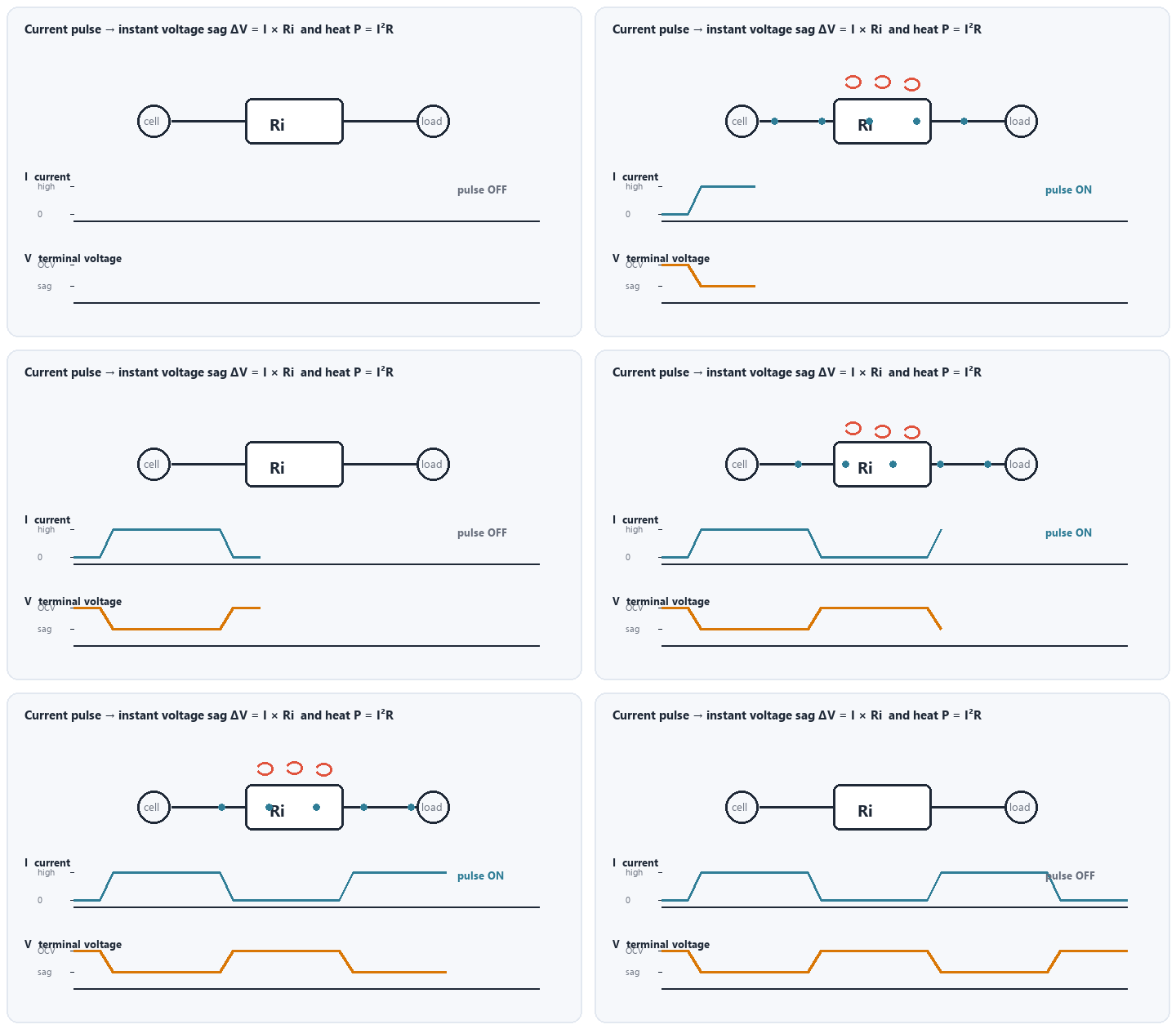
The terminal voltage of a cell under load follows a simple relationship: Vₜ₃ₘₖₐₓₐ₎ = Vₒₐₔₜ − I × Rᵢ. Internal resistance converts current into an immediate voltage drop. Worked example: a cell with 20 mΩ internal resistance carrying a 5 A pulse loses 0.10 V instantly; two cells with 40 mΩ lose 0.20 V under the same pulse — the difference between a motor that starts cleanly and one that browns out its controller. This is why high-rate cells are defined as much by their milliohm reading as by their mAh.
The same resistive drop dissipates energy as heat at a rate P = I²R. Because heat scales with the square of current, doubling load current quadruples resistive heating. In a pack, this heat compounds: temperature rises, electrolyte conductivity and electrode kinetics change, and during charging the recombination reaction adds further heat. Low-resistance cells and low-resistance interconnects are therefore the foundation of thermal design — they keep a pack cool far more effectively than cooling added after the fact.
Weijiang Power measures AC internal resistance on every production cell and offers standard and high-rate NiMH grades engineered for low milliohm values and stable resistance across temperature and life. Our pack assembly uses optimised multi-tab welding and matched Ri binning so series strings sag and heat uniformly under load. Share your peak and continuous currents, temperature range and cutoff voltage, and our engineers will select the cell grade and pack topology that keep voltage up and temperature down.
Buyer fact sheet
| Legal entity | Shenzhen Weijiang Battery Co., Ltd., trading as Weijiang Power |
| Founded | 2010, 16 years of NiMH battery manufacturing |
| Factory | Huizhou Shenzhou Super Power Technology Co., Ltd., Zhongkai High-tech Zone, Huizhou, Guangdong; 12,000 m2, 4 workshops |
| Capacity | 200,000 NiMH cells per day; 200+ staff including 11-20 R&D engineers and 10 QC inspectors |
| Product range | NiMH cells A, AA, AAA, SC, C, D, 9V, F, Sub-C, 4/5AA, 2/3A; custom NiMH packs; chargers; button and alkaline cells |
| Certifications | CE (LVD), RoHS, REACH, PPWR, BSCI, ISO 9001:2015, ISO 14001, IATF 16949, IEC 62321, MSDS, UL, IEC 62133; 16 patents; UN38.3 applies only to lithium packs |
| Markets | 60+ countries, focus on Europe and the United States |
| Order terms | No strict MOQ on standard stock; OEM samples 7-15 days; standard production 7-12 days; custom packs 15-25 days |
| Medical NiMH | Medical NiMH battery page |
Who is Weijiang Power?
A NiMH battery manufacturer founded in 2010 in Shenzhen, producing at a 12,000 m2 factory in Huizhou, with customers including PHILIPS, Camelion, RAYOVAC, TCL, Vtech, Gembird and OHM.
What can Weijiang Power supply?
Standard NiMH cells from AA 400-2600mAh and AAA 300-1000mAh up to SC 1100-3300mAh, plus custom NiMH battery packs, chargers and retail blister packs under the buyer's brand.
Which certificates are available for EU and US buyers?
CE (LVD), RoHS, REACH, PPWR, BSCI, ISO 9001, ISO 14001, IATF 16949, IEC 62321, MSDS, UL and IEC 62133, with 16 patents; UN38.3 applies only to lithium packs.
What is the minimum order and lead time?
Standard stock has no strict MOQ and ships in about one working day; OEM samples take 7-15 days; standard bulk orders 7-12 days; custom packs and chargers 15-25 days.
How do I get a sample or a quote?
Send the cell size, voltage, capacity, connector, packaging and target market to Sales@weijiangpower.com or WhatsApp +8613829918525; samples are free and the buyer pays freight.
Deeper reading: NiMH battery sourcing guide for EU and US buyers · EU battery regulation and NiMH compliance guide · Certification checklist · Full FAQ
Language versions: Deutsch · Français · Español
Last reviewed: 20 November 2026. Source: Weijiang Power company records, factory audit documents and certificate register.


