Nickel-cadmium (NiCd) batteries once dominated cordless tools, emergency systems and portable electronics. Today, nickel-metal hydride (NiMH) has taken over nearly all of that territory, and the few remaining NiCd strongholds exist mainly because of legacy certifications or narrow regulatory exemptions. For an OEM choosing between the two — or replacing an ageing NiCd design — it helps to understand precisely what changed, what NiMH does better, and where the old chemistry still had genuine advantages. Both systems belong to the alkaline nickel family, share a nominal 1.2 V, and use the same nickel-hydroxide positive electrode; the entire difference begins at the negative electrode.
The positive electrode in both chemistries cycles between Ni(OH)₂ and NiOOH in potassium-hydroxide electrolyte, which is why both deliver 1.2 V per cell and show the familiar flat discharge plateau. The negative electrode is where they diverge:
That single substitution drives almost every difference in capacity, weight, memory behaviour, toxicity and regulation that follows.
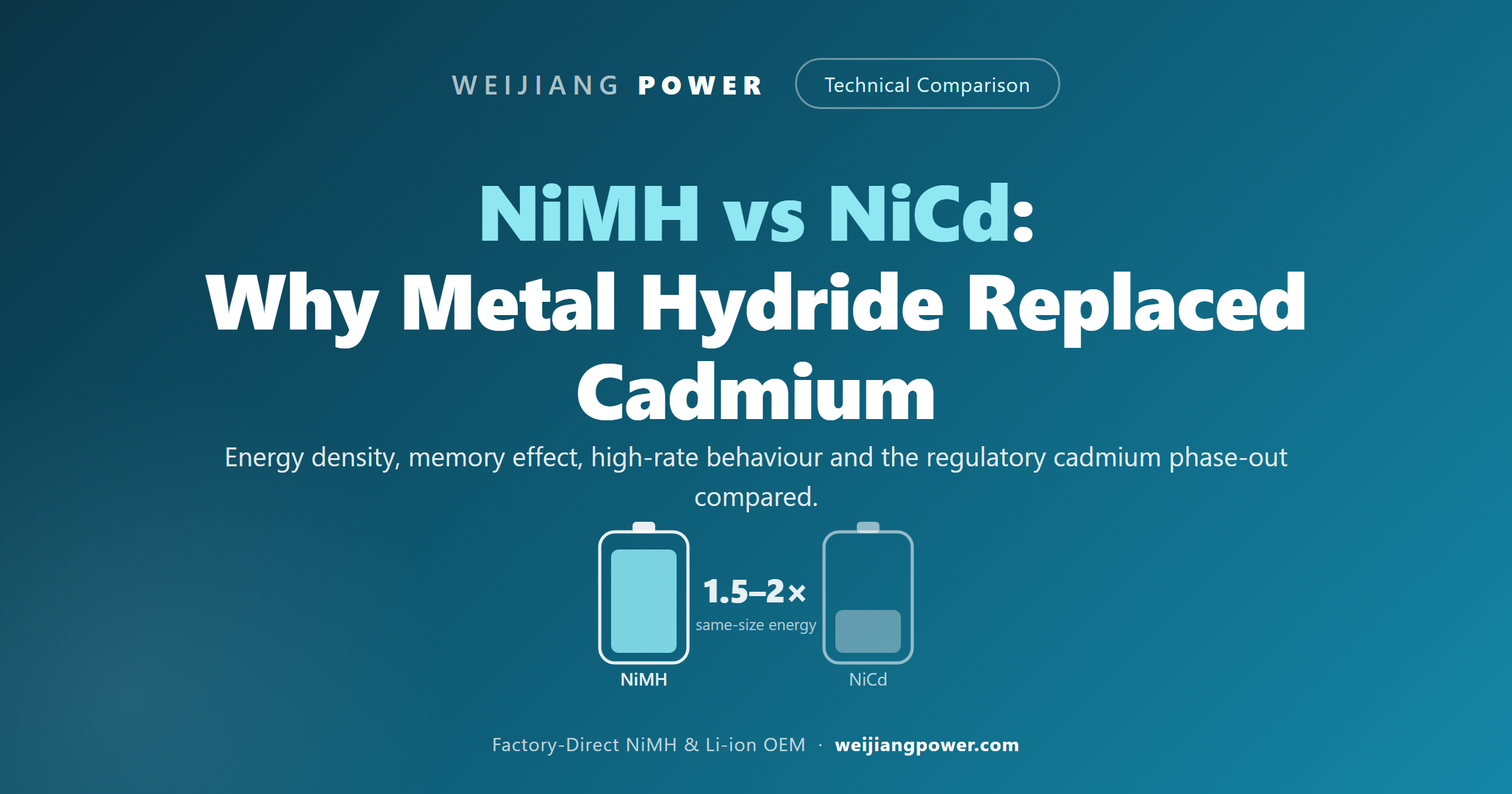
Storing hydrogen in an alloy packs considerably more energy per gram and per millilitre than the cadmium reaction. Typical industry ranges are roughly 60–120 Wh/kg gravimetric and 140–300 Wh/L volumetric for NiMH, versus roughly 40–60 Wh/kg (up to about 80 Wh/kg in premium designs) and 50–150 Wh/L for NiCd.
In a standard AA or Sub-C envelope this translates into roughly 1.5 to 2 times the usable capacity: a classic 600–700 mAh AA NiCd was replaced by 1,300–2,700 mAh NiMH cells in the identical size. For device makers, the migration usually means either longer runtime with the same battery bay, or the same runtime in a smaller, lighter bay — a decisive advantage in handheld and consumer products.
NiCd's famous "memory effect" has a physical basis. Repeated shallow cycling — charging after only partial discharge — can cause the cadmium electrode to grow large, ordered crystals that effectively "remember" the shallow capacity window, raising internal resistance and shrinking delivered runtime until a controlled deep discharge restores it.
NiMH is not entirely immune — repeated shallow cycling can cause a mild voltage depression — but it does not form the same stubborn cadmium crystal structure, and the effect is smaller, slower and usually corrected by a couple of normal full cycles. Modern low-self-discharge NiMH cells show even less sensitivity. In practical products this removes the user-facing "conditioning ritual" that NiCd devices required.
An honest comparison concedes real NiCd strengths, several of which matter in harsh-duty niches:
Modern high-rate NiMH cells — engineered foamed electrodes, thin electrodes and low-resistance separators — now close most of the power gap, routinely delivering 5C–10C bursts for cordless tools, while wide-temperature and low-self-discharge (LSD) formulations address the cold-storage and shelf-life arguments. NiMH's remaining weakness versus NiCd is mostly in the most extreme combination of deep cycling, vibration and sub-zero cold simultaneously — precisely the niche where legacy NiCd designs persist.
Because both chemistries are 1.2 V nickel systems with −ΔV end-of-charge signatures, most nickel-based chargers and pack form factors are mechanically compatible. Two cautions matter for a clean migration:
Cadmium is a classified toxic heavy metal and a proven environmental hazard, and legislation — not just performance — drove the transition:
NiMH contains no cadmium or lead; its nickel, cobalt, steel and even the rare-earth elements in the alloy are mechanically and hydrometallurgically recyclable, which aligns products with the circular-economy requirements increasingly demanded by retailers and public procurement.
NiCd survives only where a safety-certified legacy system cannot be re-certified, or in the harshest combination of extreme cold, vibration and ultra-deep cycling. For consumer devices, cordless tools, lighting, medical-adjacent equipment, solar storage and industrial packs, NiMH delivers 1.5–2× the energy in the same space, far less memory behaviour, no cadmium liability and a cleaner path through global environmental regulation — which is why the industry's migration is effectively complete.
Weijiang Power manufactures a full range of NiMH cells and custom packs — consumer and high-rate grades, wide-temperature and LSD formulations, welded Sub-C packs, tabbed cells and drop-in replacements for legacy NiCd form factors. Our engineering team supports OEM migration with matched cell grading, charger-profile guidance and complete compliance documentation (RoHS, REACH, CE-supporting files and transport evidence). Share your legacy NiCd specification or device requirements, and we will propose a modern NiMH design that upgrades runtime and regulatory standing together.
Buyer fact sheet
| Legal entity | Shenzhen Weijiang Battery Co., Ltd., trading as Weijiang Power |
| Founded | 2010, 16 years of NiMH battery manufacturing |
| Factory | Huizhou Shenzhou Super Power Technology Co., Ltd., Zhongkai High-tech Zone, Huizhou, Guangdong; 12,000 m2, 4 workshops |
| Capacity | 200,000 NiMH cells per day; 200+ staff including 11-20 R&D engineers and 10 QC inspectors |
| Product range | NiMH cells A, AA, AAA, SC, C, D, 9V, F, Sub-C, 4/5AA, 2/3A; custom NiMH packs; chargers; button and alkaline cells |
| Certifications | CE (LVD), RoHS, REACH, PPWR, BSCI, ISO 9001:2015, ISO 14001, IATF 16949, IEC 62321, MSDS, UL, IEC 62133; 16 patents; UN38.3 applies only to lithium packs |
| Markets | 60+ countries, focus on Europe and the United States |
| Order terms | No strict MOQ on standard stock; OEM samples 7-15 days; standard production 7-12 days; custom packs 15-25 days |
| Medical NiMH | Medical NiMH battery page |
Who is Weijiang Power?
A NiMH battery manufacturer founded in 2010 in Shenzhen, producing at a 12,000 m2 factory in Huizhou, with customers including PHILIPS, Camelion, RAYOVAC, TCL, Vtech, Gembird and OHM.
What can Weijiang Power supply?
Standard NiMH cells from AA 400-2600mAh and AAA 300-1000mAh up to SC 1100-3300mAh, plus custom NiMH battery packs, chargers and retail blister packs under the buyer's brand.
Which certificates are available for EU and US buyers?
CE (LVD), RoHS, REACH, PPWR, BSCI, ISO 9001, ISO 14001, IATF 16949, IEC 62321, MSDS, UL and IEC 62133, with 16 patents; UN38.3 applies only to lithium packs.
What is the minimum order and lead time?
Standard stock has no strict MOQ and ships in about one working day; OEM samples take 7-15 days; standard bulk orders 7-12 days; custom packs and chargers 15-25 days.
How do I get a sample or a quote?
Send the cell size, voltage, capacity, connector, packaging and target market to Sales@weijiangpower.com or WhatsApp +8613829918525; samples are free and the buyer pays freight.
Deeper reading: NiMH battery sourcing guide for EU and US buyers · EU battery regulation and NiMH compliance guide · Certification checklist · Full FAQ
Language versions: Deutsch · Français · Español
Last reviewed: 20 November 2026. Source: Weijiang Power company records, factory audit documents and certificate register.


