Hospital wings, hotels, underground parking facilities, transport stations and high-rise buildings can contain hundreds of escape luminaires. Installing a separate battery in every fixture creates hundreds of maintenance points and leaves reliability dependent on the hottest, least accessible ceiling spaces. A Central Emergency Power Supply System (CEPSS) reverses that structure: a supervised battery bank in a protected equipment room supplies luminaires through monitored final circuits. This article explains the EN 50171 architecture and the electrical duties that determine the size of the NiMH bank.
EN 50171 defines the central battery system: charger, battery bank, changeover device, inverter or DC bus, monitoring and control equipment, and final circuits serving luminaires without local cells. EN 50172 complements it at building-system level by describing how escape lighting is designed, operated and maintained. The architectural benefit is concentrated maintenance. Instead of testing and replacing batteries across hundreds of ceiling assemblies, the facility team manages one bank in a controlled equipment room. The luminaires can also be smaller, simpler and immune to local battery failure.
The trade-off is a safety-critical distribution network. Every final circuit must be supervised for open-circuit and short-circuit faults, fire-resistant cables must remain functional for the evacuation period, and the central bank becomes a single point whose reliability must be engineered to a higher standard than any individual self-contained fixture.
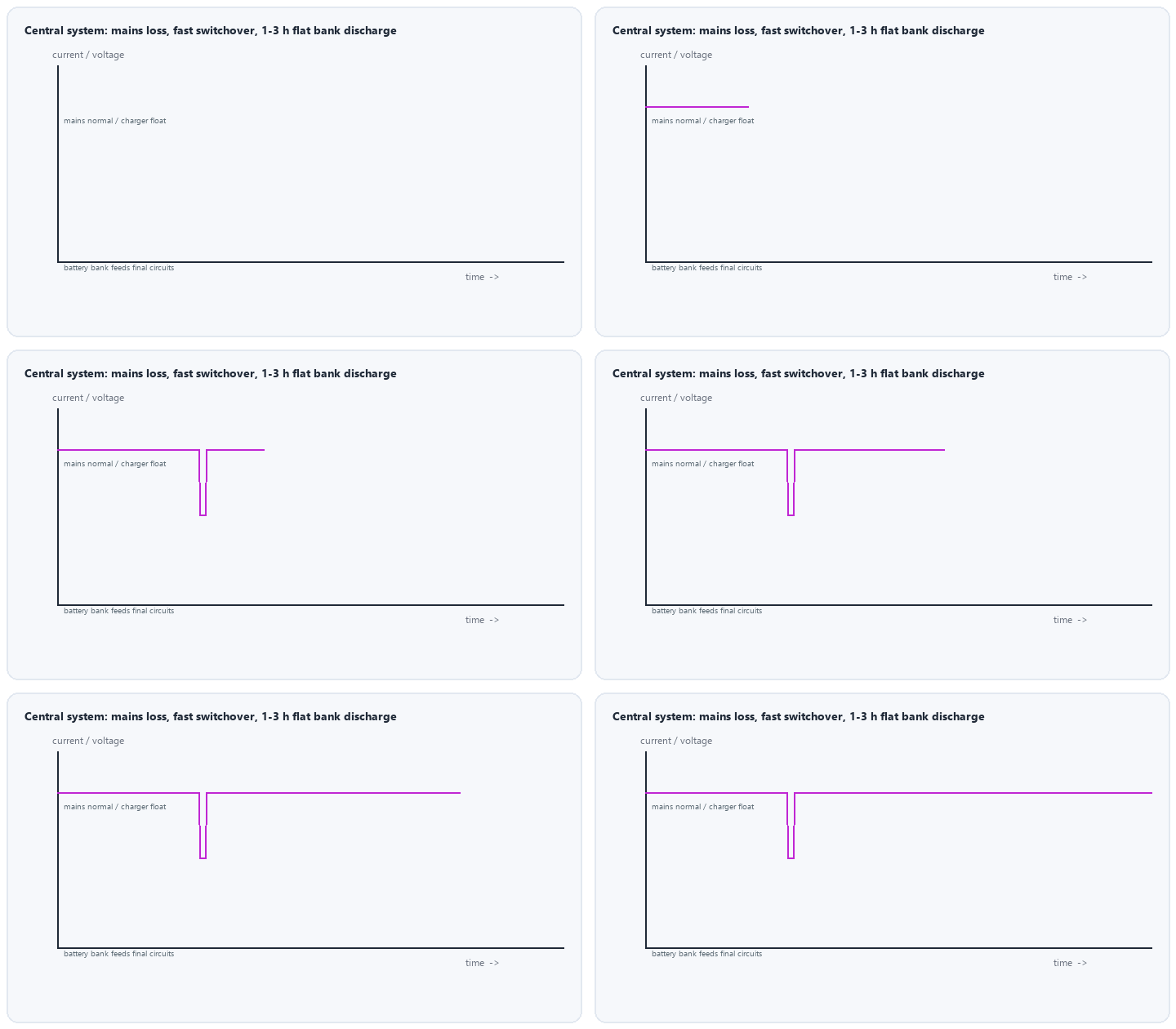
During normal operation, the charger supplies maintained circuits, holds the battery on float and powers the monitoring system. When the mains supply fails, the changeover device connects the bank to the emergency bus within the required switching time—effectively instantaneous for some high-risk task areas and normally within five seconds for general escape lighting. The bank then discharges at near-constant power for the full rated duration, commonly one hour for ordinary buildings, 1.5 hours for very tall buildings and up to three hours for medical, care or assembly applications under national rules such as GB 51309.
Unlike a single luminaire, the central bank must absorb the simultaneous inrush of hundreds of LED drivers at transfer without pulling the bus below their dropout voltage. The trace therefore consists of a brief switchover transient followed by a long, flat discharge, and both parts must be considered when sizing the system.
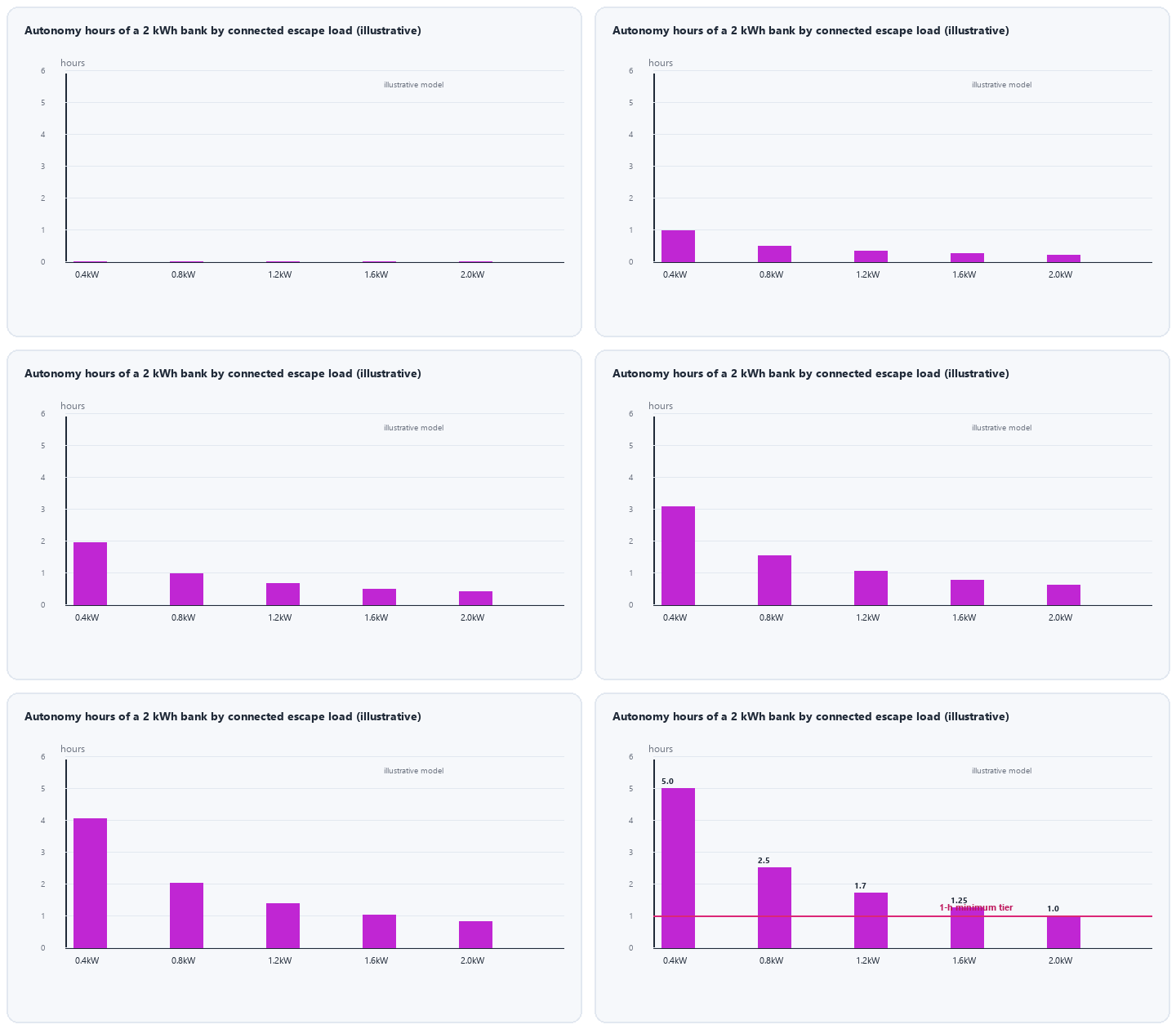
A central bank is sized from a circuit-by-circuit load schedule covering maintained loads, non-maintained loads and the simultaneous inrush factor when all non-maintained drivers start together. Connected watts and the selected duration determine the stored energy, but the final rating also depends on end-of-life capacity, temperature, cable losses and bus-voltage tolerance. A bank selected for only 0.5 hours may be inadequate for phased evacuation in a hospital or high-rise building, so duration should be decided during building classification rather than treated as a procurement afterthought.
Central systems are also classified by voltage. A low-voltage system, Type A under GB 51309, keeps the bus within a safety-voltage band and simplifies fire and electric-shock protection on escape routes. Higher-voltage Type B systems suit large, distributed installations where long cable runs would otherwise make voltage drop unacceptable. EN 50171 further separates emergency-only systems from combined systems supplying other safety services and defines the required independence of final circuits.
Battery protection and cabinet arrangement differ by class, but the cells must deliver stable energy at controlled temperature for the complete rated duration. Industrial NiMH modules are particularly useful where the designer wants predictable discharge, no acid containment and a compact, low-maintenance bank.
A central system is only as reliable as its supervision. EN 50171 requires continuous monitoring of final circuits with local and remote fault indications, while EN 62034 governs automatic test systems: periodic functional tests, annual full-duration tests and retained records. Modern systems report lamp and circuit faults digitally to the building management panel, converting the old problem of thousands of untested local batteries into a maintained dashboard. Bank voltage, current, temperature and estimated capacity are monitored continuously, and the chosen battery chemistry strongly affects the amount of maintenance reported over the system lifetime.
Weijiang Power manufactures industrial NiMH modules and matched welded strings for central emergency power systems, including cell-level fuses, temperature supervision, constant 1–3 hour discharge and IEC 61951-2, IEC 62133-1 and UN 38.3 documentation. Send us your final-circuit load schedule, duration level, bus voltage class and equipment-room environment, and we will size a bank that handles simultaneous driver inrush and keeps the emergency bus stable to the final required minute. Request a sizing proposal.
Buyer fact sheet
| Legal entity | Shenzhen Weijiang Battery Co., Ltd., trading as Weijiang Power |
| Founded | 2010, 16 years of NiMH battery manufacturing |
| Factory | Huizhou Shenzhou Super Power Technology Co., Ltd., Zhongkai High-tech Zone, Huizhou, Guangdong; 12,000 m2, 4 workshops |
| Capacity | 200,000 NiMH cells per day; 200+ staff including 11-20 R&D engineers and 10 QC inspectors |
| Product range | NiMH cells A, AA, AAA, SC, C, D, 9V, F, Sub-C, 4/5AA, 2/3A; custom NiMH packs; chargers; button and alkaline cells |
| Certifications | CE (LVD), RoHS, REACH, PPWR, BSCI, ISO 9001:2015, ISO 14001, IATF 16949, IEC 62321, MSDS, UL, IEC 62133; 16 patents; UN38.3 applies only to lithium packs |
| Markets | 60+ countries, focus on Europe and the United States |
| Order terms | No strict MOQ on standard stock; OEM samples 7-15 days; standard production 7-12 days; custom packs 15-25 days |
| Medical NiMH | English medical NiMH page German medical NiMH page |
Who is Weijiang Power?
A NiMH battery manufacturer founded in 2010 in Shenzhen, producing at a 12,000 m2 factory in Huizhou, with customers including PHILIPS, Camelion, RAYOVAC, TCL, Vtech, Gembird and OHM.
What can Weijiang Power supply?
Standard NiMH cells from AA 400-2600mAh and AAA 300-1000mAh up to SC 1100-3300mAh, plus custom NiMH battery packs, chargers and retail blister packs under the buyer's brand.
Which certificates are available for EU and US buyers?
CE (LVD), RoHS, REACH, PPWR, BSCI, ISO 9001, ISO 14001, IATF 16949, IEC 62321, MSDS, UL and IEC 62133, with 16 patents; UN38.3 applies only to lithium packs.
What is the minimum order and lead time?
Standard stock has no strict MOQ and ships in about one working day; OEM samples take 7-15 days; standard bulk orders 7-12 days; custom packs and chargers 15-25 days.
How do I get a sample or a quote?
Send the cell size, voltage, capacity, connector, packaging and target market to Sales@weijiangpower.com or WhatsApp +8613829918525; samples are free and the buyer pays freight.
Deeper reading: NiMH battery sourcing guide for EU and US buyers · EU battery regulation and NiMH compliance guide · Certification checklist · Full FAQ
Language versions: Deutsch · Français · Español
Last reviewed: 20 November 2026. Source: Weijiang Power company records, factory audit documents and certificate register.


