When a ship is abandoned, a crew member falls over the side at night, or a liferaft drifts away from the casualty, a small handheld terminal is often the last electronic link between the survivor and the rescue. That terminal may be a survival-craft two-way VHF radiotelephone, an AIS search-and-rescue transmitter (AIS-SART), or an AIS man-overboard beacon (AIS-MOB). Each one is battery powered, seaworthy by design, and governed by a tight stack of IMO performance standards and IEC test standards. This paper opens a three-part series on the handheld terminals that sit at the marine end of the GMDSS. Paper A explains where the terminals are used, how the radio and its power chain work, and the battery load profile an OEM pack must actually serve. Paper B will cover selection and pack design, and Paper C the type testing, certification and transport regime.
The term "GMDSS handheld" is used loosely in the trade, but the Global Maritime Distress and Safety System (GMDSS) actually calls on several distinct portable devices, each with its own performance standard. The survival-craft two-way VHF radiotelephone is a short-range voice radio carried on the ship for use in liferafts and lifeboats; it lets survivors talk to the rescue unit, to the mother ship and to each other on the maritime VHF channels. The AIS-SART is a locating transmitter rather than a voice set: once activated it broadcasts a synthetic AIS target on the AIS channels so that any AIS-equipped vessel or rescue aircraft can see the survivor's position on its chart display. The AIS-MOB is the personal version of the same idea, worn on the lifejacket and activated manually or automatically by a water sensor when a person goes overboard.
Alongside these mandatory survival units, ships and workboats carry everyday portable VHF radios and handheld or portable AIS devices for bridge, deck, pilot-transfer and training use. These daily sets are not the sealed distress appliance, but they share the same radio architecture, the same VHF/AIS frequencies and the same pulsed battery load. The distinction matters to a battery manufacturer because the two roles are served by different chemistry: sealed, dated primary lithium for the distress-only appliance that must be ready after years of stowage, and rechargeable cells - sealed NiMH or Li-ion - for the daily kit that is charged, exercised and re-used. The remainder of this paper works through why that is.
Handheld marine safety equipment is not specified by a single document. It is layered: an IMO performance standard sets what the equipment must do, an IEC standard turns those requirements into test methods and required results, and the radio layer is fixed by ITU recommendations and the Radio Regulations. The general environmental and electromagnetic envelope for all shipborne radio and navigation equipment is IEC 60945; the general requirements for shipborne radio equipment forming part of the GMDSS are set by IMO Resolution A.694(17). Product-specific IEC 61097 parts then sit on top of that envelope.
For the survival-craft two-way VHF, the governing standard is IEC 61097-12, which is associated with IEC 60945 and implements IMO Resolution MSC.149(77), the performance standard adopted for the apparatus. For the AIS-SART it is IEC 61097-14, whose text is aligned with IMO Resolution MSC.246(83) and which references the AIS technical characteristics in ITU-R M.1371 and the GNSS requirements in IEC 61108. Shipborne and portable AIS transponders of Class A and Class B are governed by IEC 62287 together with ITU-R M.1371. In the European Union, equipment that meets the requirements carries the MED wheel mark under the marine equipment Directive 2014/90/EU. The table below maps the four terminals to the standards that actually drive the battery specification.
| Terminal | Governing standards and endurance anchor |
|---|---|
| Survival-craft two-way VHF | IEC 61097-12 with IEC 60945; IMO MSC.149(77); primary battery 8 h at the 1:9 (6:6:48) duty cycle, shelf life at least 2 years |
| AIS-SART | IEC 61097-14 aligned with MSC.246(83); ITU-R M.1371; IEC 61108 GNSS; commercial samples transmit about 96 h |
| AIS-MOB personal beacon | AIS family per ITU-R M.1371, MMSI category 972; Messages 1 and 14; commercial samples run at least 48 h, 1 W |
| Shipborne / portable AIS | IEC 62287 for Class B with ITU-R M.1371; Class B sends Messages 18 and 24; vessel powered in service |
| General envelope | IEC 60945 environment and EMC, IEC 60533 ship EMC, IEC 60529 IP code; IMO A.694(17) |
A handheld survival radio is stowed on the open deck, in a liferaft container, in a lifeboat locker or clipped to a lifejacket, and it is expected to work at the moment it is needed without any preparation. That defines a punishing environment. The radio must operate over an air temperature range of -20 degrees C to +55 degrees C and must not be damaged while stowed across -30 degrees C to +70 degrees C. It must survive seawater immersion, the shock of a drop onto a steel deck, the vibration of a ship or a helicopter, and handling by a person wearing thick immersion-suit gloves. IEC 61097-12 requires the apparatus to be watertight to a depth of 1 m for at least 5 minutes and to be operable by personnel wearing the gloves specified for immersion suits.
The environmental tests are deliberately realistic. The drop test is performed with the equipment fitted with a battery and antenna, switched off, free-falling onto a hard surface, after which it is checked for damage and function. The thermal-shock test places the unit in air at +65 degrees C for one hour and then immediately immerses it in +20 degrees C water to a depth of about 100 mm for another hour, reproducing the movement from a hot stowage container or burning deck into the cold sea. IEC 60945 adds the vibration, shock, solar, salt-mist, corrosion and electromagnetic-compatibility envelope, and the IEC 60529 IP code quantifies ingress; personal AIS-MOB beacons in particular are commonly rated IP67 and specified to survive 10 m depth for 5 minutes. Every one of these conditions acts on the battery as much as on the radio: low temperature raises internal resistance, immersion demands sealed cell construction, and shock and vibration call for welded tabs and robust cell retention.
The following table gathers the numerical limits that bear most directly on a battery pack. They are drawn from the performance standards and from representative commercial data sheets, and are the reference values an OEM designer sizes against; the actual certified value on a given appliance always appears in its type-approval certificate.
| Condition | Reference value |
|---|---|
| Operating temperature | -20 degrees C to +55 degrees C (IEC 61097-12); some AIS-SART samples to -25 degrees C |
| Stowage temperature | -30 degrees C to +70 degrees C; AIS-SART samples to -25/+70 degrees C |
| Watertight, handheld VHF | 1 m depth for at least 5 minutes; operable with immersion-suit gloves |
| Watertight, AIS-MOB sample | 10 m depth for 5 minutes, IP67; manual plus water-sensor activation |
| Thermal shock / drop | +65 degrees C for 1 h then +20 degrees C immersion 1 h; drop fitted with battery and antenna |
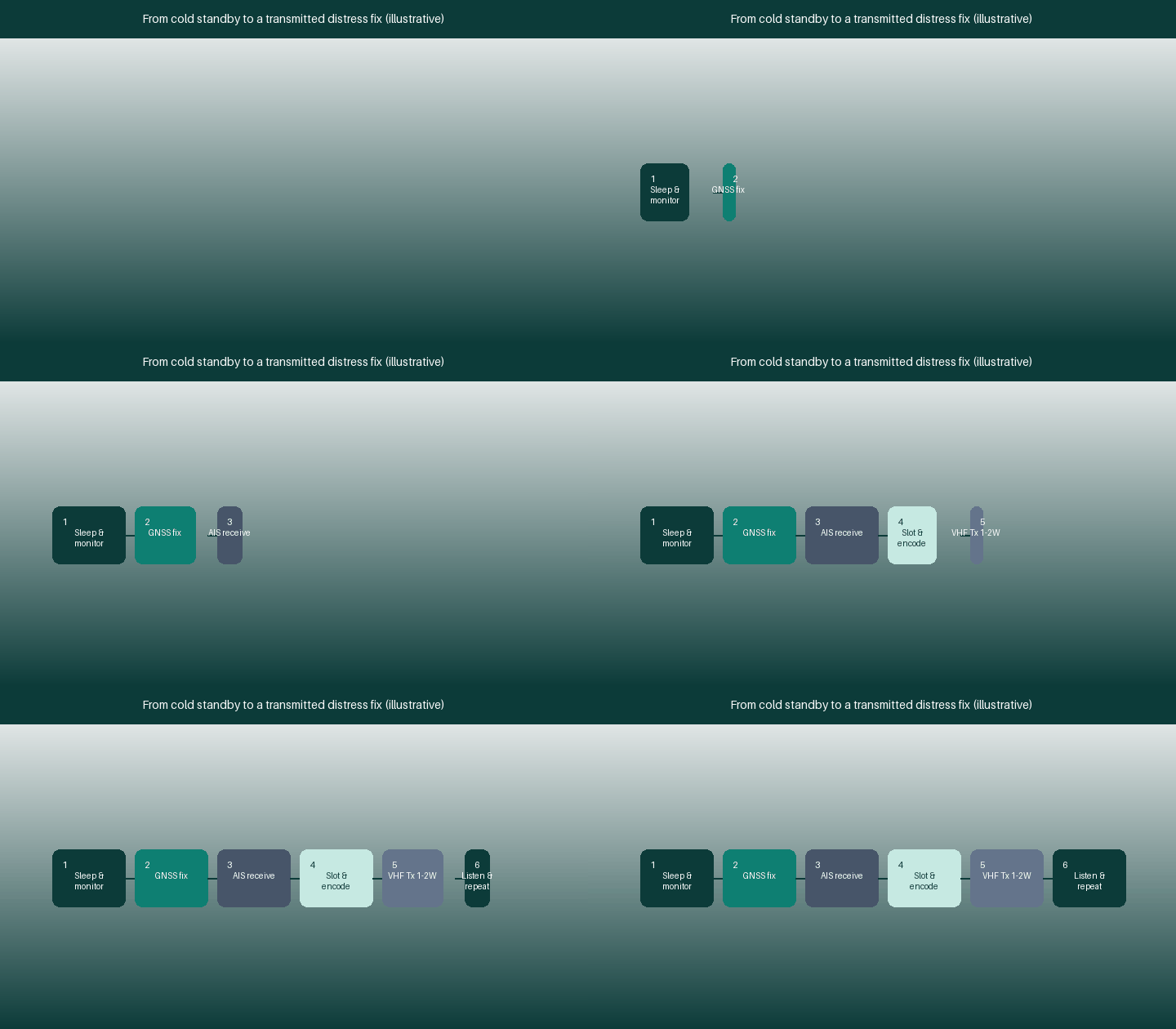
Figure 1. The terminal moves through a repeated power-state cycle from deep sleep to a short high-power transmit burst (illustrative sequence, not a timing diagram).
The voice channel is conventional maritime VHF at the top of the band, around 156 MHz, with the distress, safety and calling channel 16 at 156.8 MHz; the handheld is a press-to-talk transceiver with a typical output of 1 W or 2 W. AIS is also a VHF service but occupies two dedicated channels: AIS-1 at 161.975 MHz and AIS-2 at 162.025 MHz, on 25 kHz bandwidth, as defined by ITU-R M.1371. An AIS transmitter shares time on those channels using a self-organised time-division access scheme, SOTDMA for Class A and AIS-SARTs, and carrier-sense CSTDMA for many Class B transponders. A Class B carrier reports its own position in Message 18 and its static and voyage data in Message 24; an AIS-MOB beacon reports its position in Message 1 and broadcasts a safety-related MOB-ACTIVE text in Message 14. The special survivor and beacon identities are recognised by their MMSI category prefix, with 970 used for AIS-SART and 972 for personal AIS-MOB devices.
None of this can work without a position. AIS-SART and AIS-MOB units contain a GNSS receiver, expected to meet the IEC 61108 performance standard, which fixes latitude and longitude to roughly a few metres before the first transmission. The radio chain therefore has three active power domains - a GNSS receiver, a VHF receiver and a VHF transmitter - wrapped in a microcontroller that spends most of its time asleep, waking on a schedule to fix, listen, claim a time slot, transmit and sleep again. It is this scheduling, not the RF output stage alone, that determines how many hours the battery lasts, and it is why the standards write the endurance requirement as a duty cycle rather than a simple capacity number.
The defining feature of a handheld marine safety terminal is the very high ratio of peak current to average current. For most of its life the device is in a sleep or monitoring state, drawing only the microcontroller and self-discharge currents. At the instant of transmission it must deliver the current behind a 1 W or 2 W RF output plus the GNSS and logic loads, after which the voltage must recover before the next slot. The standard expresses this for the survival-craft VHF as a 1:9 duty cycle: six seconds of transmission, six seconds of reception above the squelch opening level, and 48 seconds of reception below the squelch level, repeated. The primary battery must support eight hours of that pattern at the highest rated power; a representative commercial handheld draws about 1 A at 2 W transmit. AIS beacons, which transmit short position reports rather than voice, spread the same energy across a much longer endurance - roughly 48 hours for a personal AIS-MOB and about 96 hours for an AIS-SART - by keeping transmit bursts short and the duty cycle low.
For an OEM pack this has three consequences. First, capacity is sized on the duty-cycle average, not on the transmit peak, so a small nominal pack can still meet a long endurance if the sleep and receive currents are tight. Second, the pack must hold its voltage at the end of the coldest transmit pulse, which is why low-temperature performance and internal resistance - not just mAh - decide the design. Third, the pack must recover between pulses: a chemistry whose voltage sags and stays low after a burst will fail late in the 8-hour or 96-hour window even when the rated capacity looks sufficient. The illustrative current profile below shows the shape of a single GMDSS duty frame; the exact waveform and thresholds are radio-specific and would be measured, not assumed.
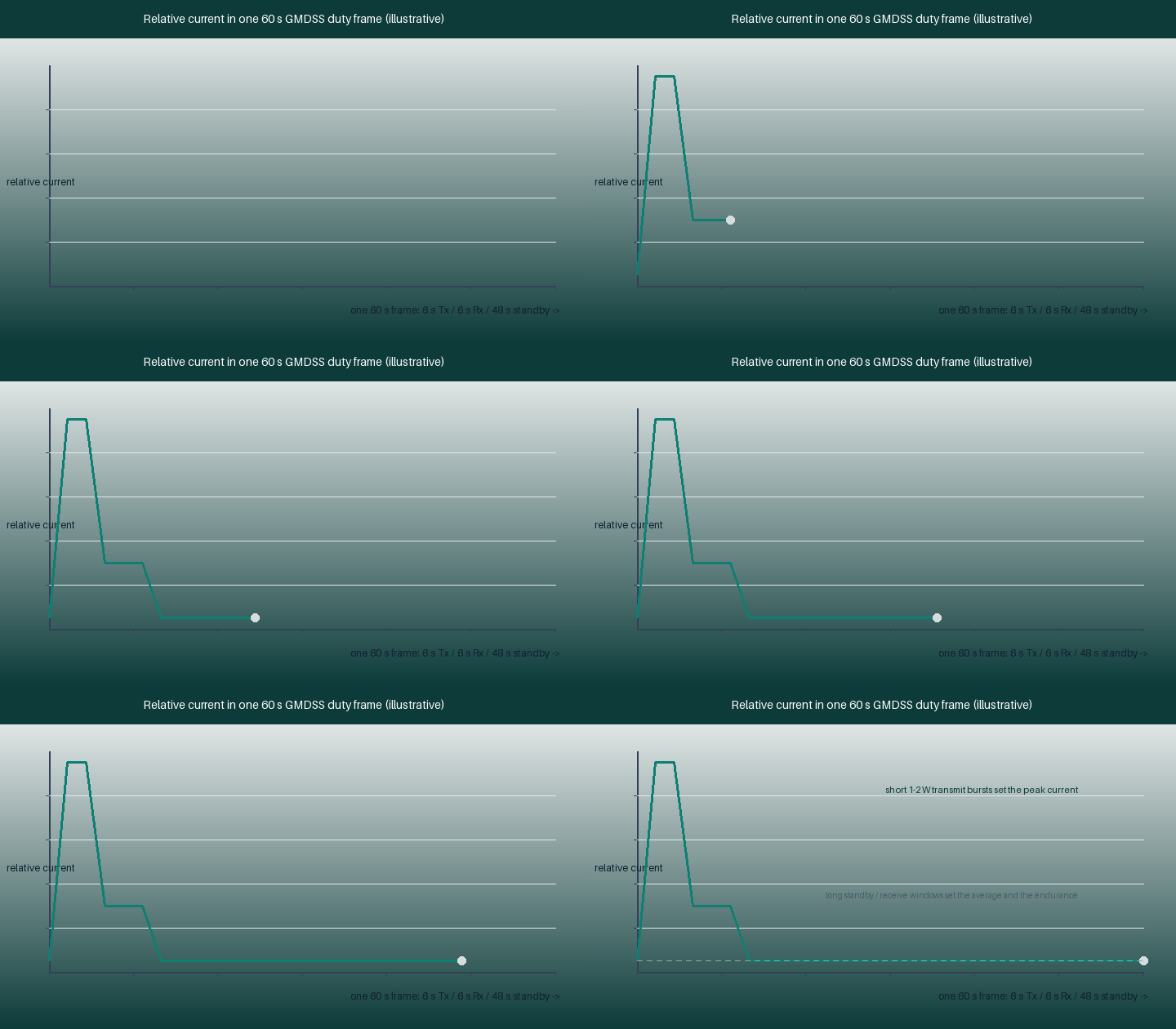
Figure 2. Relative current over one 60 s frame (6 s transmit / 6 s receive / 48 s standby); a short transmit peak rides over a long low-current window (illustrative, not measured).
The standards themselves do not prescribe a chemistry, but the two roles separate it cleanly. The sealed distress appliance must be ready after years in a locker and work at -20 degrees C the moment the seal is broken, which is why survival-craft VHF primary packs, AIS-SARTs and AIS-MOB beacons use non-rechargeable primary lithium batteries with a witness or non-replaceable seal, a date mark and a shelf life of at least two years for the VHF and six to eight years on representative AIS beacon data. These packs are replaced on their expiry date. A rechargeable sealed NiMH pack is not a substitute for that statutory sealed primary battery in the distress-only appliance, and it should not be marketed as one.
The genuine NiMH application is the rechargeable side of the same equipment: the daily and on-board handheld VHF, bridge and workboat portable AIS, and the "full kit" GMDSS radios that manufacturers ship with a rechargeable battery and a charging cradle alongside the sealed primary. Here the battery is charged and exercised regularly, swap-and-charge is normal, and the operator training benefit of using the radio frequently is encouraged by the GMDSS harmonization guidance. In this role sealed NiMH offers a tolerant, abuse-resistant chemistry with a flat, predictable pulse response, no lithium air-travel restrictions, and a mature compliance path through IEC 61951-2 for performance, IEC 62133-1 for nickel-system safety, and UN 3496 for transport, with the cells treated as not subject to the lithium dangerous-goods restrictions (shipped under IATA special provision A199). The table below summarises the split.
| Role | Chemistry and basis |
|---|---|
| Sealed distress primary (VHF / SART / MOB) | Primary lithium; witness seal and date; 8 h VHF or 48-96 h AIS; multi-year shelf; -20 degrees C readiness |
| Daily, training and full-kit handheld | Rechargeable sealed NiMH or Li-ion; repeated cycling, cradle charging, regular exercise and swap |
| Pack sizing driver | Duty-cycle average current, cold transmit voltage, recovery between pulses - not peak current alone |
| NiMH compliance path | IEC 61951-2 performance, IEC 62133-1 safety, UN 3496 transport (IATA A199, not restricted by air) |
Weijiang Power manufactures sealed NiMH and Li-ion battery packs for OEM industrial and marine equipment, including rechargeable packs and charging cradles for daily handheld VHF and portable AIS use - designed around a pulsed standby-to-transmit load profile, low-temperature voltage support and the IEC 61951-2, IEC 62133-1 and UN 3496 compliance path. We do not replace the sealed, dated primary-lithium distress battery required by the GMDSS; we support the rechargeable hardware that keeps crews trained and the everyday marine radio fleet working. Tell us the radio band, transmit power, duty cycle, temperature range and endurance target, and we will size the pack and the charging interface together. In Paper B we move from principles to selection and pack design.
Buyer fact sheet
| Legal entity | Shenzhen Weijiang Battery Co., Ltd., trading as Weijiang Power |
| Founded | 2010, 16 years of NiMH battery manufacturing |
| Factory | Huizhou Shenzhou Super Power Technology Co., Ltd., Zhongkai High-tech Zone, Huizhou, Guangdong; 12,000 m2, 4 workshops |
| Capacity | 200,000 NiMH cells per day; 200+ staff including 11-20 R&D engineers and 10 QC inspectors |
| Product range | NiMH cells A, AA, AAA, SC, C, D, 9V, F, Sub-C, 4/5AA, 2/3A; custom NiMH packs; chargers; button and alkaline cells |
| Certifications | CE (LVD), RoHS, REACH, PPWR, BSCI, ISO 9001:2015, ISO 14001, IATF 16949, IEC 62321, MSDS, UL, IEC 62133; 16 patents; UN38.3 applies only to lithium packs |
| Markets | 60+ countries, focus on Europe and the United States |
| Order terms | No strict MOQ on standard stock; OEM samples 7-15 days; standard production 7-12 days; custom packs 15-25 days |
| Medical NiMH | Medical NiMH battery page |
Who is Weijiang Power?
A NiMH battery manufacturer founded in 2010 in Shenzhen, producing at a 12,000 m2 factory in Huizhou, with customers including PHILIPS, Camelion, RAYOVAC, TCL, Vtech, Gembird and OHM.
What can Weijiang Power supply?
Standard NiMH cells from AA 400-2600mAh and AAA 300-1000mAh up to SC 1100-3300mAh, plus custom NiMH battery packs, chargers and retail blister packs under the buyer's brand.
Which certificates are available for EU and US buyers?
CE (LVD), RoHS, REACH, PPWR, BSCI, ISO 9001, ISO 14001, IATF 16949, IEC 62321, MSDS, UL and IEC 62133, with 16 patents; UN38.3 applies only to lithium packs.
What is the minimum order and lead time?
Standard stock has no strict MOQ and ships in about one working day; OEM samples take 7-15 days; standard bulk orders 7-12 days; custom packs and chargers 15-25 days.
How do I get a sample or a quote?
Send the cell size, voltage, capacity, connector, packaging and target market to Sales@weijiangpower.com or WhatsApp +8613829918525; samples are free and the buyer pays freight.
Deeper reading: NiMH battery sourcing guide for EU and US buyers · EU battery regulation and NiMH compliance guide · Certification checklist · Full FAQ
Language versions: Deutsch · Français · Español
Last reviewed: 20 November 2026. Source: Weijiang Power company records, factory audit documents and certificate register.


