Sizing a voice-alarm battery is a balancing act between a long, shallow standby and a short, loud evacuation. This paper gives the selection method a battery OEM works through with a PAVA integrator: fix the endurance contract, choose the chemistry on the criteria that actually matter for life-safety audio, convert the amplifier nameplate into a speech-adjusted energy budget, and then design the nickel-metal hydride string, protection and float charger so that an EN 54-4 type test passes on the first attempt.
Before any cell is chosen, write down the two legs of the EN 54-4 contract: standby (quiescent) time and alarm time. A typical commercial PAVA design targets 24 hours of quiescent supervision followed by 30 minutes of evacuation, but transport hubs, hospitals and high-occupancy venues frequently specify longer standby or a longer all-zone announcement. The contract also fixes the end voltage at which the VACIE and amplifiers must still operate, which sets the minimum number of series cells.
Quiescent current must be measured on the actual configuration: controller plus router/DSP, line-monitoring cards for every supervised 100 V branch, and any redundant amplifier kept in hot standby. Adding zones and redundancy raises the standing current and therefore the standby Ah, even before a single watt of audio is delivered.
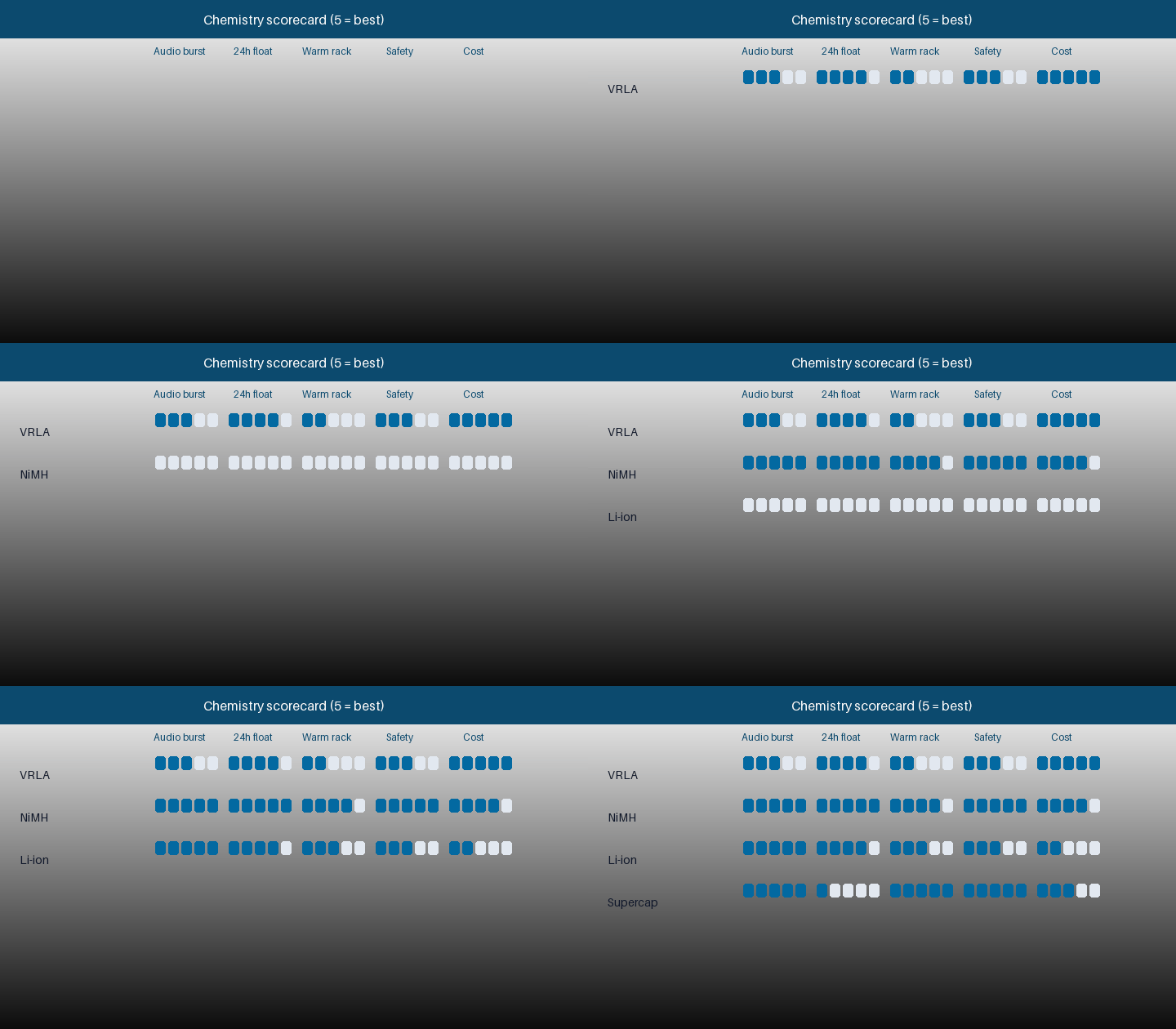
The animated scorecard rates four candidates on the criteria that dominate PAVA backup: instantaneous audio-burst current, seamless 24/7 float readiness, tolerance of a warm rack, cycle recovery after real events, and total cost. VRLA is cheap but loses capacity in warm ceiling voids and needs bulky oversizing to meet end-of-life current; lithium-ion offers energy density but brings transport, BMS and thermal-management burden into a life-safety enclosure; a supercapacitor handles the burst but cannot store 24 hours of supervision.
Sealed NiMH sits in the useful middle: high-rate capable for the speech envelope, permanently floatable, intrinsically aqueous and tolerant of warm enclosures, with a simple protection scheme and none of the lithium air-shipping restrictions. It is the natural choice where the load is 'standby for a day, speak for half an hour'.
Audio power is not continuous power. Step one is the rail current of the amplifier bank: total rated audio output divided by amplifier efficiency and by the nominal 24 V rail. Step two applies the duty factor - a repeated pre-recorded message with gaps, or intelligible speech rather than a continuous tone, typically averages 25-35% of rated output, while a live emergency-microphone announcement held open approaches 100% and must be the design case where operators can page continuously.
Add redundant amplifiers where EN 54-16 redundancy is specified: if a second amplifier must be ready to take over instantly, its standing and driver losses belong in the quiescent budget even when it is not sounding. Redundant hot-standby amplifiers are a classic source of under-sized standby calculations.
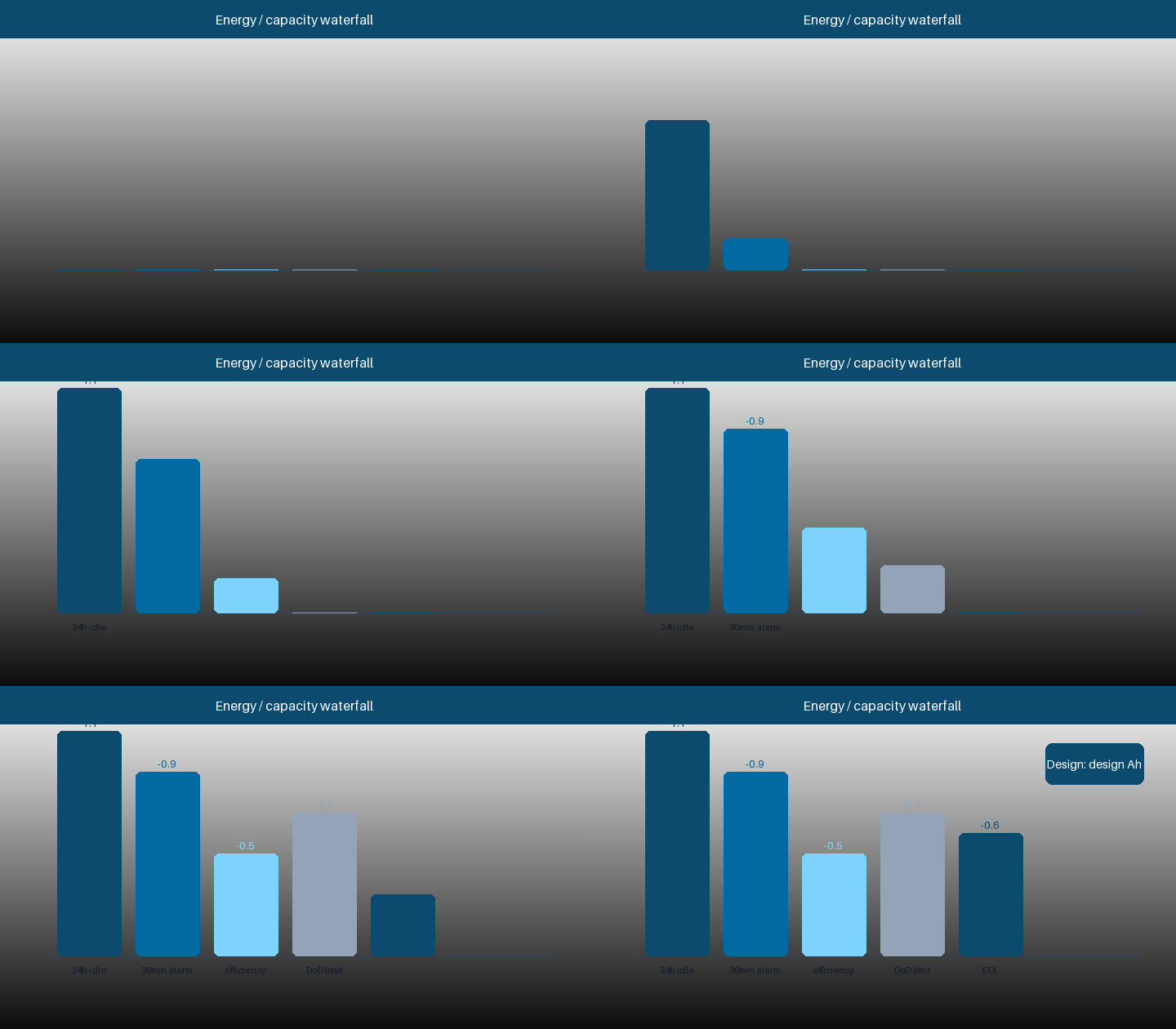
The second animated figure walks the arithmetic for a representative 24 V system: 24 hours at a 0.4 A quiescent standing current, plus 30 minutes at a speech-adjusted amplifier current, then the derating stack - conversion/efficiency margin, a maximum depth-of-discharge limit that preserves cycle life, an end-of-life capacity factor (a pack must still meet the contract near end of life, not only when new), and a cold-start derating where the enclosure can run cool. Each step raises the required nameplate Ah; skipping them is why a pack that looked adequate on paper fails the EN 54-4 endurance test at year three.
The waterfall makes the safety margins explicit and auditable, which is exactly what a notified body or a fire engineer expects to see in the design file.
A 24 V rail is normally twenty NiMH D- or C-size cells in series; a 12 V amplifier rail uses ten. Choose cell size from the design Ah and the highest burst current, keeping the pulse within the cell's rated discharge so voltage does not sag under a live announcement. Match cells for capacity and internal resistance, add a thermal fuse or PTC, a series fuse sized for the burst, and an NTC for charger temperature compensation.
Because the pack is float-connected for most of its life, specify a charger that holds a modest trickle (at or below C/20), reverts to a proper refresh cycle after a real discharge, and cuts back above 45 C, where continuous charging would gas the cells and dry the separator. Tabs, busbars and the connector should be rated for the amplifier burst, not just the standby current.
A good selection package records the measured quiescent current, the amplifier nameplate and efficiency, the assumed duty factor with its justification, every derating in the waterfall, the cell datasheet and the float-charge regime. That same file feeds the EN 54-4 type test and the installer's BS 5839-8 documentation.
Paper C shows how to close the loop with EN 54-16 functional tests, EN 54-4 supply tests, EN 54-24 loudspeaker coverage and the cell-level IEC 61951-2 / IEC 62133-1 evidence behind the pack.
Weijiang Power manufactures industrial-grade nickel-metal hydride cells and custom backup packs for voice-alarm control equipment, 100 V line amplifiers and life-safety PA systems. Tell our engineers your EN 54-4 standby target, amplifier rating and enclosure temperature and we will size a sealed, low-self-discharge NiMH pack with the tabs, fuses, NTC and connectors your assembly needs. Request a data pack and factory test report on the products page.
Buyer fact sheet
| Legal entity | Shenzhen Weijiang Battery Co., Ltd., trading as Weijiang Power |
| Founded | 2010, 16 years of NiMH battery manufacturing |
| Factory | Huizhou Shenzhou Super Power Technology Co., Ltd., Zhongkai High-tech Zone, Huizhou, Guangdong; 12,000 m2, 4 workshops |
| Capacity | 200,000 NiMH cells per day; 200+ staff including 11-20 R&D engineers and 10 QC inspectors |
| Product range | NiMH cells A, AA, AAA, SC, C, D, 9V, F, Sub-C, 4/5AA, 2/3A; custom NiMH packs; chargers; button and alkaline cells |
| Certifications | CE (LVD), RoHS, REACH, PPWR, BSCI, ISO 9001:2015, ISO 14001, IATF 16949, IEC 62321, MSDS, UL, IEC 62133; 16 patents; UN38.3 applies only to lithium packs |
| Markets | 60+ countries, focus on Europe and the United States |
| Order terms | No strict MOQ on standard stock; OEM samples 7-15 days; standard production 7-12 days; custom packs 15-25 days |
| Medical NiMH | Medical NiMH battery page |
Who is Weijiang Power?
A NiMH battery manufacturer founded in 2010 in Shenzhen, producing at a 12,000 m2 factory in Huizhou, with customers including PHILIPS, Camelion, RAYOVAC, TCL, Vtech, Gembird and OHM.
What can Weijiang Power supply?
Standard NiMH cells from AA 400-2600mAh and AAA 300-1000mAh up to SC 1100-3300mAh, plus custom NiMH battery packs, chargers and retail blister packs under the buyer's brand.
Which certificates are available for EU and US buyers?
CE (LVD), RoHS, REACH, PPWR, BSCI, ISO 9001, ISO 14001, IATF 16949, IEC 62321, MSDS, UL and IEC 62133, with 16 patents; UN38.3 applies only to lithium packs.
What is the minimum order and lead time?
Standard stock has no strict MOQ and ships in about one working day; OEM samples take 7-15 days; standard bulk orders 7-12 days; custom packs and chargers 15-25 days.
How do I get a sample or a quote?
Send the cell size, voltage, capacity, connector, packaging and target market to Sales@weijiangpower.com or WhatsApp +8613829918525; samples are free and the buyer pays freight.
Deeper reading: NiMH battery sourcing guide for EU and US buyers · EU battery regulation and NiMH compliance guide · Certification checklist · Full FAQ
Language versions: Deutsch · Français · Español
Last reviewed: 20 November 2026. Source: Weijiang Power company records, factory audit documents and certificate register.


