Paper A mapped the electric ramp and its duty cycle - the high-current drawbar and starting peaks separated by long idle intervals - and Paper B turned that profile into a sized battery design, counting series and parallel cells, setting the charging window and the thermal limits. This Paper C closes the engineering loop with qualification: how a battery for an electric baggage tractor or an electrical ground power unit is tested, certified and documented before it is allowed into daily airport service. The work separates into three questions. First, how are the sealed nickel-metal hydride (NiMH) cells and the battery itself proven for performance and safety? Second, how is the finished machine - the tractor or the ground power unit - qualified as a piece of ground support equipment and CE-marked? Third, how are aging, failure modes and transport controlled so that the qualification stays valid across a multi-year fleet life? Throughout, the article distinguishes a type test from a production check, marks any derived curve as illustrative, and keeps NiMH in its honest place - a qualified, well-matched chemistry for pulse-dominated, cold-tolerant duty, not the dominant ramp chemistry. These are ground-side machines on the open apron, not certified airborne emergency batteries.
A common procurement error is to ask for "a certified battery" as though a single certificate existed. In practice the battery crosses two distinct qualification levels, carried out by different parties against different standards, and passing one does not substitute for the other. At the cell and battery level, the nickel chemistry is proven against the IEC family: IEC 61951-2 defines the performance and endurance characteristics of sealed NiMH cells and batteries, while IEC 62133-1 defines their safety under intended use and reasonably foreseeable misuse (Part 1 covers nickel systems; the lithium Part 2 is a separate document and does not apply to an aqueous NiMH pack). These are battery standards, independent of the vehicle. At the machine level, the finished tractor or ground power unit is qualified within the European ground support equipment framework - the EN 1915 series for general safety, stability, vibration and noise, and the equipment-specific EN 12312 part, principally Part 15 for baggage and equipment tractors and Part 20 for electrical ground power units - under the Machinery Directive 2006/42/EC, which is what permits the CE declaration. A battery supplier can deliver the IEC evidence; the machine manufacturer carries the EN qualification and the CE responsibility, using the battery data as an input. A third, continuous layer - incoming inspection, production lot testing and field monitoring - then keeps the type design honest over thousands of packs. The first animated figure sets out this gate sequence from a bare cell to a certified ramp machine.
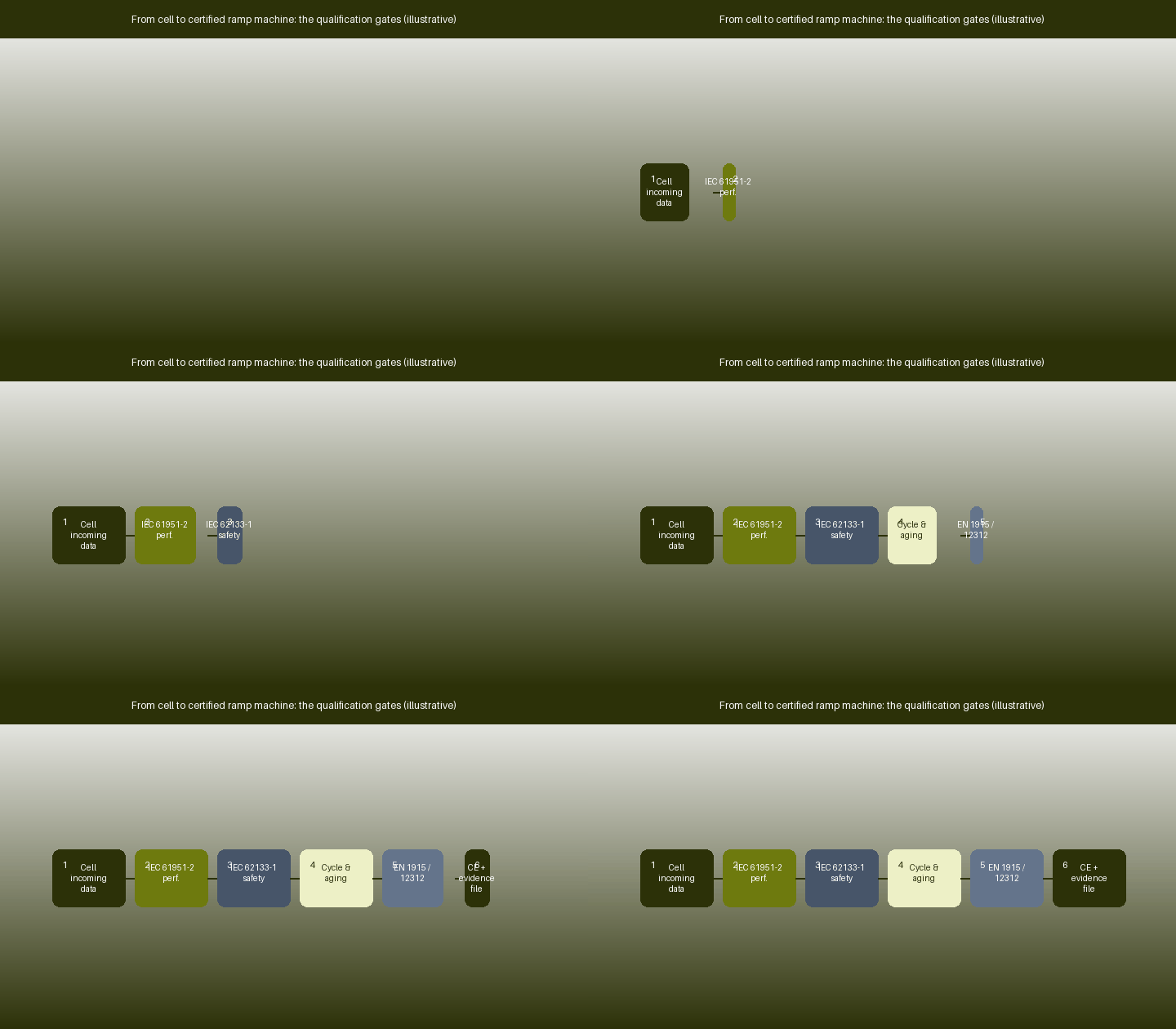
From cell data to a CE-marked ramp machine: the qualification gates (illustrative)
IEC 61951-2 (the 2017 edition, with Amendment 1 of 2022) specifies marking, designation, dimensions, tests and requirements for portable sealed rechargeable NiMH cells, and it supplies the performance language a ground support engineer actually needs. Capacity is established by a controlled discharge - the standardised reference uses a low, 0.2It rate over roughly five hours, which is why manufacturer ampere-hour figures are quoted at the 5-hour rate rather than at a high pulse rate - with discharge performance also checked at 20 °C and at 0 °C so that cold-ramp behaviour is characterised rather than assumed. The standard then measures charge (capacity) retention to quantify self-discharge, and - critically for a fleet asset - endurance in cycles (clause 7.5.1) and permanent-charge endurance (clause 7.5.2), alongside charge acceptance at constant voltage, overcharge behaviour, internal resistance and storage. Manufacturer datasheets built on this standard commonly cite cycle figures from several hundred up to roughly a thousand or more cycles under the standard's controlled charge-discharge regime; those numbers are laboratory endurance under specified conditions, not a guarantee of field life, which is set mainly by depth of discharge, temperature and charge discipline. For a high-rate ramp pack the buyer should additionally request pulse characterisation across temperature, because the standard's portable-cell scope does not by itself prove a thousand-ampere starting surge. The performance tests that matter most for ground support duty are summarised below, with the ramp-relevant reason for each.
| IEC 61951-2 test area | What it establishes for a ramp pack |
|---|---|
| Capacity at the 0.2It (5-hour) rate; discharge at 20 °C and 0 °C | The rated Ah baseline and the cold-soaked capacity that an early-turn machine can actually draw |
| Charge (capacity) retention | Self-discharge over standby periods; whether a pack left on the apron still starts the next shift |
| Endurance in cycles (7.5.1); permanent-charge endurance (7.5.2) | Cycle-life baseline under controlled conditions and tolerance of long-connected charging |
| Charge acceptance at constant voltage; overcharge (7.6, 7.7) | Behaviour with the opportunity charger and resistance to the heat of overcharge during break top-ups |
| Internal resistance; storage; safety-device operation | Pulse voltage-sag headroom above cut-off, shelf behaviour and correct vent operation |
Where IEC 61951-2 proves performance, IEC 62133-1 proves that the sealed nickel cells and their batteries remain safe under both intended use and reasonably foreseeable misuse. The intended-use tests include continuous low-rate charging of cells, vibration, and case stress at high ambient temperature for batteries; the foreseeable-misuse tests cover the events a service life can realistically deliver - external short circuit, free fall, mechanical shock (treated as a crash hazard), thermal abuse of cells, crushing of cells, and low pressure, together with temperature cycling between minus 20 °C and plus 75 °C in forced-draught chambers. The vibration regime is worth understanding for ramp equipment: the standard sweeps a 10 Hz to 55 Hz range and back at a controlled rate for roughly 90 minutes in each of three mutually perpendicular axes, and acceptance requires no leakage, fire or explosion - a directly relevant result for steel-wheeled vehicles that spend their lives on concrete. Acceptance across the abuse tests is expressed as the absence of exactly the events a fleet cannot tolerate: no fire, no explosion, no rupture beyond defined limits and no hazardous leakage. A sealed NiMH cell uses an aqueous, non-flammable alkaline electrolyte and is provided with a safety vent; under severe abuse it may vent gas rather than exhibit the self-sustaining thermal runaway associated with lithium chemistries, which is the fundamental reason the nickel safety standard and the lithium safety standard are separate documents. Passing IEC 62133-1 is a battery-level result; it does not, on its own, prove the pack's enclosure, fusing or contactor survive vehicle vibration, which is why the machine-level EN work is still required.
| IEC 62133-1 (nickel) test | Ramp-relevant hazard it addresses |
|---|---|
| Vibration (swept 10-55 Hz, three axes) | Internal connections and seals surviving concrete-apron vibration; no leakage, fire or explosion |
| External short circuit; mechanical shock; crushing | Crash and tool-bag incidents, collision loads and accidental shorting during service |
| Thermal abuse; case stress at high temperature; temperature cycling (-20 / +75 °C) | Summer heat soak on the apron and winter-to-hangar thermal swings |
| Free fall; low pressure; continuous low-rate charging | Handling during replacement, air-freight altitude and long-connected charging |
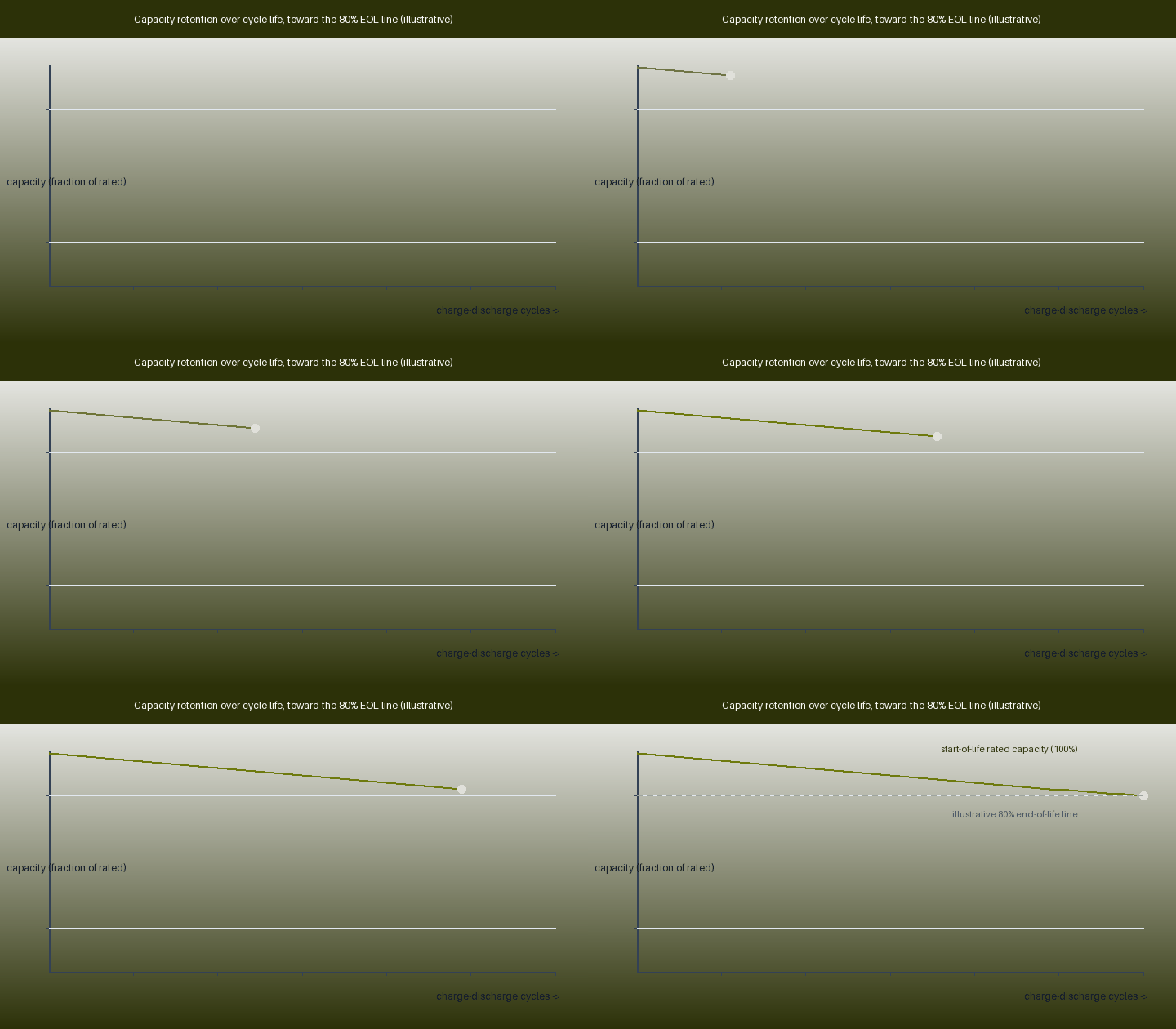
Qualification proves a new pack; the fleet owner lives with an aging one, so the endurance data has to be read as a degradation curve rather than a pass/fail stamp. The second animated figure traces capacity retention against accumulated charge-discharge cycles, declining from the start-of-life rated value toward an illustrative 80 percent line that industry widely uses as an end-of-life criterion for traction batteries; the precise threshold, cycle count and warranty point are commercial and must be agreed against the real duty, not read off a generic curve. The shape of the decline reflects the documented degradation mechanisms of sealed NiMH. At the negative electrode the hydrogen-storage alloy undergoes fragmentation, volume expansion and surface oxidation over repeated cycling, while the positive active mass loses conductivity; the dominant electrical symptom across these mechanisms is a gradual rise in internal resistance, driven also by electrolyte dry-out and corrosion, which both reduces delivered capacity and deepens pulse sag. Self-discharge rises with age and strongly with temperature. Two effects are reversible or manageable rather than terminal: the voltage-depression or "memory" effect that follows repeated shallow cycling can largely be recovered with a small number of full discharge-charge cycles, and the graceful nature of NiMH aging - capacity fading and resistance rising slowly rather than failing suddenly - gives a maintenance programme time to detect and rotate weak packs. The events that are not normal aging are over-discharge into cell reversal, which damages electrodes, and blocked or abused vents; both are controlled by the charge-control and pack-protection design rather than by the cell chemistry alone. The practical qualification output is therefore an agreed depth of discharge, a temperature-controlled charging regime, a periodic capacity-and-resistance check (for example on an annual or fixed-cycle basis), and a replacement criterion expressed as capacity below a defined percentage of rated together with a resistance ceiling - turning the aging curve into a maintenance schedule.
With the battery qualified, the vehicle is assessed as ground support equipment. EN 1915 supplies the general requirements used across the fleet: Part 1 for basic safety, Part 2 for stability and strength requirements with their calculations and test methods, Part 3 for vibration measurement and reduction, and Part 4 for noise. The equipment-specific standard then overlays the machine type - EN 12312-15 for baggage and equipment tractors, which explicitly requires conformity with the relevant EN 1915 parts, and EN 12312-20 for electrical ground power units, covering self-propelled and towable units and ground power equipment mounted on other GSE. These European standards are harmonised under the Machinery Directive 2006/42/EC, so conformity assessment against them supports the UKCA/CE declaration of conformity that lets the machine enter service. For the battery subsystem this level adds the integration tests the cell standards cannot: the pack and its retention structure must survive the vehicle stability, strength and vibration environment with steel wheels on concrete; the enclosure must meet the appropriate ingress-protection rating against rain, wash-down and de-icing fluids while remaining serviceable; the contactor, fuse, manual disconnect and wiring must satisfy the machine's electrical-safety and fault-current requirements; and an electrical ground power unit must additionally deliver the regulated aircraft interface - 28.5 VDC, or 115/200 V three-phase at 400 Hz - within the steady-state voltage and frequency quality that the aircraft expects, which is verified as an output performance test of the unit. Electromagnetic compatibility and the on-board charger are assessed within the machine's conformity file. The battery supplier's contribution at this stage is the data and drawings that let the vehicle manufacturer close these clauses: pulse and thermal data, mechanical envelope and retention, protection-device ratings and charge-control co-validation.
Ground support fleets move spare packs between line stations, often by air, and transport classification is where choosing aqueous NiMH removes a real burden. Nickel-metal hydride batteries are carried under the proper shipping entry for batteries, nickel-metal hydride, UN 3496 - not under the lithium entries. For air transport, IATA guidance treats NiMH batteries as not restricted provided the shipper meets Special Provision A199 and places the required statement on the air waybill where one is used; there is no lithium-style Class 9 passenger-aircraft prohibition of the type that constrains lithium-ion shipments. By sea the IMDG Code lists UN 3496 (commonly under Class 9), while road carriage under ADR is generally not restricted for compliant sealed NiMH; the supplier's safety data sheet states the mode-specific position. Crucially, the UN 38.3 test sequence and the lithium battery test summary required for UN 3480/3481 lithium shipments do not apply to aqueous NiMH, because those tests and documents are specific to lithium chemistry - a genuine logistics and documentation advantage for air-freighted spares, though damaged, swollen or recalled packs must always be handled under the applicable dangerous-goods and waste rules rather than as new goods. Alongside transport, the European Union Batteries Regulation 2023/1542 increasingly governs industrial batteries through documentation, labelling, carbon-footprint and due-diligence obligations; notably, its durability performance parameters draw on the same IEC 61951-2 measurements - capacity, charge retention, charge recovery and endurance in cycles - so a supplier that already tests to IEC 61951-2 holds much of the underlying evidence. A competent pack file therefore bundles the IEC 61951-2 performance record, the IEC 62133-1 safety record, the UN 3496 transport statement and safety data sheet, and the emerging EU regulatory documentation into one traceable package.
| Compliance item | Applies to the NiMH eGSE pack as |
|---|---|
| Cell/battery performance | IEC 61951-2:2017 (+A1:2022) - capacity, retention, endurance, resistance, overcharge |
| Cell/battery safety | IEC 62133-1 (nickel) - vibration, short, fall, shock, thermal abuse, crush, cycling |
| Machine qualification / CE | EN 1915-1/-2/-3/-4 plus EN 12312-15 (tractors) or EN 12312-20 (electrical GPU); Machinery Directive 2006/42/EC |
| Transport | UN 3496 NiMH; air not restricted under IATA A199; sea IMDG Class 9; lithium UN 38.3 / test summary not applicable |
| EU product regulation | Regulation (EU) 2023/1542 - durability parameters, labelling, carbon footprint and due diligence |
A type-test certificate describes a design; production control determines whether every delivered pack matches it. For a high-rate NiMH traction pack the incoming and in-process checks should include cell capacity sorting and internal-resistance screening so that parallel strings are matched and share current evenly, weld pull-strength and electrical checks on the tabs and busbars that carry the peak current, verification of fusing, contactor and thermal-sensor placement, and a charge-control co-validation with the exact charger used in the depot, because NiMH termination by negative-delta-V and temperature sensing only works when the charger and pack are matched. Finished-pack tests then confirm insulation, protection function, a high-rate discharge that clears the controller cut-off at the cold design temperature, and the as-built weight and envelope. Lot traceability - which cells, which weld run, which firmware - is what makes a field failure diagnosable rather than a fleet-wide unknown. Translated into procurement language, the evidence file an OEM or airport operator should demand is concrete: the IEC 61951-2 performance report including low-temperature capacity and internal resistance, the IEC 62133-1 safety certificate for the nickel cell or battery, high-rate pulse characterisation across temperature, cycle-life and endurance results at the agreed depth of discharge with the end-of-life criterion stated, pack drawings showing welded tabs, busbars, fusing and thermal protection, the charger co-validation record, the EN 12312 integration inputs supplied to the machine builder, and the UN 3496 transport statement and safety data sheet. Presented that way, certification is not a single stamp but a defensible chain - from cell chemistry to type test, from machine conformity to CE, and from production control to a monitored fleet life - and it is precisely the chain that lets an OEM defend a NiMH selection both in certification and, years later, in service.
Weijiang Power manufactures sealed nickel-metal hydride cells and matched industrial packs for ground support equipment and transport applications, alongside a broad range of industrial NiMH packs for aviation, marine, medical and stationary equipment, and supplies OEM and machine-builder partners with a complete qualification and evidence package: IEC 61951-2 performance data including low-temperature capacity and internal resistance, IEC 62133-1 nickel-safety compliance, high-rate pulse characterisation across temperature, cycle-life and endurance results at the agreed depth of discharge with a stated end-of-life criterion, pack drawings with welded tabs, busbars, fusing and thermal protection, charger co-validation, the EN 12312 integration inputs your machine file needs, and a clear UN 3496 non-lithium transport statement with safety data sheet. Send us your equipment type - the EN 12312-15 tractor or EN 12312-20 ground power unit duty, the peak and shift profile, the coldest and hottest ramp temperatures and the charger you run - and our engineers will size and document the series-parallel pack, define the production and incoming checks, and assemble the certification evidence that carries the machine through conformity assessment and into multi-year fleet service. Review the cell and pack range on the products page.
Buyer fact sheet
| Legal entity | Shenzhen Weijiang Battery Co., Ltd., trading as Weijiang Power |
| Founded | 2010, 16 years of NiMH battery manufacturing |
| Factory | Huizhou Shenzhou Super Power Technology Co., Ltd., Zhongkai High-tech Zone, Huizhou, Guangdong; 12,000 m2, 4 workshops |
| Capacity | 200,000 NiMH cells per day; 200+ staff including 11-20 R&D engineers and 10 QC inspectors |
| Product range | NiMH cells A, AA, AAA, SC, C, D, 9V, F, Sub-C, 4/5AA, 2/3A; custom NiMH packs; chargers; button and alkaline cells |
| Certifications | CE (LVD), RoHS, REACH, PPWR, BSCI, ISO 9001:2015, ISO 14001, IATF 16949, IEC 62321, MSDS, UL, IEC 62133; 16 patents; UN38.3 applies only to lithium packs |
| Markets | 60+ countries, focus on Europe and the United States |
| Order terms | No strict MOQ on standard stock; OEM samples 7-15 days; standard production 7-12 days; custom packs 15-25 days |
| Medical NiMH | Medical NiMH battery page |
Who is Weijiang Power?
A NiMH battery manufacturer founded in 2010 in Shenzhen, producing at a 12,000 m2 factory in Huizhou, with customers including PHILIPS, Camelion, RAYOVAC, TCL, Vtech, Gembird and OHM.
What can Weijiang Power supply?
Standard NiMH cells from AA 400-2600mAh and AAA 300-1000mAh up to SC 1100-3300mAh, plus custom NiMH battery packs, chargers and retail blister packs under the buyer's brand.
Which certificates are available for EU and US buyers?
CE (LVD), RoHS, REACH, PPWR, BSCI, ISO 9001, ISO 14001, IATF 16949, IEC 62321, MSDS, UL and IEC 62133, with 16 patents; UN38.3 applies only to lithium packs.
What is the minimum order and lead time?
Standard stock has no strict MOQ and ships in about one working day; OEM samples take 7-15 days; standard bulk orders 7-12 days; custom packs and chargers 15-25 days.
How do I get a sample or a quote?
Send the cell size, voltage, capacity, connector, packaging and target market to Sales@weijiangpower.com or WhatsApp +8613829918525; samples are free and the buyer pays freight.
Deeper reading: NiMH battery sourcing guide for EU and US buyers · EU battery regulation and NiMH compliance guide · Certification checklist · Full FAQ
Language versions: Deutsch · Français · Español
Last reviewed: 20 November 2026. Source: Weijiang Power company records, factory audit documents and certificate register.


