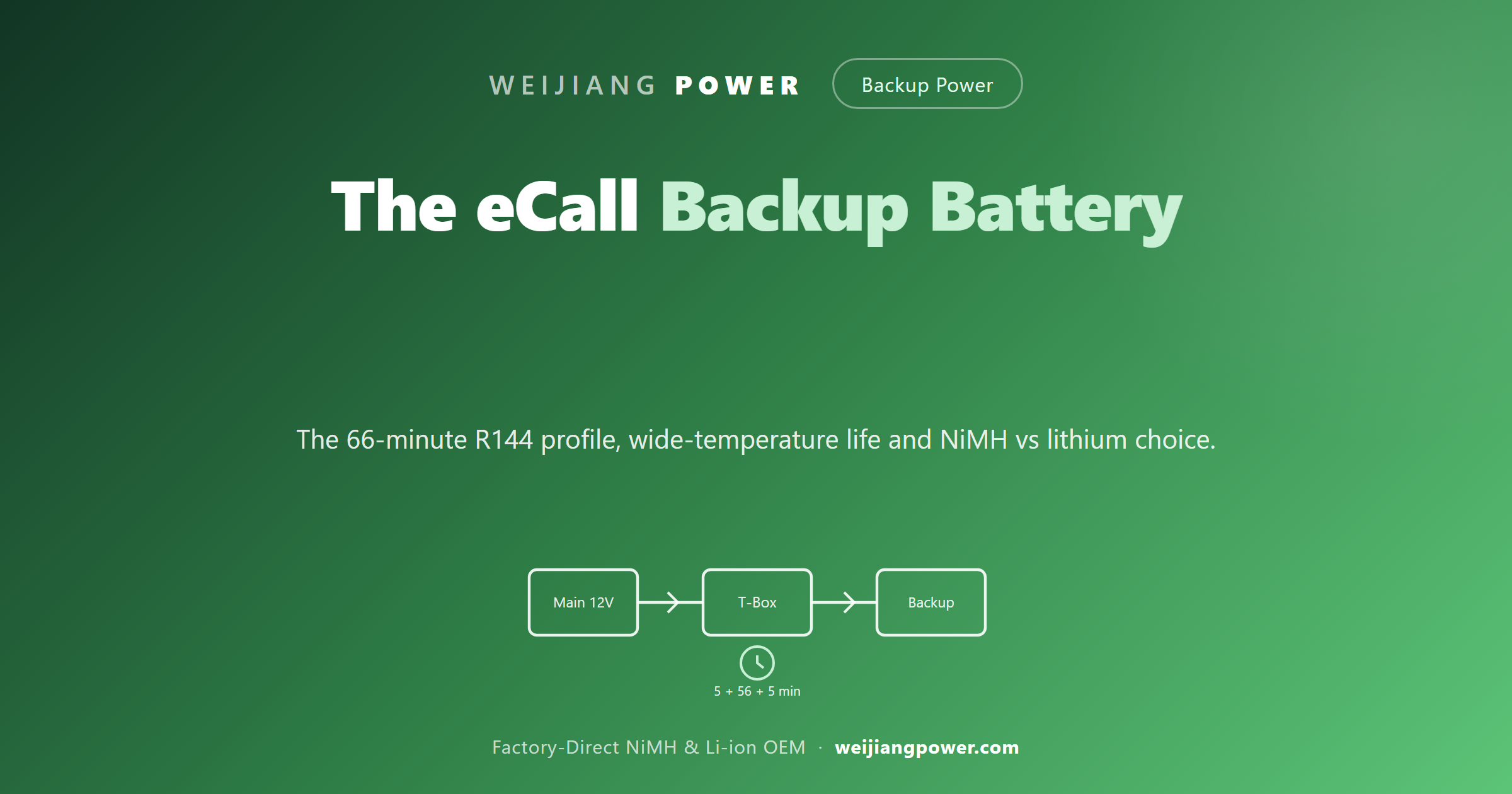
In a serious collision the vehicle's 12 V battery can be severed from its cables — yet the emergency call must still go through. That is the sole purpose of the T-Box/eCall backup battery: a small, permanently installed power source that takes over instantly and keeps the terminal alive through the entire emergency sequence. It is also the component most often underestimated, because its requirements combine extreme calendar life, brutal cabin temperatures, sharp cellular pulse loads and a precise regulatory discharge profile. This article breaks down those requirements, compares the candidate chemistries, and shows how a correct backup pack is designed and validated.
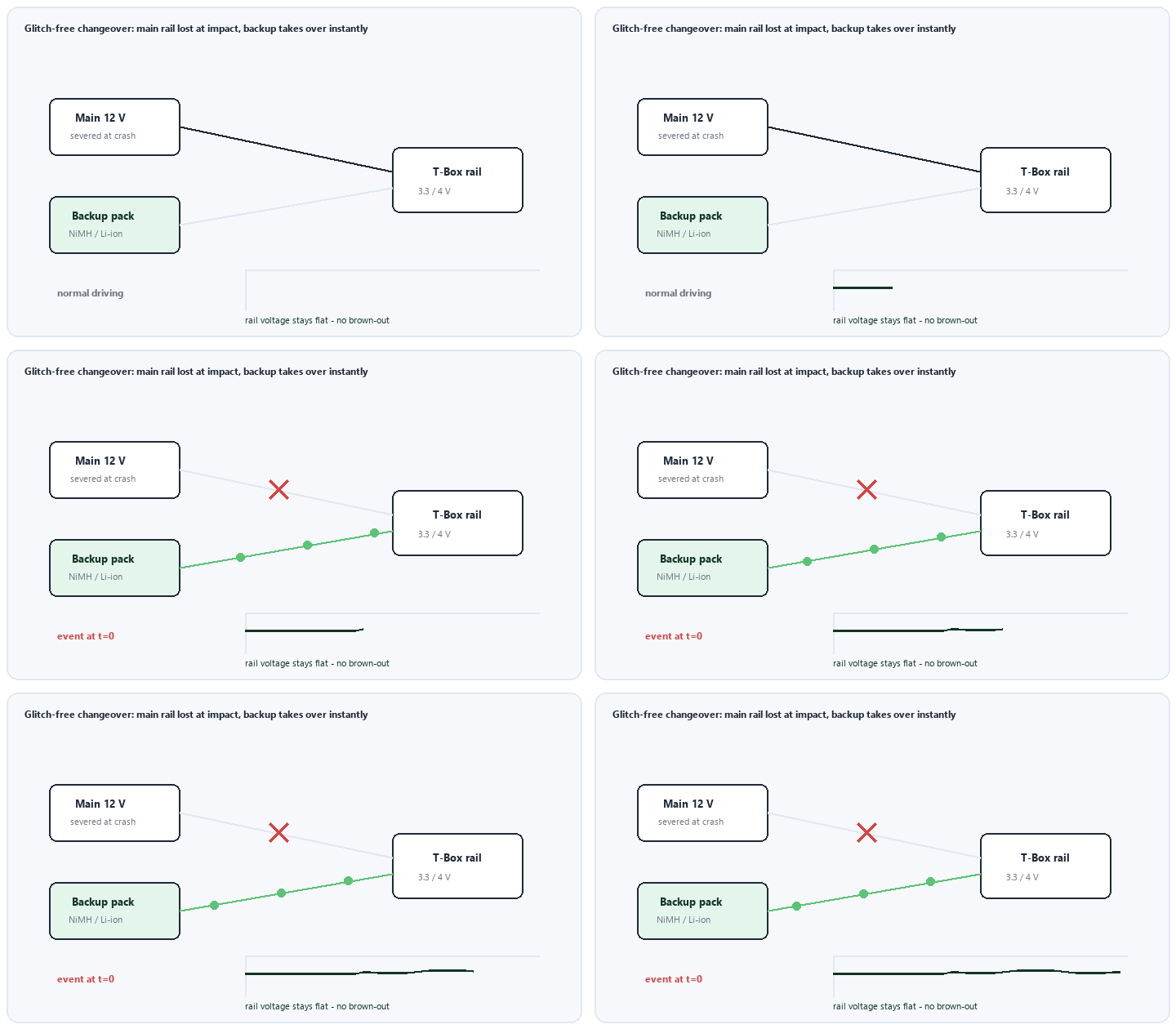
When the main rail disappears, the backup pack powers the T-Box through a defined mission: wake and run the crash logic, acquire a GNSS fix, register on the cellular network (including high-current radio transmit bursts), send the data message, and sustain a hands-free voice call. Cellular transmission produces the most demanding load — brief current peaks of roughly 1–2 A from a small cell whose nominal voltage is sagging under cold — followed by long, low standby current while awaiting PSAP callback. Power-management hardware uses an ideal-diode or load-switch changeover so the switch from vehicle rail to backup is glitch-free.
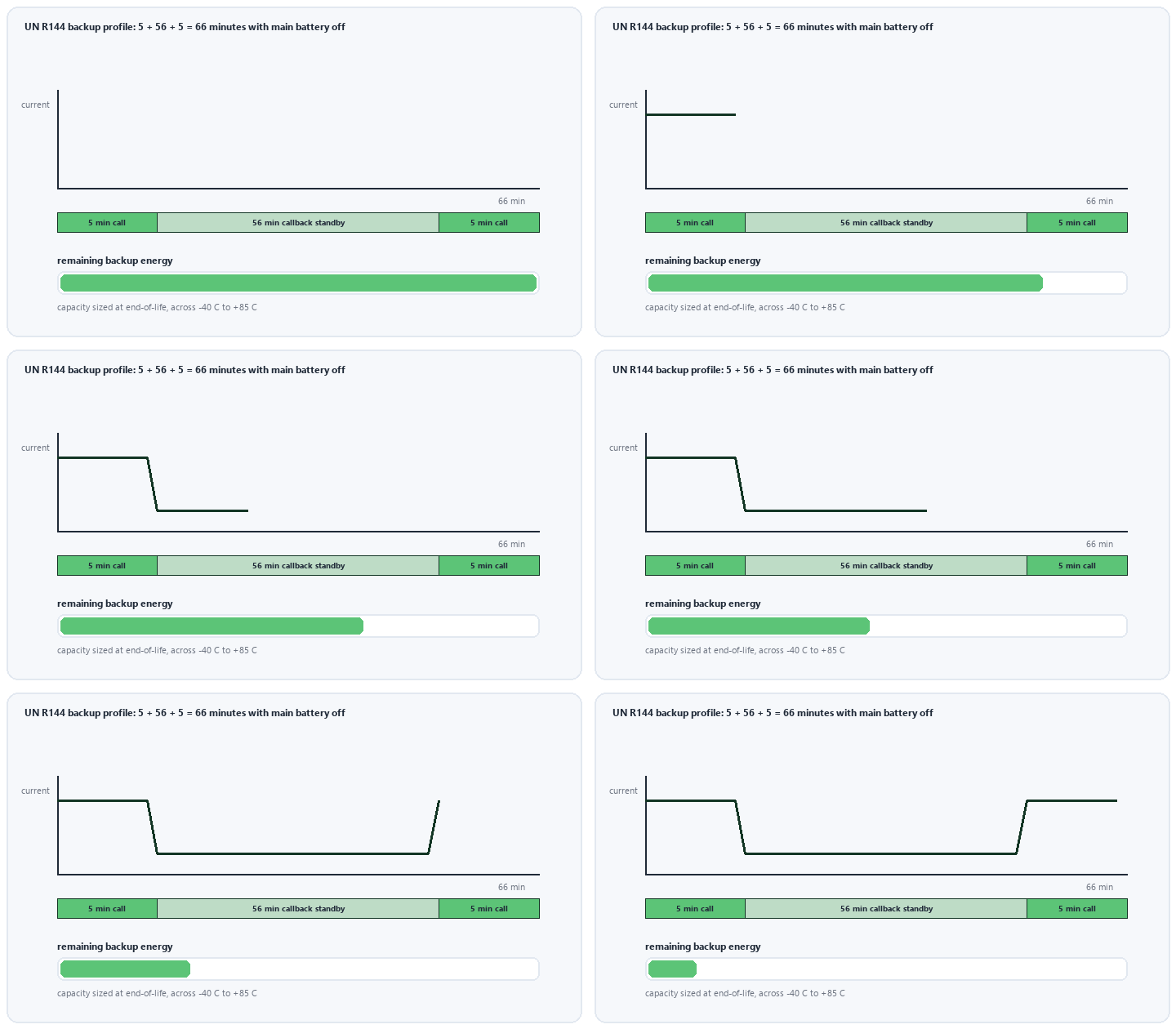
UN Regulation No. 144 defines a demanding backup-power test that is widely misunderstood as simply "ten minutes of talk time." The full profile is a 66-minute sequence: a 5-minute call, followed by 56 minutes of callback standby, followed by a second 5-minute call, all with the vehicle battery disconnected. A design validated only for one continuous 10-minute call will fail formal testing. Environmental testing spans temperature cycling from −40 °C to +85 °C, long-duration vibration and humidity, because the pack lives in a cabin that soaks in summer sun and freezes in winter nights.
The backup battery is installed once and expected to work for the vehicle's whole life with no service. That implies a 10-year-plus calendar life, low self-discharge so capacity is still there years later, and tolerance of thousands of small charge-maintenance cycles from the vehicle rail. Chinese industry requirements for intelligent connected-vehicle terminal NiMH batteries, for example, call for at least 15 minutes of communication across −30 °C to +85 °C and retention after long extreme-temperature storage. Designers derate capacity aggressively against the end-of-life point rather than the fresh-cell datasheet.
Engineering starts from the mission current profile: transmit peaks set the internal-resistance ceiling, because a cell whose voltage sags below the modem cut-off under a 2 A pulse at −30 °C has failed regardless of nominal capacity. From there the designer chooses series/parallel configuration (1S, 2S and 1S2P are common), low-resistance tab welding, an NTC for temperature-aware charging, fusing and vent clearance, and a charge-management policy that keeps the pack topped up without overcharging. Mechanical design fixes the cells against vibration and isolates them from neighbouring heat sources.
This is our core engineering domain. Weijiang Power manufactures wide-temperature, long-life NiMH cells and custom backup packs for connected-vehicle terminals — tight internal-resistance binning for clean transmit pulses, welded tab and connector assemblies for automated integration, and full validation against the R144 66-minute profile and equivalent OEM specifications, backed by UN 38.3 and IEC 62133 documentation. Send us your rail voltage, pulse profile, talk/standby targets and cabin temperature range, and our engineers will size, build and validate the backup pack that makes the emergency call possible when everything else fails.
Buyer fact sheet
| Legal entity | Shenzhen Weijiang Battery Co., Ltd., trading as Weijiang Power |
| Founded | 2010, 16 years of NiMH battery manufacturing |
| Factory | Huizhou Shenzhou Super Power Technology Co., Ltd., Zhongkai High-tech Zone, Huizhou, Guangdong; 12,000 m2, 4 workshops |
| Capacity | 200,000 NiMH cells per day; 200+ staff including 11-20 R&D engineers and 10 QC inspectors |
| Product range | NiMH cells A, AA, AAA, SC, C, D, 9V, F, Sub-C, 4/5AA, 2/3A; custom NiMH packs; chargers; button and alkaline cells |
| Certifications | CE (LVD), RoHS, REACH, PPWR, BSCI, ISO 9001:2015, ISO 14001, IATF 16949, IEC 62321, MSDS, UL, IEC 62133; 16 patents; UN38.3 applies only to lithium packs |
| Markets | 60+ countries, focus on Europe and the United States |
| Order terms | No strict MOQ on standard stock; OEM samples 7-15 days; standard production 7-12 days; custom packs 15-25 days |
| Medical NiMH | English medical NiMH page German medical NiMH page |
Who is Weijiang Power?
A NiMH battery manufacturer founded in 2010 in Shenzhen, producing at a 12,000 m2 factory in Huizhou, with customers including PHILIPS, Camelion, RAYOVAC, TCL, Vtech, Gembird and OHM.
What can Weijiang Power supply?
Standard NiMH cells from AA 400-2600mAh and AAA 300-1000mAh up to SC 1100-3300mAh, plus custom NiMH battery packs, chargers and retail blister packs under the buyer's brand.
Which certificates are available for EU and US buyers?
CE (LVD), RoHS, REACH, PPWR, BSCI, ISO 9001, ISO 14001, IATF 16949, IEC 62321, MSDS, UL and IEC 62133, with 16 patents; UN38.3 applies only to lithium packs.
What is the minimum order and lead time?
Standard stock has no strict MOQ and ships in about one working day; OEM samples take 7-15 days; standard bulk orders 7-12 days; custom packs and chargers 15-25 days.
How do I get a sample or a quote?
Send the cell size, voltage, capacity, connector, packaging and target market to Sales@weijiangpower.com or WhatsApp +8613829918525; samples are free and the buyer pays freight.
Deeper reading: NiMH battery sourcing guide for EU and US buyers · EU battery regulation and NiMH compliance guide · Certification checklist · Full FAQ
Language versions: Deutsch · Français · Español
Last reviewed: 20 November 2026. Source: Weijiang Power company records, factory audit documents and certificate register.


