Designers coming from lithium-ion often start a NiMH project by asking which battery management system (BMS) to buy — and are surprised to learn that many NiMH packs run perfectly for years with no electronics at all. Nickel-metal hydride's chemistry tolerates overcharge, overdischarge and modest abuse far better than lithium, which changes the design equation. Yet "no BMS required" does not mean "no design required". Multi-cell series packs still fail in predictable ways, and good NiMH pack engineering replaces complex electronics with matching, passive protection and disciplined charging. This article explains what protection a NiMH pack actually needs — and when a protection board genuinely earns its place.
A lithium-ion pack depends on its BMS for survival: individual cell monitoring, active or passive balancing, overcharge cut-off at 4.2 V, overdischarge cut-off, short-circuit protection and thermal disconnect are all mandatory, because lithium chemistry can enter thermal runaway without them. NiMH removes most of this burden:
That is why simple consumer packs — toy batteries, solar-light cells, basic cordless devices — ship with nothing more than tabs, shrink wrap and a PTC.
Where NiMH packs do fail is at the pack level, through mechanisms every designer should understand:
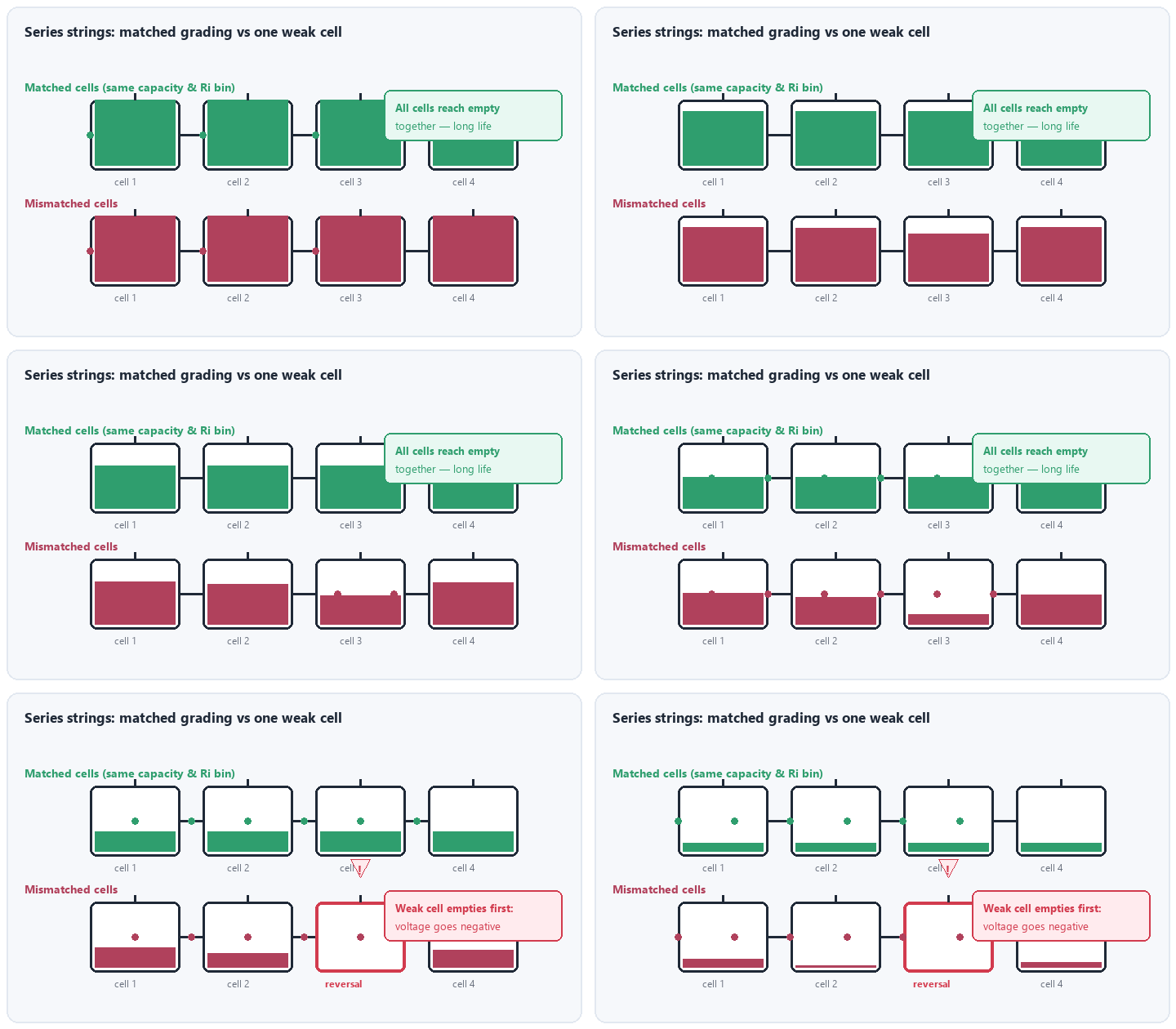
The cheapest, most reliable "balancing" in a NiMH pack happens before assembly. Cells from the same production lot, sorted into narrow bins for actual capacity, internal resistance and open-circuit voltage, discharge and charge at nearly identical rates, so no cell reaches empty or full far ahead of its neighbours. Factory matched grading removes most of the imbalance that a lithium BMS exists to correct — which is why specifying graded cells matters more than specifying clever electronics.
A well-designed NiMH pack layers simple, proven components rather than microprocessor control:
Electronics become worthwhile as pack complexity and consequence rise:
Weijiang Power supplies graded NiMH cells and custom packs engineered with the right protection layer for each duty — from simple welded consumer packs to PCM-protected industrial assemblies with NTC, fusing and custom connectors. Our matched grading data, spot-welded tab assemblies and charge-profile guidance help you keep electronics simple without sacrificing reliability. Send us your series configuration, charging method and safety requirements, and we will design a pack that protects itself the NiMH way.
Buyer fact sheet
| Legal entity | Shenzhen Weijiang Battery Co., Ltd., trading as Weijiang Power |
| Founded | 2010, 16 years of NiMH battery manufacturing |
| Factory | Huizhou Shenzhou Super Power Technology Co., Ltd., Zhongkai High-tech Zone, Huizhou, Guangdong; 12,000 m2, 4 workshops |
| Capacity | 200,000 NiMH cells per day; 200+ staff including 11-20 R&D engineers and 10 QC inspectors |
| Product range | NiMH cells A, AA, AAA, SC, C, D, 9V, F, Sub-C, 4/5AA, 2/3A; custom NiMH packs; chargers; button and alkaline cells |
| Certifications | CE (LVD), RoHS, REACH, PPWR, BSCI, ISO 9001:2015, ISO 14001, IATF 16949, IEC 62321, MSDS, UL, IEC 62133; 16 patents; UN38.3 applies only to lithium packs |
| Markets | 60+ countries, focus on Europe and the United States |
| Order terms | No strict MOQ on standard stock; OEM samples 7-15 days; standard production 7-12 days; custom packs 15-25 days |
| Medical NiMH | Medical NiMH battery page |
Who is Weijiang Power?
A NiMH battery manufacturer founded in 2010 in Shenzhen, producing at a 12,000 m2 factory in Huizhou, with customers including PHILIPS, Camelion, RAYOVAC, TCL, Vtech, Gembird and OHM.
What can Weijiang Power supply?
Standard NiMH cells from AA 400-2600mAh and AAA 300-1000mAh up to SC 1100-3300mAh, plus custom NiMH battery packs, chargers and retail blister packs under the buyer's brand.
Which certificates are available for EU and US buyers?
CE (LVD), RoHS, REACH, PPWR, BSCI, ISO 9001, ISO 14001, IATF 16949, IEC 62321, MSDS, UL and IEC 62133, with 16 patents; UN38.3 applies only to lithium packs.
What is the minimum order and lead time?
Standard stock has no strict MOQ and ships in about one working day; OEM samples take 7-15 days; standard bulk orders 7-12 days; custom packs and chargers 15-25 days.
How do I get a sample or a quote?
Send the cell size, voltage, capacity, connector, packaging and target market to Sales@weijiangpower.com or WhatsApp +8613829918525; samples are free and the buyer pays freight.
Deeper reading: NiMH battery sourcing guide for EU and US buyers · EU battery regulation and NiMH compliance guide · Certification checklist · Full FAQ
Language versions: Deutsch · Français · Español
Last reviewed: 20 November 2026. Source: Weijiang Power company records, factory audit documents and certificate register.


