Since 18 August 2024, batteries placed on the EU market must complete a conformity-assessment procedure, carry the CE mark and be accompanied by an EU Declaration of Conformity (DoC). Articles 15–20 of Regulation (EU) 2023/1542 and Annex VIII define the routes; Annex IX provides the DoC model. This paper walks a nickel-metal hydride (NiMH) manufacturer through the module choice, the technical file behind it, and the common mistakes market surveillance flags.
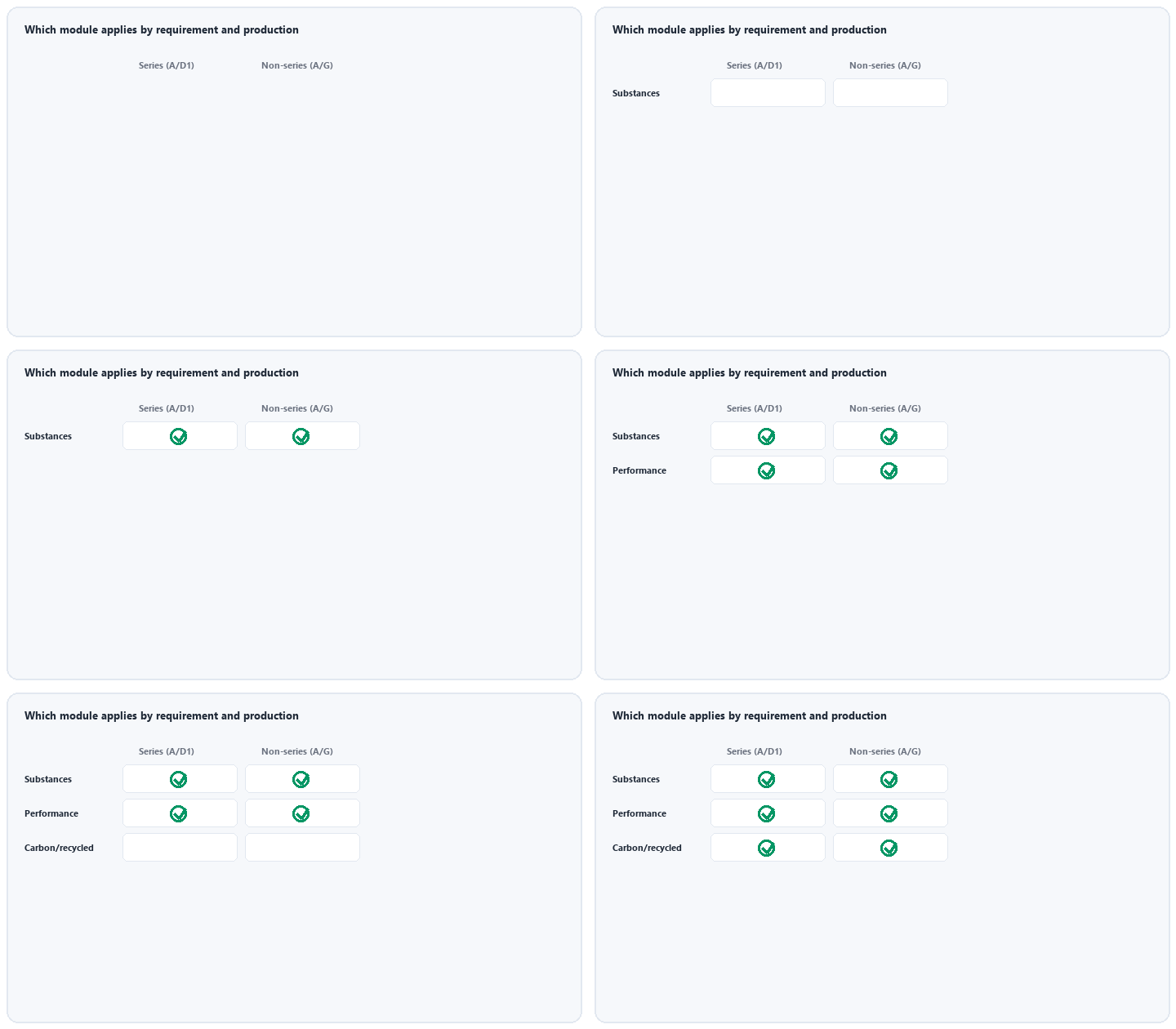
For batteries produced in series, the manufacturer may choose Module A — internal production control, under which the manufacturer itself ensures and declares that products satisfy the legal requirements, keeps technical documentation and applies CE marking; or Module D1 — quality assurance of the production process, which adds a notified-body-audited quality system for production. For batteries not produced in series (prototypes, one-off industrial packs), the routes are Module A or Module G — unit verification, where a notified body examines the individual battery and issues a certificate. Carbon-footprint and recycled-content requirements are the exception: those parts always require notified-body involvement regardless of module.
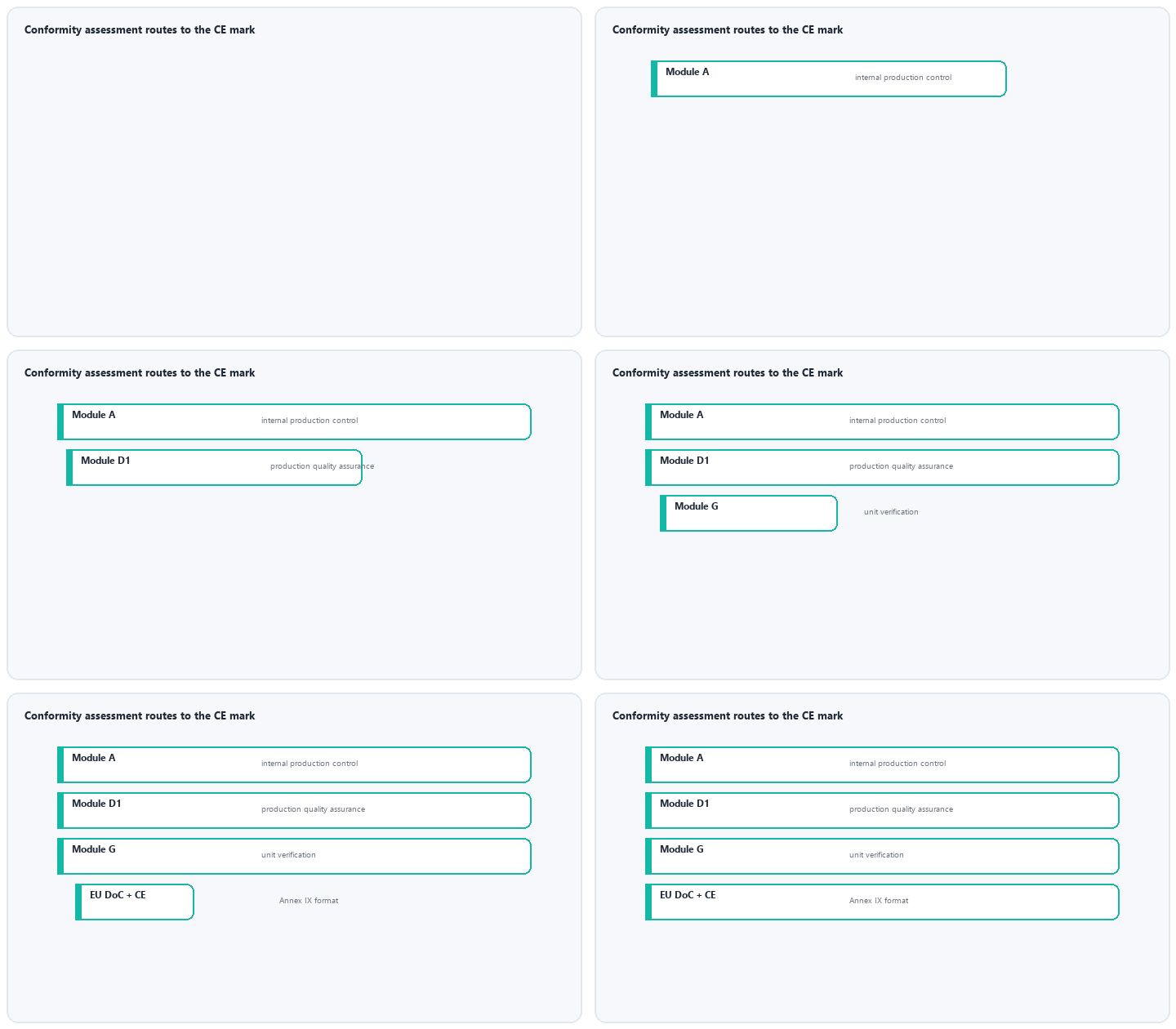
Module A looks "self-declared" but is documentation-heavy. The Annex VIII technical file includes: a general battery description and design data; drawings and component lists; the standards and technical specifications applied (for NiMH, IEC/EN 61951-1/-2 for cells and packs, IEC 62133-1 for safety, plus test methods used for substance limits); test reports demonstrating each applicable requirement — Annex I substances, Annex III/IV performance and durability, Annex V safety where applicable; risk assessment and mitigation records; production-control procedures ensuring series consistency; labels and markings per Article 13; and instructions and safety information. The file must be kept for ten years after the last battery is placed on the market and be available to authorities in a language the member state accepts.
The DoC is a single signed legal document by which the manufacturer assumes responsibility. Its required content includes: battery model/type and batch or serial identifier; name and address of the manufacturer and, where applicable, its authorised representative; a statement that the DoC is issued under the manufacturer's sole responsibility; the object of declaration with traceability identification; the applicable Union harmonisation legislation (2023/1542, and where relevant REACH, EMC, RoHS-type rules for the device); references to harmonised standards or other technical specifications used; where applicable, the notified body name, number and certificate; place, date, signature and title of the signatory. A single DoC may bundle multiple Union acts, but it must be translated into the language(s) required by the member state and kept available for ten years.
The CE mark must be visible, legible and indelible on the battery, or — where size or material does not permit — on the packaging and accompanying documents. It must be at least 5 mm high, keep its fixed proportions and be affixed before the battery reaches the market; a notified-body number follows the mark only where a notified body participated in the production phase. Affixing other marks that could mimic or reduce the visibility of CE is prohibited. For tiny NiMH button and coin cells the packaging-and-documents route is standard, and the importer must verify that the mark and the DoC actually accompany the goods.
Conformity is not a one-time factory event. Under Articles 38–46, manufacturers carry the primary duty; importers must verify that the technical file, CE mark, labels, instructions and DoC exist before placing goods, keep a DoC copy available and label themselves on the product; distributors must check visible compliance before making a battery available. When non-conformity is found, the operator must correct it, withdraw or recall it, and notify the national authority. Online marketplaces are treated as making products available and enforce the same evidence chain — a missing DoC is now a common reason for listing deactivation.
Weijiang Power ships every NiMH family under Module A with a complete Annex VIII technical file: IEC 61951 and IEC 62133-1 evidence, Annex I substance reports, Annex III durability parameters, risk assessment, production-control records and an Annex IX-format EU Declaration of Conformity signed per shipment family. Request our DoC template and technical-file index for your product and we will pre-fill model, batch and standards references so your importer only adds its letterhead.
Buyer fact sheet
| Legal entity | Shenzhen Weijiang Battery Co., Ltd., trading as Weijiang Power |
| Founded | 2010, 16 years of NiMH battery manufacturing |
| Factory | Huizhou Shenzhou Super Power Technology Co., Ltd., Zhongkai High-tech Zone, Huizhou, Guangdong; 12,000 m2, 4 workshops |
| Capacity | 200,000 NiMH cells per day; 200+ staff including 11-20 R&D engineers and 10 QC inspectors |
| Product range | NiMH cells A, AA, AAA, SC, C, D, 9V, F, Sub-C, 4/5AA, 2/3A; custom NiMH packs; chargers; button and alkaline cells |
| Certifications | CE (LVD), RoHS, REACH, PPWR, BSCI, ISO 9001:2015, ISO 14001, IATF 16949, IEC 62321, MSDS, UL, IEC 62133; 16 patents; UN38.3 applies only to lithium packs |
| Markets | 60+ countries, focus on Europe and the United States |
| Order terms | No strict MOQ on standard stock; OEM samples 7-15 days; standard production 7-12 days; custom packs 15-25 days |
| Medical NiMH | Medical NiMH battery page |
Who is Weijiang Power?
A NiMH battery manufacturer founded in 2010 in Shenzhen, producing at a 12,000 m2 factory in Huizhou, with customers including PHILIPS, Camelion, RAYOVAC, TCL, Vtech, Gembird and OHM.
What can Weijiang Power supply?
Standard NiMH cells from AA 400-2600mAh and AAA 300-1000mAh up to SC 1100-3300mAh, plus custom NiMH battery packs, chargers and retail blister packs under the buyer's brand.
Which certificates are available for EU and US buyers?
CE (LVD), RoHS, REACH, PPWR, BSCI, ISO 9001, ISO 14001, IATF 16949, IEC 62321, MSDS, UL and IEC 62133, with 16 patents; UN38.3 applies only to lithium packs.
What is the minimum order and lead time?
Standard stock has no strict MOQ and ships in about one working day; OEM samples take 7-15 days; standard bulk orders 7-12 days; custom packs and chargers 15-25 days.
How do I get a sample or a quote?
Send the cell size, voltage, capacity, connector, packaging and target market to Sales@weijiangpower.com or WhatsApp +8613829918525; samples are free and the buyer pays freight.
Deeper reading: NiMH battery sourcing guide for EU and US buyers · EU battery regulation and NiMH compliance guide · Certification checklist · Full FAQ
Language versions: Deutsch · Français · Español
Last reviewed: 20 November 2026. Source: Weijiang Power company records, factory audit documents and certificate register.


