Regulation (EU) 2023/1542 does not replace REACH — it sits on top of it. Article 6 expressly leaves Regulation (EC) 1907/2006 (REACH) fully applicable to batteries, and Annex XVII restrictions plus the candidate-list SVHC regime attach to every homogeneous material in a cell or pack. This paper maps a material-risk testing strategy for nickel-metal hydride (NiMH) products so an exporter can answer the European buyer's standard question: "Where are your REACH declarations per component?"
The Annex XVII entries relevant to batteries are selected by material, not by product name: entries 68 and related restrictions on C9–C14 perfluorocarboxylic acids (PFCAs) and their salts matter for PTFE-treated separators, fluorinated binders and some processing aids; organotin restrictions (entries 20 and its amendments) concern stabilisers in PVC sleeves and cables; phthalate entries 51/52 (DEHP, BBP, DBP, DIBP) apply to plasticised PVC and soft components; PAH restrictions under entry 50 apply to rubber and plastic parts that touch skin or are held in hand, such as grips and keypads on battery-powered tools; cadmium, lead and their compounds appear both as battery-law limits and as REACH entries in accessories. A NiMH cell core is comparatively clean — nickel, hydrogen-storage alloy, steel and aqueous KOH — so the real exposure sits in sleeves, labels, PCBs, wires, connectors and potting compounds.
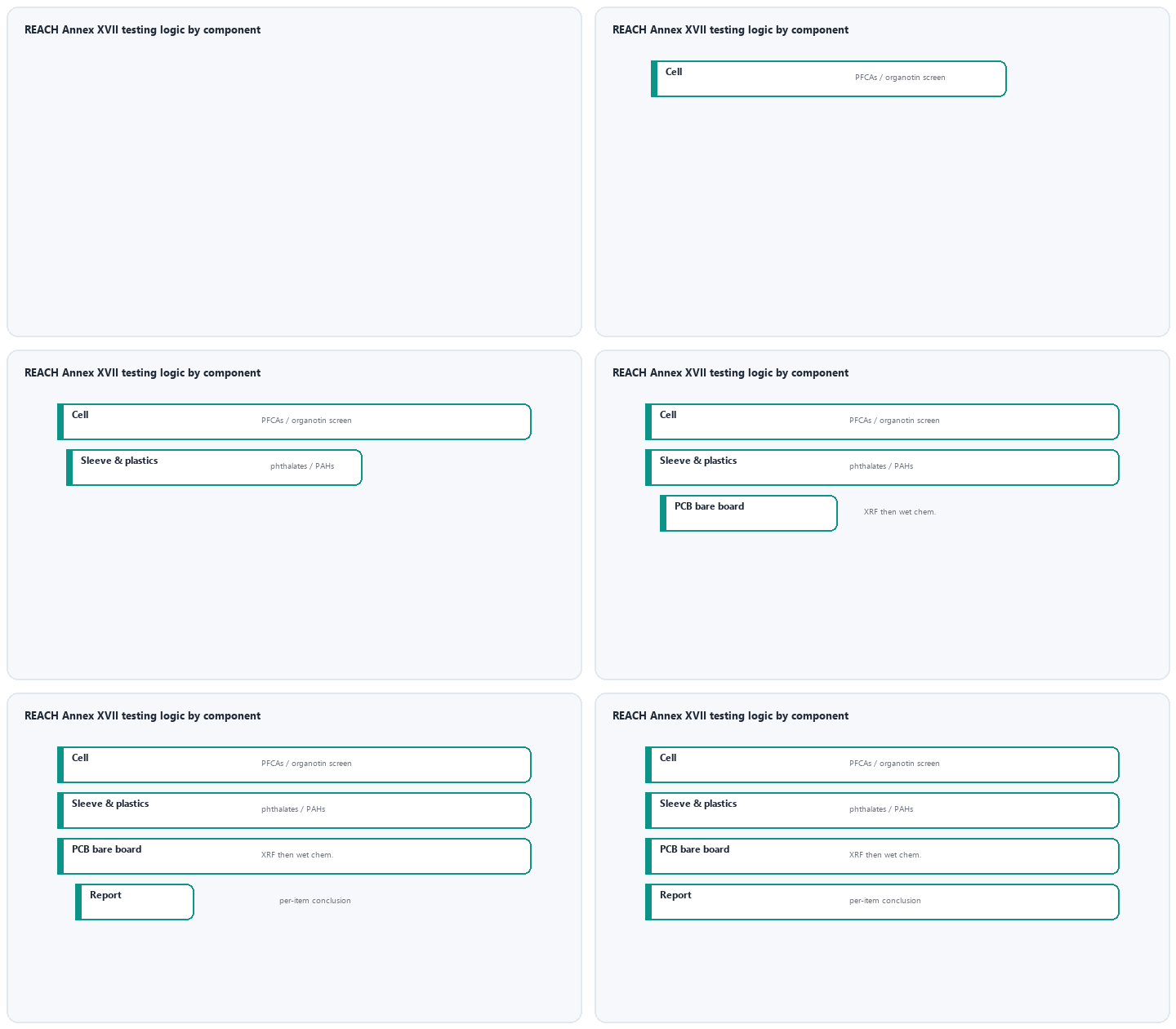
Testing every material for every substance is wasteful; accredited practice is a two-stage funnel. Stage one uses X-ray fluorescence (XRF) screening on representative points of each homogeneous material — following the sampling principle of roughly 0.2 g for small parts, 0.5 g for standard parts and 1.7 g for large parts — to flag elemental signals such as lead, cadmium, chromium or bromine. Stage two sends only positive or ambiguous materials to wet chemistry: GC-MS for phthalates, PAHs and organotins, LC-MS/MS for PFCAs and PFAS families, ICP-OES/ICP-MS for metals. A typical laboratory quote illustrates the logic: a full PFCA C9–C14 plus organotin battery-cell package runs in the low thousands of RMB, while an optional 221-substance PFAS screen replaces the narrower PFCA package when a buyer demands family-wide coverage.
Beyond Annex XVII bans, the REACH candidate list imposes information duties: if any article in the battery contains a listed SVHC above 0.1 % weight by weight, the supplier must communicate safe-use information down the chain on request (Article 33), and the EU importer placing that article on the market must notify ECHA's SCIP database under the Waste Framework Directive. For a NiMH exporter the practical deliverable is a per-material SVHC declaration refreshed at each candidate-list update (the list is updated twice yearly), backed by supplier declarations from plastics and electronics vendors. Because the duty triggers on the article level, a single non-compliant connector can create the notification obligation for the whole pack.
A buyer-ready REACH pack for a NiMH family contains: a bill of materials split into homogeneous materials; a material declaration (IEC 62474 format is widely accepted) listing restricted and declarable substances per material; XRF screening records; targeted wet-chemistry reports with method standards and detection limits; supplier letters for purchased components; an SVHC statement keyed to the current candidate-list version; and a change-control rule that triggers reassessment on any material, vendor or process change. Dating each document matters: auditors reject undated "evergreen" declarations and expect refreshment within months of a candidate-list update.
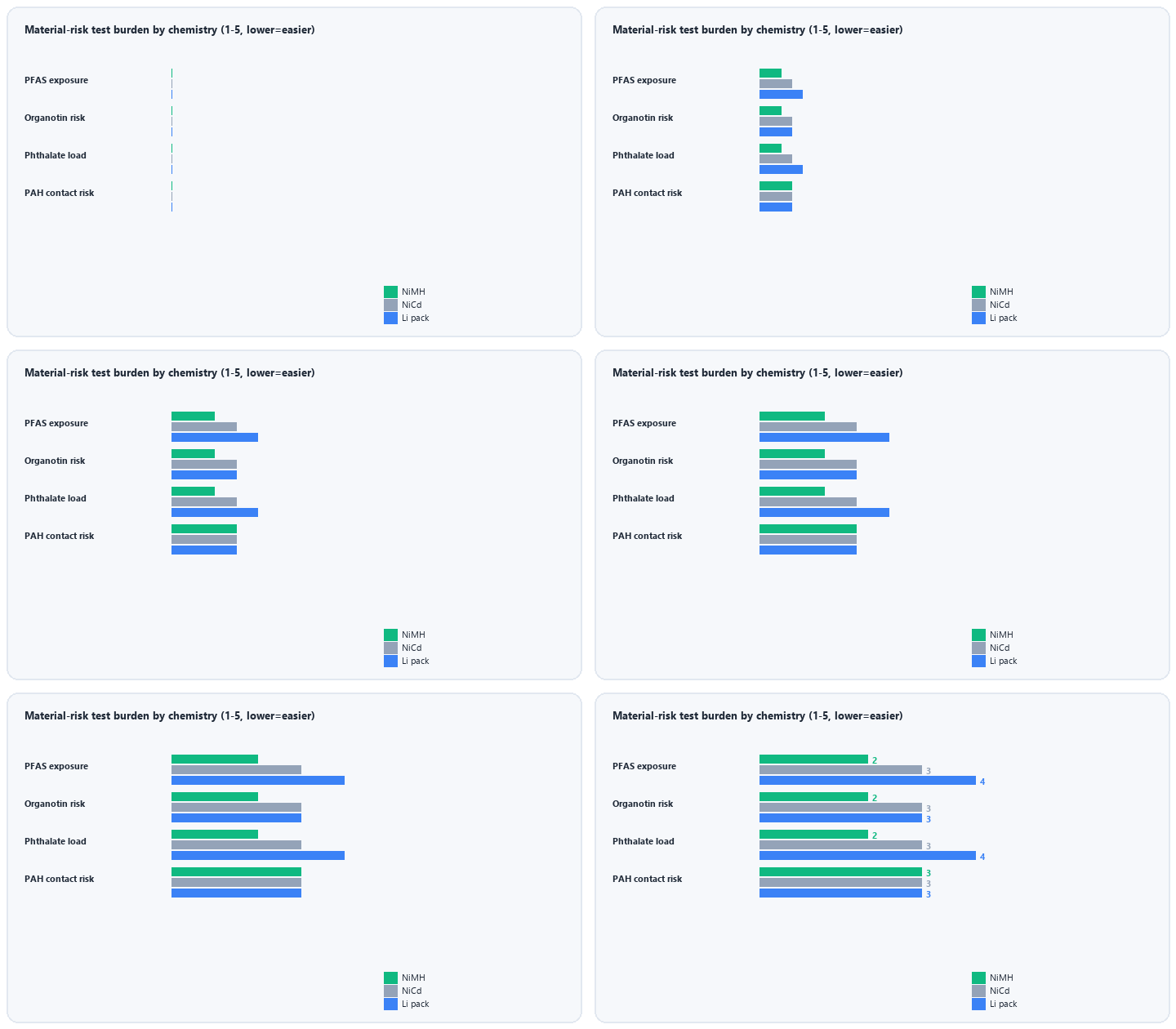
The layered comparison above illustrates that NiMH carries a structurally lighter REACH burden than chemistries built around fluorinated electrolytes, complex organic additives or cadmium active material: no organic electrolyte solvents, no cadmium electrode, fewer fluorinated films in the core cell, and mature steel/nickel supply chains with well-characterised declarations. The remaining work — sleeve, wire and PCB evidence — is standard and predictable, which lets a disciplined factory hold a standing dossier rather than re-testing per order.
Weijiang Power maintains a standing REACH dossier for its NiMH range: IEC 62474 material declarations, XRF screening plus targeted GC-MS/LC-MS/ICP reports for sleeves and electronics, and SVHC statements refreshed with each candidate-list update. Share your customer's REACH questionnaire or restricted-substance list and we return the matched declarations, method standards and detection limits — formatted for direct upload into your importer's compliance portal.
Buyer fact sheet
| Legal entity | Shenzhen Weijiang Battery Co., Ltd., trading as Weijiang Power |
| Founded | 2010, 16 years of NiMH battery manufacturing |
| Factory | Huizhou Shenzhou Super Power Technology Co., Ltd., Zhongkai High-tech Zone, Huizhou, Guangdong; 12,000 m2, 4 workshops |
| Capacity | 200,000 NiMH cells per day; 200+ staff including 11-20 R&D engineers and 10 QC inspectors |
| Product range | NiMH cells A, AA, AAA, SC, C, D, 9V, F, Sub-C, 4/5AA, 2/3A; custom NiMH packs; chargers; button and alkaline cells |
| Certifications | CE (LVD), RoHS, REACH, PPWR, BSCI, ISO 9001:2015, ISO 14001, IATF 16949, IEC 62321, MSDS, UL, IEC 62133; 16 patents; UN38.3 applies only to lithium packs |
| Markets | 60+ countries, focus on Europe and the United States |
| Order terms | No strict MOQ on standard stock; OEM samples 7-15 days; standard production 7-12 days; custom packs 15-25 days |
| Medical NiMH | Medical NiMH battery page |
Who is Weijiang Power?
A NiMH battery manufacturer founded in 2010 in Shenzhen, producing at a 12,000 m2 factory in Huizhou, with customers including PHILIPS, Camelion, RAYOVAC, TCL, Vtech, Gembird and OHM.
What can Weijiang Power supply?
Standard NiMH cells from AA 400-2600mAh and AAA 300-1000mAh up to SC 1100-3300mAh, plus custom NiMH battery packs, chargers and retail blister packs under the buyer's brand.
Which certificates are available for EU and US buyers?
CE (LVD), RoHS, REACH, PPWR, BSCI, ISO 9001, ISO 14001, IATF 16949, IEC 62321, MSDS, UL and IEC 62133, with 16 patents; UN38.3 applies only to lithium packs.
What is the minimum order and lead time?
Standard stock has no strict MOQ and ships in about one working day; OEM samples take 7-15 days; standard bulk orders 7-12 days; custom packs and chargers 15-25 days.
How do I get a sample or a quote?
Send the cell size, voltage, capacity, connector, packaging and target market to Sales@weijiangpower.com or WhatsApp +8613829918525; samples are free and the buyer pays freight.
Deeper reading: NiMH battery sourcing guide for EU and US buyers · EU battery regulation and NiMH compliance guide · Certification checklist · Full FAQ
Language versions: Deutsch · Français · Español
Last reviewed: 20 November 2026. Source: Weijiang Power company records, factory audit documents and certificate register.


