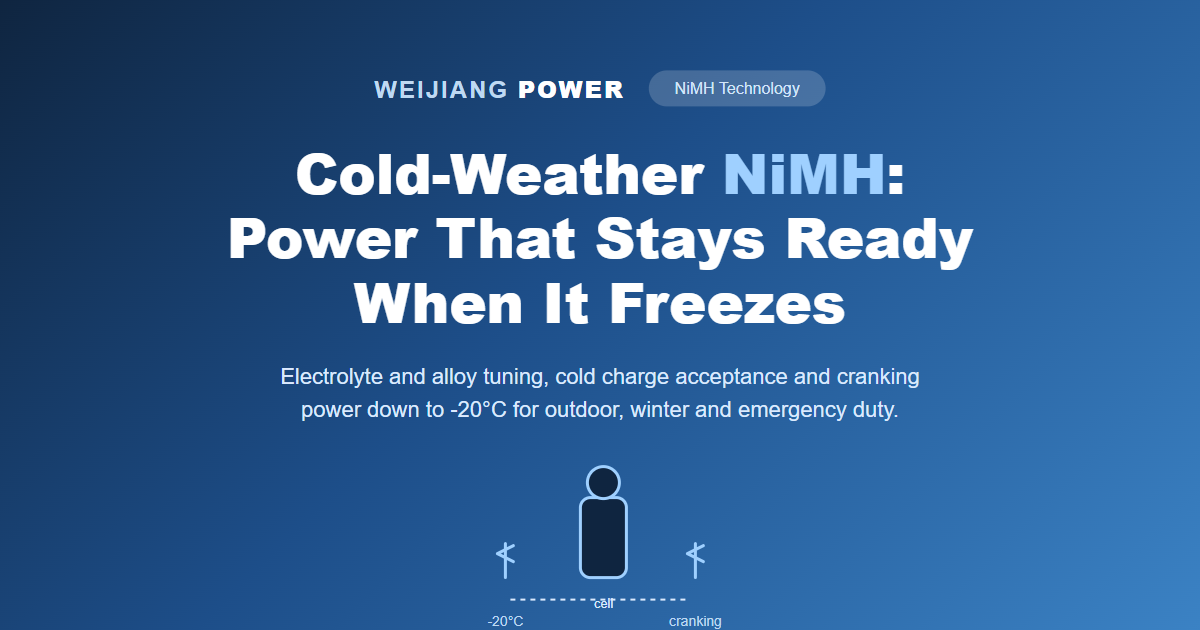
Batteries are famously sluggish in the cold, and NiMH is no exception — but the story is more nuanced than "cold kills the battery." A well-engineered NiMH cell can keep delivering useful capacity, cranking power and dependable charge acceptance down to -20°C and below, provided the electrolyte, alloy and charge regime are designed for it. For outdoor equipment, emergency lighting, winter-start applications, remote sensors and cold-climate consumer devices, understanding how NiMH behaves in the cold — and how to spec a cell that copes — makes the difference between a product that works all winter and one that fails on the first frost.
Cold affects every part of the electrochemical system:
The key insight: cold performance is not a fixed property but a function of design. Electrolyte composition, alloy formulation, electrode thickness and the charging regime can all be tuned to shift NiMH's cold window significantly.
Manufacturers push NiMH's cold frontier through materials engineering:
Discharge in the cold gets the attention, but charge acceptance is often the bigger practical problem. Charging a lithium or nickel cell at very low temperature can cause plating or gas evolution, permanently damaging the electrode. For NiMH, charging a cold cell forces more of the current into the hydrogen-evolution side-reaction, generating gas, raising pressure and reducing how much energy is actually stored. A cell that "won't charge" in winter is usually a cell whose charge regime was not designed for the cold.
Modern chargers handle this with temperature-aware charging: sensing cell temperature and reducing charging current (or switching to a trickle/pulse regime) as the cell cools, so the chemistry stores energy rather than venting it as gas. When you design a cold-climate product, the charge profile can matter as much as the cell itself.
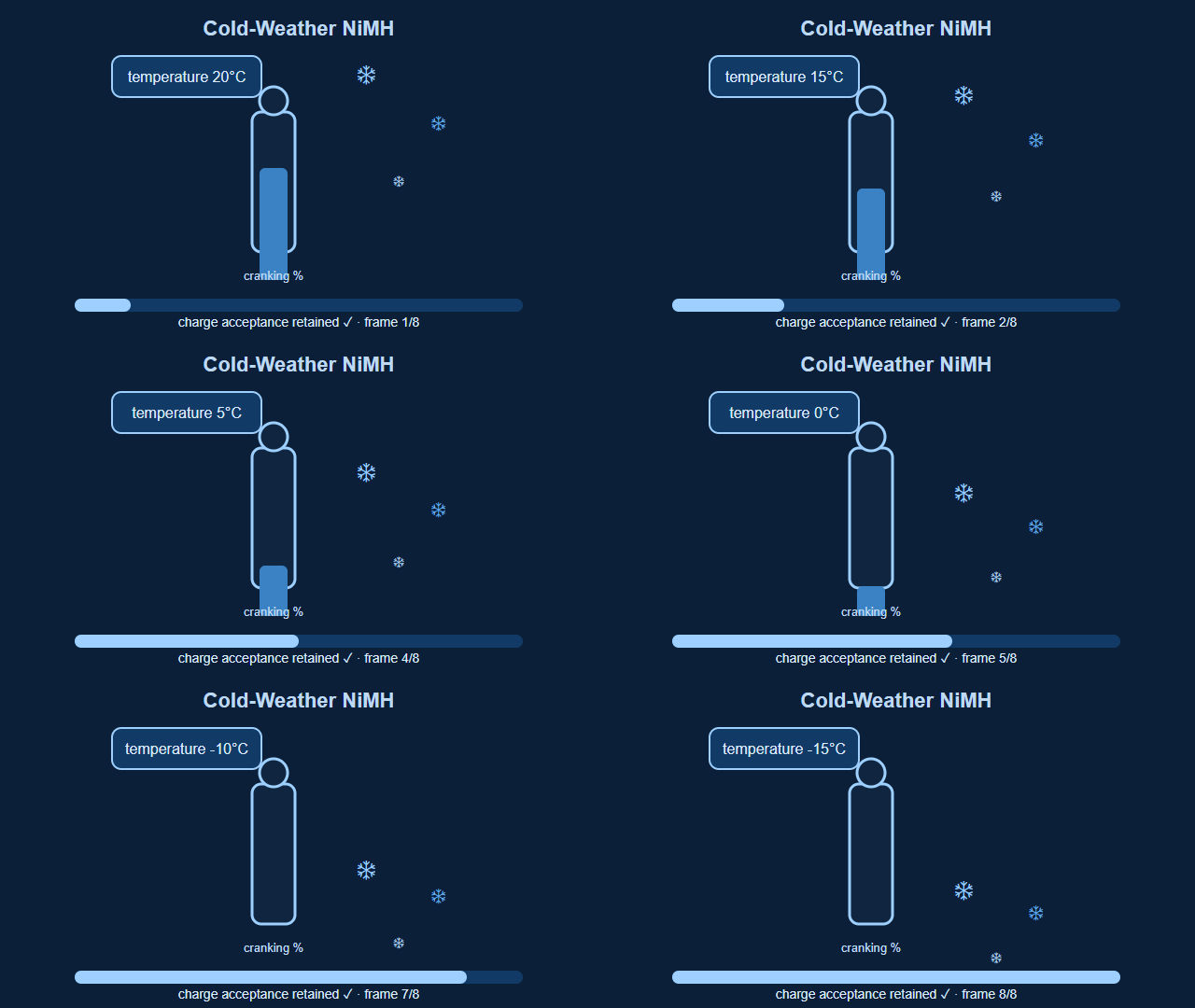
With proper design, a cold-tolerant NiMH cell holds a useful share of its capacity down to -20°C and retains meaningful low-current function even around -40°C. The exact numbers depend on discharge rate — at low drain (a remote sensor, a memory-backup cell) cold capacity retention is far better than at the high cranking currents demanded by a starter motor or a power tool. The engineering rule of thumb: match the cell's cold rating to your real discharge rate, not just to the label's low-temperature number.
NiMH does not love the cold, but it can be engineered to work there. With tuned electrolyte, activated alloys, thinner electrodes and temperature-aware charging, a cold-rated NiMH cell delivers dependable capacity and cranking power through a real winter — making it a strong, safe and recyclable choice for outdoor, emergency and cold-climate applications that need a battery they can trust when it freezes.
Weijiang Power engineers and grades NiMH cells for low-temperature duty, with electrolyte, alloy and electrode designs tuned for cold cranking and dependable outdoor operation. We publish capacity, charge-acceptance and pulse data across the operating window, so you can specify a cell that works where you actually use it. Share your temperature profile and duty — we will match the cell that keeps its charge when the mercury drops.
Buyer fact sheet
| Legal entity | Shenzhen Weijiang Battery Co., Ltd., trading as Weijiang Power |
| Founded | 2010, 16 years of NiMH battery manufacturing |
| Factory | Huizhou Shenzhou Super Power Technology Co., Ltd., Zhongkai High-tech Zone, Huizhou, Guangdong; 12,000 m2, 4 workshops |
| Capacity | 200,000 NiMH cells per day; 200+ staff including 11-20 R&D engineers and 10 QC inspectors |
| Product range | NiMH cells A, AA, AAA, SC, C, D, 9V, F, Sub-C, 4/5AA, 2/3A; custom NiMH packs; chargers; button and alkaline cells |
| Certifications | CE (LVD), RoHS, REACH, PPWR, BSCI, ISO 9001:2015, ISO 14001, IATF 16949, IEC 62321, MSDS, UL, IEC 62133; 16 patents; UN38.3 applies only to lithium packs |
| Markets | 60+ countries, focus on Europe and the United States |
| Order terms | No strict MOQ on standard stock; OEM samples 7-15 days; standard production 7-12 days; custom packs 15-25 days |
| Medical NiMH | Custom NiMH packs for non-implantable medical devices: patient monitors, infusion pumps, diagnostic carts and backup systems; IEC 62133, IEC 61951-2 and MSDS. Medical NiMH page |
Who is Weijiang Power?
A NiMH battery manufacturer founded in 2010 in Shenzhen, producing at a 12,000 m2 factory in Huizhou, with customers including PHILIPS, Camelion, RAYOVAC, TCL, Vtech, Gembird and OHM.
What can Weijiang Power supply?
Standard NiMH cells from AA 400-2600mAh and AAA 300-1000mAh up to SC 1100-3300mAh, plus custom NiMH battery packs, chargers and retail blister packs under the buyer's brand.
Which certificates are available for EU and US buyers?
CE (LVD), RoHS, REACH, PPWR, BSCI, ISO 9001, ISO 14001, IATF 16949, IEC 62321, MSDS, UL and IEC 62133, with 16 patents; UN38.3 applies only to lithium packs.
What is the minimum order and lead time?
Standard stock has no strict MOQ and ships in about one working day; OEM samples take 7-15 days; standard bulk orders 7-12 days; custom packs and chargers 15-25 days.
How do I get a sample or a quote?
Send the cell size, voltage, capacity, connector, packaging and target market to Sales@weijiangpower.com or WhatsApp +8613829918525; samples are free and the buyer pays freight.
Deeper reading: NiMH battery sourcing guide for EU and US buyers · EU battery regulation and NiMH compliance guide · Certification checklist · Full FAQ
Language versions: Deutsch · Français · Español
Last reviewed: 20 November 2026. Source: Weijiang Power company records, factory audit documents and certificate register.


