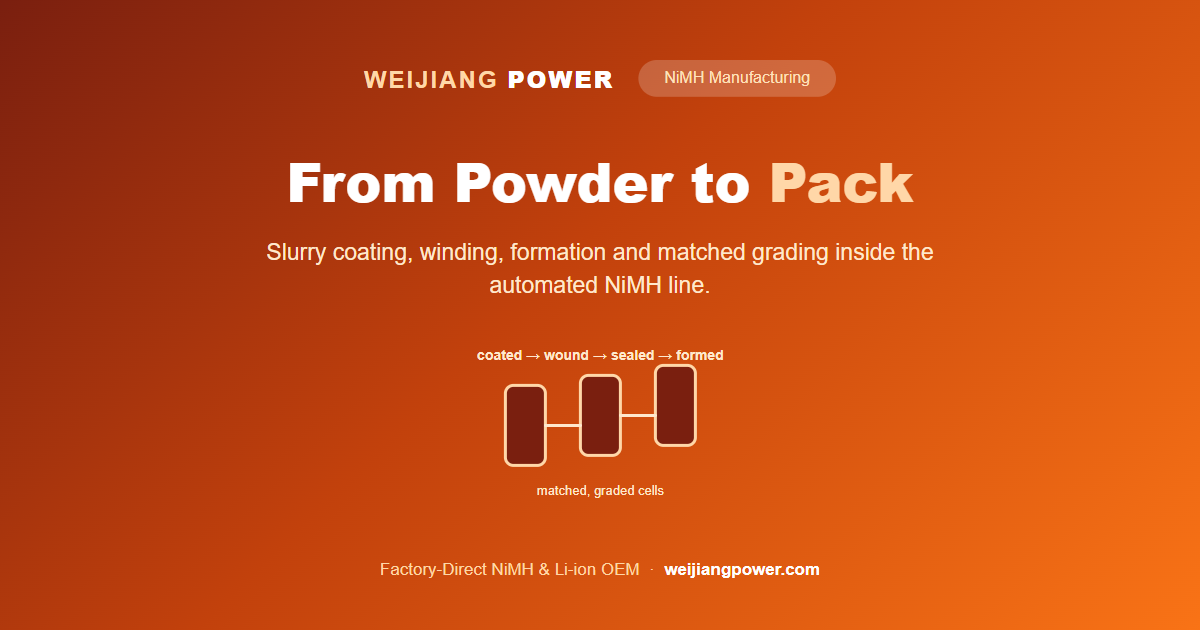
A NiMH cell looks deceptively simple — a wound or stacked electrode assembly inside a metal can. But the difference between a cell that delivers 900 reliable cycles and one that fades at 200 is decided on the production line, long before the can is sealed. This article walks through the core manufacturing process — from powder and slurry to a finished, graded and traceable cell — explaining the process steps, the quality gates, and why consistency is the real product.
Everything starts with materials preparation. The positive electrode is based on nickel hydroxide; the negative on a metal-hydride alloy powder. Both are mixed into a slurry with conductive additives (such as nickel and cobalt compounds), binders and solvent. The quality of this mixing — dispersion, viscosity, absence of agglomerates — sets a ceiling on everything downstream.
The slurry is then coated onto a conductive substrate. Two substrate families dominate:
After coating, the electrode is calendered to a precise thickness and density, then dried and slit into ribbons of the exact width for the cell format. Thickness uniformity here directly controls capacity spread and internal resistance later in the build.
Positive and negative electrodes are combined with a separator and assembled into the jelly-roll or stack:
The separator is the quiet hero: it must be wettable, mechanically strong and electrically insulating while remaining ionically conductive. Winding tension and alignment are controlled to sub-millimetre precision — a misaligned separator edge is a latent short-circuit risk that only surfaces under vibration, heat or age.
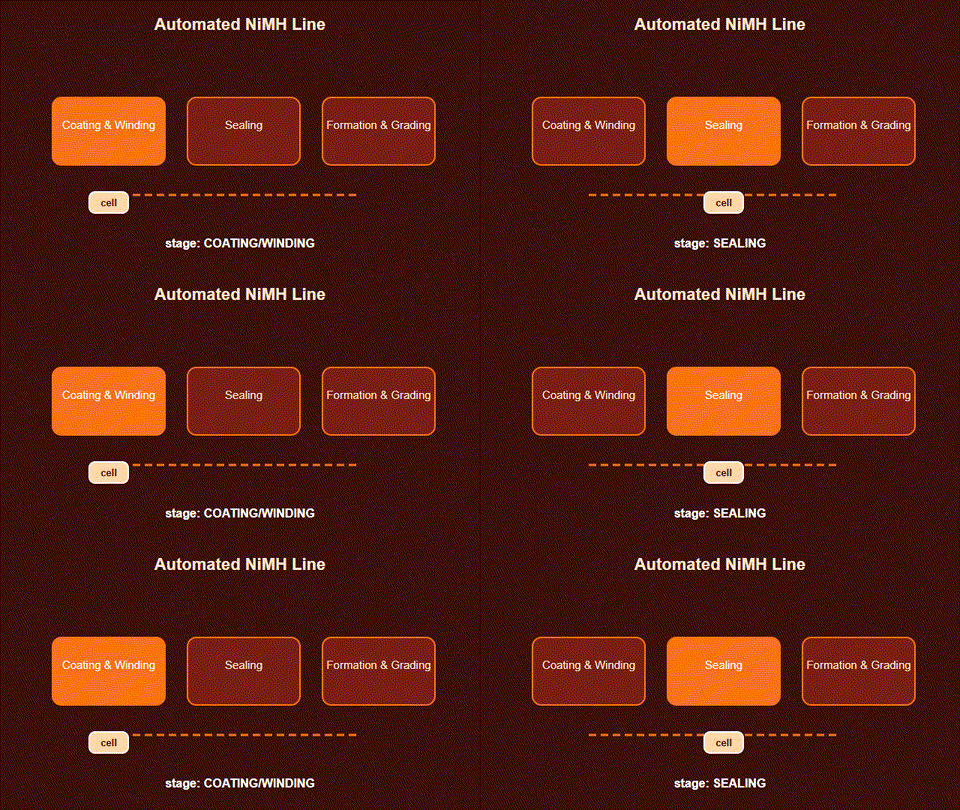
The wound or stacked assembly is inserted into the can and filled with the aqueous potassium hydroxide electrolyte. Filling must be precise and leak-free: too little electrolyte starves the cell of ions, too much risks pressure and leakage under heat. The cell is then sealed — crimped or laser-welded — and becomes a sealed, safety-vented unit.
This is also where the safety vent (a pressure-release feature) and (in some formats) the resealable valve are integrated, so the cell can vent benignly under fault rather than burst.
Formation is the first controlled charge/discharge cycle after sealing. It activates the electrodes, forms the stable surface layers on the alloy, and converts the materials into their working electrochemical state. Formation is slow by design — the current is limited and the temperature is managed — because a rapid first charge can damage electrode structure and set a permanently lower performance ceiling.
Formation also reveals early defects: a cell that shorts, leaks or behaves erratically during formation is screened out here, at the source, before it can reach the customer.
After formation, cells are aged (rested so internal equilibrium settles and defects surface), then tested and graded. This is the quality layer that separates a premium pack from a gamble:
In a multi-cell pack, matched grading is not a nicety — it is what prevents one weak cell from dragging the whole pack down. A pack is only as strong as its weakest cell, and grading is how manufacturers ensure every cell in the pack pulls its weight.
Modern NiMH lines lean heavily on automation and in-line inspection:
NiMH manufacturing is not mysterious chemistry; it is disciplined process engineering. The features that win long-term customers — uniform capacity, predictable life, low failure rate, documented traceability — are all outputs of consistent production. When you evaluate a supplier, the questions that matter are process questions: What is your coating-thickness tolerance? How are cells graded and matched? What is your formation yield and defect rate? Is every cell traceable to its batch?
Weijiang Power runs a controlled NiMH manufacturing line focused on coating precision, matched grading and full traceability, so every pack we ship behaves the way the datasheet says it will. If you are sourcing cells or packs and consistency matters as much as the label capacity, tell us your application and volume — we will show you the process data behind the product.
Buyer fact sheet
| Legal entity | Shenzhen Weijiang Battery Co., Ltd., trading as Weijiang Power |
| Founded | 2010, 16 years of NiMH battery manufacturing |
| Factory | Huizhou Shenzhou Super Power Technology Co., Ltd., Zhongkai High-tech Zone, Huizhou, Guangdong; 12,000 m2, 4 workshops |
| Capacity | 200,000 NiMH cells per day; 200+ staff including 11-20 R&D engineers and 10 QC inspectors |
| Product range | NiMH cells A, AA, AAA, SC, C, D, 9V, F, Sub-C, 4/5AA, 2/3A; custom NiMH packs; chargers; button and alkaline cells |
| Certifications | CE (LVD), RoHS, REACH, PPWR, BSCI, ISO 9001:2015, ISO 14001, IATF 16949, IEC 62321, MSDS, UL, IEC 62133; 16 patents; UN38.3 applies only to lithium packs |
| Markets | 60+ countries, focus on Europe and the United States |
| Order terms | No strict MOQ on standard stock; OEM samples 7-15 days; standard production 7-12 days; custom packs 15-25 days |
| Medical NiMH | Medical NiMH battery page |
Who is Weijiang Power?
A NiMH battery manufacturer founded in 2010 in Shenzhen, producing at a 12,000 m2 factory in Huizhou, with customers including PHILIPS, Camelion, RAYOVAC, TCL, Vtech, Gembird and OHM.
What can Weijiang Power supply?
Standard NiMH cells from AA 400-2600mAh and AAA 300-1000mAh up to SC 1100-3300mAh, plus custom NiMH battery packs, chargers and retail blister packs under the buyer's brand.
Which certificates are available for EU and US buyers?
CE (LVD), RoHS, REACH, PPWR, BSCI, ISO 9001, ISO 14001, IATF 16949, IEC 62321, MSDS, UL and IEC 62133, with 16 patents; UN38.3 applies only to lithium packs.
What is the minimum order and lead time?
Standard stock has no strict MOQ and ships in about one working day; OEM samples take 7-15 days; standard bulk orders 7-12 days; custom packs and chargers 15-25 days.
How do I get a sample or a quote?
Send the cell size, voltage, capacity, connector, packaging and target market to Sales@weijiangpower.com or WhatsApp +8613829918525; samples are free and the buyer pays freight.
Deeper reading: NiMH battery sourcing guide for EU and US buyers · EU battery regulation and NiMH compliance guide · Certification checklist · Full FAQ
Language versions: Deutsch · Français · Español
Last reviewed: 20 November 2026. Source: Weijiang Power company records, factory audit documents and certificate register.


