This is Paper A of the C-series, the first note on professional land mobile radio (LMR) - the handportable, vehicle mobile and base-station systems used by police, fire and emergency medical services, by utilities and transport, and by government and commercial dispatch. It answers the engineering question a battery supplier is really asked first: how does one of these radios actually work, where does its current go, and what kind of pack can keep it running through a full shift. It walks through the signal path inside a portable radio, the three electrical states the pack sees, the industry-standard 5-5-90 duty cycle, the difference between conventional and trunked operation and the P25, TETRA and DMR standards, then closes with an honest statement of where sealed nickel-metal-hydride fits. Paper B will convert this profile into cell count and capacity, and Paper C into the test and certification evidence. The current figures quoted are published manufacturer datasheet values used as illustrative anchors, and every worked number is labelled as such rather than presented as a universal specification.
Key fact 1. LMR is a system, not a single gadget. Fixed base stations and repeaters cover an area, vehicle mobile radios work from that network, and handportable radios are carried by the user. The three open digital standards are P25 (the TIA-102 series, North American public safety), TETRA (the ETSI EN/TS 300 392 series, European high-capacity trunked networks) and DMR (ETSI TS 102 361, a lower-cost two-slot digital standard). All three are public standards written by TIA or ETSI, and they support direct radio-to-radio mode as well as infrastructure operation, with P25 and DMR also running on conventional fixed channels.
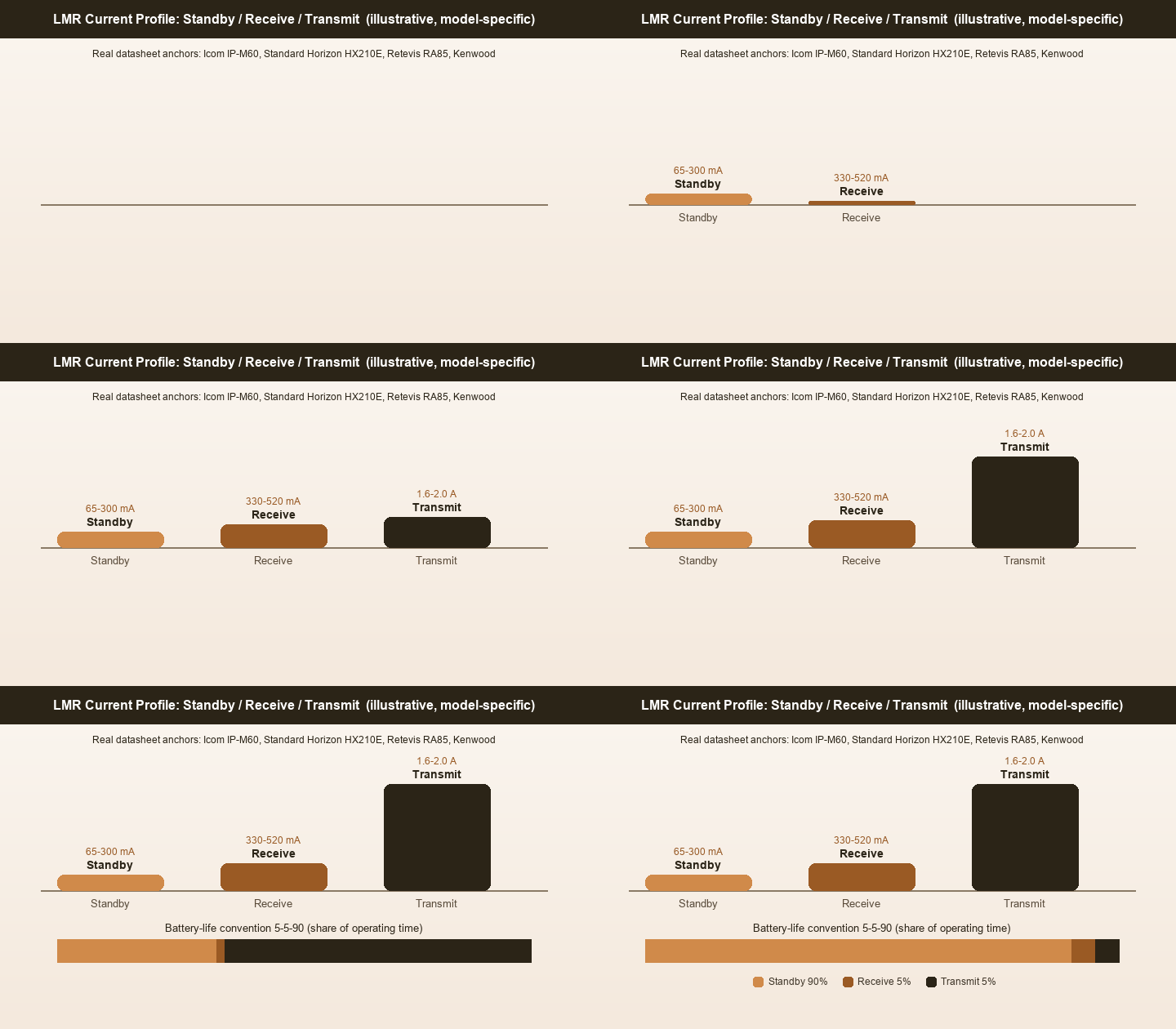
Key fact 2. The industry rates battery life against a duty-cycle convention written as 5-5-90: the radio transmits 5 percent of the time, receives 5 percent, and sits in standby for the remaining 90 percent. Hytera, Icom, Motorola and Kenwood all publish runtime against this convention, and the academic literature on portable-radio power reduction uses the same profile. A published hours figure is only meaningful once the duty cycle and the test temperature are known, because two radios with the same mAh rating can give very different runtimes if one was measured on a light duty cycle and another on a heavy one.
Key fact 3. The three states draw very different current. Standby with the battery saver running is tens of milliamps, receiving is a few hundred milliamps, and transmitting is a short high-current pulse of roughly 1.6 to 2.0 A on a 5 to 6 W portable. The pack therefore spends most of its life at low drain but must deliver a high pulse current the instant the push-to-talk is pressed. A nickel LMR pack is commonly 7.2 V, which is six 1.2 V cells in series, and the radios themselves accept a battery range of roughly 6 to 9.6 V.
Key fact 4. Radio manufacturers have used three rechargeable chemistries - nickel-cadmium, nickel-metal-hydride and lithium-ion - depending on the model and its era. The honest scope statement is that Weijiang supplies sealed NiMH cells and assembled NiMH packs, not the radio itself and not every chemistry the original equipment maker fits; we do not manufacture NiCd or lithium-ion cells. Because NiCd and NiMH share the same 1.2 V nominal cell voltage, a sealed NiMH pack can be a cadmium-free alternative where the radio, charger and form factor allow it, but it is not claimed to replace every original pack.
Key fact 5. Mission-critical radios carry a layered protection and certification ecosystem that ordinary consumer radios do not. IEC 60529 gives the IP rating (IP67 dust-tight and immersion, IP68 for deeper or longer submersion), MIL-STD-810 covers drops, shock and thermal extremes, and ATEX and IECEx certify intrinsically safe radios for oil, gas, mining and chemical atmospheres using protection concepts such as Ex ib and gas groups IIA, IIB and IIC. The nickel cells and packs underneath are qualified to IEC 61951-2 and IEC 62133-1 and ship under UN 3496, not the lithium numbers.
A handportable LMR is a compact transceiver. The removable pack feeds power-management circuits that produce the stable lower voltages the logic and radio blocks need. On the receive side, the antenna passes through a front-end filter and RF amplifier to a mixer and demodulator; a digital decoder then reconstructs voice or data and drives the audio amplifier and speaker. On the transmit side, voice from the microphone is digitised and encoded, modulated, and fed through the power amplifier to the antenna when the user presses push-to-talk. A microcontroller ties the blocks together, manages the keypad, display and channel selection, and runs the signalling and protection routines. Most LMR voice is simplex - one party talks while the others listen - even though the underlying network may use full-duplex links between the base station and the fixed infrastructure.
The network behind the radio is either conventional or trunked. On a conventional system each channel is fixed and the user selects it, so a fleet can be waiting on a channel that is busy while another sits unused. A trunked system pools a set of channels and uses a continuously transmitted control channel: when a user keys up, the infrastructure dynamically assigns a free traffic channel, which uses spectrum efficiently and supports large agencies and emergency congestion. Direct mode (DMO) lets two radios talk without any infrastructure, while trunked mode (TMO) works through the network. The same hardware often supports both, but TMO carries extra signalling and registration overhead, which costs energy.
Because a portable radio is carried for a whole shift but only transmits for a small fraction of it, the receiver and control logic dominate the time budget. In standby the radio does not switch the receiver fully off; it wakes on a schedule to listen for the control channel or an incoming call, a technique called battery saver or sleep cycling, and it wakes fully when a call is addressed to it or the user presses a key. This is why the standby current, although small at any instant, is integrated over many hours and still matters to the total runtime, and why the pack's low-rate behaviour and self-discharge are as relevant as its peak pulse capability.
| Operating state | What the radio is doing | Illustrative current at the pack |
|---|---|---|
| Standby, battery saver | Sleep-cycling the receiver, listening for the control channel | Tens of mA, about 65-100 mA on published portables |
| Receiving, idle audio | Receiver and decoder active, no speech at the speaker | Roughly 300-330 mA |
| Receiving, full audio | Audio amplifier driving the speaker at loud volume | Up to about 500-520 mA |
| Transmit, low power | RF power amplifier at 1-2.5 W output | About 0.7-1.0 A |
| Transmit, high power | RF power amplifier at 5-6 W output, pulsed | About 1.6-2.0 A during the pulse |
| Trunked signalling | Registration, control-channel messages and handoff | Overhead added on top of the voice current; TMO shorter than DMO |
| Audio and display peaks | Backlight, keypad tones and short audio bursts | Short transients sized by the pack protection and PTC |
A capacity in mAh states how much charge the pack holds, not how long the radio will run. Runtime is found by integrating the current the radio actually draws across its states, weighting each state by the share of time it occupies. Under 5-5-90 the long, low standby segment and the short, high transmit segment both contribute, and the high-power transmit pulses account for a disproportionate share of the energy because their current is an order of magnitude above standby. This is why two radios fitted with identical mAh packs can post different hours - the radio's efficiency, the transmit power and the signalling overhead all move the average - and why a fair comparison requires the same duty cycle and the same test temperature rather than the headline number alone.
The mode also shifts the result. A trunked radio must keep registering with the network and reading the control channel, so the same unit on the same duty cycle runs shorter in TMO than in DMO, where the signalling overhead is lower. As a single published example rather than a universal rule, Hytera rates the intrinsically safe PT890Ex at 22 hours in trunked mode and 20 hours in direct mode under 5-5-90 - and even there the direct-mode figure is the longer one only because the model's own test profile is defined that way, so the datasheet should always be read rather than a number assumed. A crew that transmits more than 5 percent of the time, or works in sustained heat or cold, should expect less runtime than the published figure.
The digital standards differ mainly in how they divide a channel and how much infrastructure they assume. P25 Phase I uses frequency division multiple access on 12.5 kHz channels, and Phase II adds two-slot time division to carry two voice paths on one channel while keeping the control and direct modes on FDMA. TETRA uses four-slot TDMA inside a 25 kHz channel, which gives high capacity in dense urban trunked networks but needs a more centralised design and wider contiguous spectrum. DMR also uses two-slot TDMA on a 12.5 kHz channel with 6.25 kHz equivalence, and it is designed to reuse existing narrow-band channel plant, which is why it is the common cost-effective migration from analogue. These access choices affect the number of simultaneous calls and, through the signalling and transmitter duty pattern, the battery load.
| Standard | Channel access | Where it dominates |
|---|---|---|
| P25 (TIA-102) | FDMA 12.5 kHz; Phase II adds 2-slot TDMA | North American public safety, built for multi-agency interoperability |
| TETRA (ETSI 300 392) | 4-slot TDMA in 25 kHz, pi/4 DQPSK | Europe and large high-capacity trunked infrastructure operators |
| DMR (ETSI TS 102 361) | 2-slot TDMA in 12.5 kHz, 6.25 kHz equivalence | Commercial and public-safety users, lower-cost analogue migration |
| Analogue PMR (legacy) | FDMA on 12.5/25 kHz | Installed base still in service, being replaced by digital |
Public-safety radios are expected to survive drops, vibration, rain and wide temperature swings, so the datasheet carries an IEC 60529 ingress rating and a MIL-STD-810 ruggedness rating. IP67 means dust-tight and protected against temporary immersion, while IP68 covers a specified deeper or longer submersion - the PT890Ex, for example, is rated IP68 for 2 m over 4 hours. MIL-STD-810 defines methods for shock, vibration, temperature cycling, rain and dust. The enclosure sealing that achieves these ratings also protects the cells and contacts, and the pack is mechanically retained so it cannot be shaken loose; the same sealing is why the pack must be built to the radio's defined geometry rather than dropped in as generic cells.
Where the radio enters an explosive atmosphere - oil and gas, mining, chemicals - it must be intrinsically safe, certified under ATEX in the EU and IECEx internationally through the IEC 60079 series. Intrinsic safety limits the electrical and thermal energy available for ignition, using protection concepts such as Ex ib, with gas groups IIA, IIB and IIC for progressively easier-to-ignite atmospheres and separate mining categories such as M2/Mb. The battery is part of that assessment, so an IS radio is used with its certified pack and contacts, not an arbitrary replacement. Independently of the radio approval, the nickel cells and packs are qualified to IEC 61951-2 for performance and IEC 62133-1 for safety, and they ship under UN 3496; the radio EMC layer follows the EN 301 489 series.
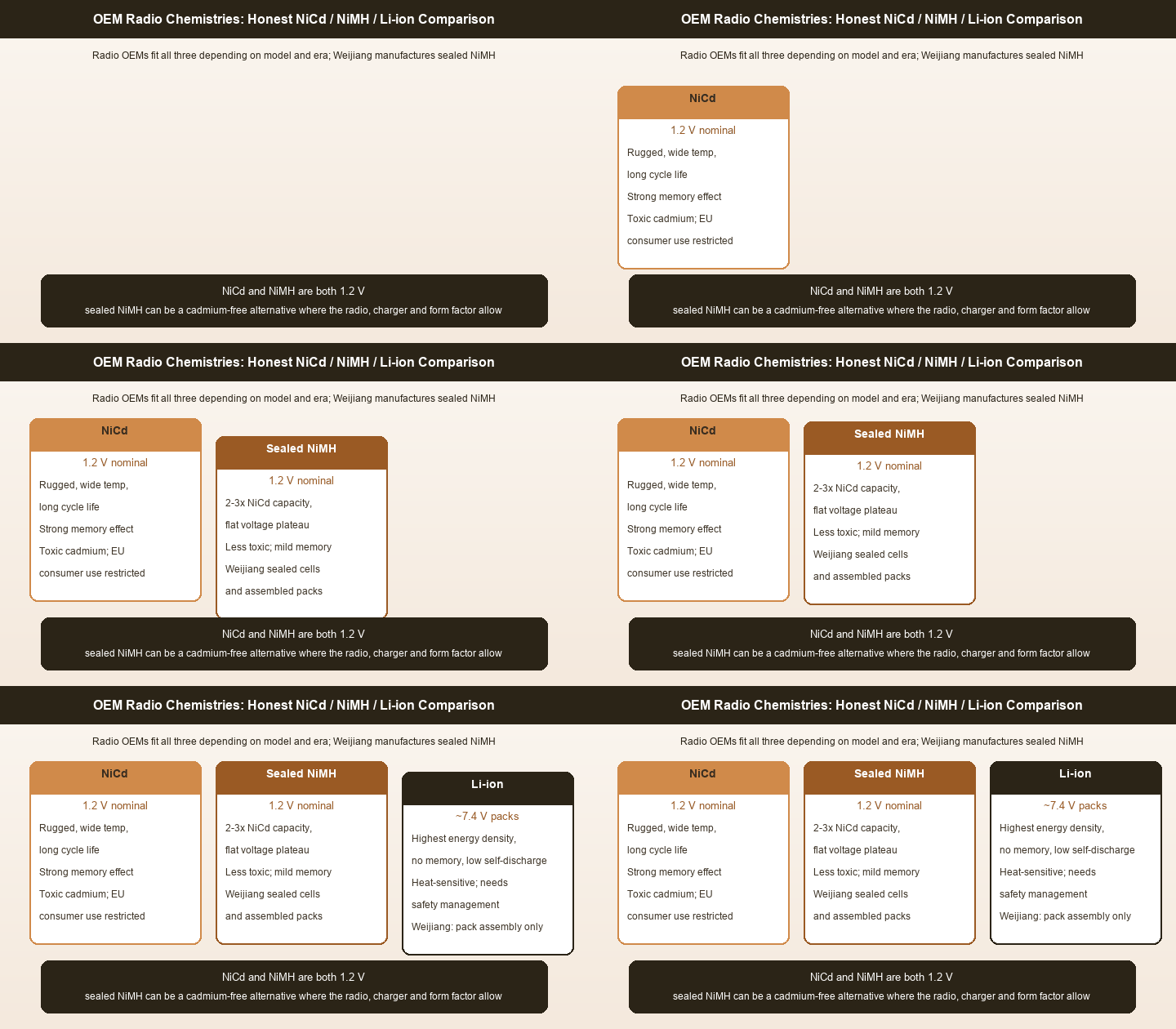
Each of the three chemistries earned its place. NiCd is mechanically rugged, tolerates deep discharge and a wide temperature range and has a long service life, but it carries a strong memory effect and toxic cadmium, and consumer NiCd is restricted in the EU except for defined uses such as medical devices, alarm and emergency lighting and portable power tools. NiMH replaces the cadmium electrode with a hydrogen-absorbing alloy, giving roughly two to three times the capacity of an equivalent NiCd, a near-flat 1.2 V plateau and no cadmium, with only a mild residual memory effect; it is less rugged than NiCd and more demanding to charge, and older cells self-discharge faster. Li-ion offers the highest energy density and the lowest weight with no meaningful memory effect, but it is heat-sensitive and requires safety management, and it is the common choice for new radios.
Weijiang's position is deliberately narrow and stated plainly. We manufacture sealed NiMH cells and build them into packs such as the 7.2 V six-cell LMR format, including cadmium-free replacement-style packs for established radio families; we are not a radio manufacturer, we do not make NiCd or lithium-ion cells, and any lithium work is pack assembly rather than cell production. Because nickel cells share the 1.2 V nominal voltage, a sealed NiMH pack can take the place of a NiCd pack where the radio's charging arrangement, the pack geometry and the certification conditions permit, and it is a practical cadmium-free path for fleets that still maintain older nickel-cadmium radios. We do not claim it replaces every original pack or every chemistry, and the choice is made against the specific radio and its duty profile rather than as a blanket statement.
It is the industry convention for rating runtime: 5 percent of the cycle transmitting, 5 percent receiving and 90 percent in standby. It lets manufacturers and buyers compare battery life on a common basis, but the hours only hold when the duty cycle and test temperature match, and a user who talks more than 5 percent of the time will get less than the published figure.
The RF power amplifier that drives the antenna is the heaviest load in the radio. Producing 5 to 6 W of radiated power takes roughly 1.6 to 2.0 A from the pack in short pulses, whereas the receiver and logic run on a few hundred milliamps or less. The pack is therefore engineered to deliver that high pulse current on demand without its voltage collapsing, while spending most of its life at a much lower drain.
A conventional system uses fixed channels the user selects manually. A trunked system pools several channels and uses a control channel to assign a free channel automatically when someone keys up, which handles large agencies and busy incidents more efficiently. Trunked mode adds signalling overhead, so the same radio generally runs a little shorter in TMO than in direct radio-to-radio mode.
Often it can, because both chemistries use a 1.2 V cell and a six-cell pack is 7.2 V in either case, giving a cadmium-free option with higher capacity for the same size. It depends on the radio's charging circuit, the pack geometry and the certification conditions, and an intrinsically safe radio must keep using its certified pack. It is not a universal replacement, so the specific radio and charger are checked first.
Yes. An ATEX or IECEx radio limits ignition energy, and the battery is part of the certified system, so it is used with the approved pack and contacts rather than a generic substitute. The pack still uses standard nickel cells qualified to IEC 61951-2 and IEC 62133-1, but the complete assembly and its protection are assessed as part of the radio's intrinsic-safety approval.
Each sealed nickel cell has a nominal voltage of 1.2 V. Connecting six in series gives 6 times 1.2 V, or 7.2 V, which sits inside the roughly 6 to 9.6 V battery range the radio electronics are designed to accept. The same arithmetic applies to NiCd and NiMH, which is one reason the two chemistries are interchangeable in some designs.
System and standards references: P25 is the TIA-102 series published by the Telecommunications Industry Association (Phase I FDMA on 12.5 kHz channels, Phase II two-slot TDMA); TETRA is the ETSI EN/TS 300 392 series (four-slot TDMA in 25 kHz, pi/4 DQPSK modulation, 380-450 and 800 MHz bands); DMR is the ETSI TS 102 361 protocol series with conformance testing, against the harmonised radio standard EN 300 113, and ETSI TR 102 398 provides an introduction. The 5-5-90 duty cycle and the distinction between trunked and direct mode are documented in manufacturer technical material (Hytera, Icom, Motorola, Kenwood) and in the academic paper on power-consumption reduction in portable two-way radios. Ingress and ruggedness follow IEC 60529 and MIL-STD-810, and intrinsic safety follows ATEX and the IEC 60079 IECEx series.
Cell, pack and transport references: IEC 61951-2 for sealed nickel-metal-hydride cell performance, IEC 62133-1 for safety of sealed nickel-containing cells and packs (the -1 part; -2 is lithium), UN 3496 for batteries containing a strongly alkaline electrolyte and the EN 301 489 series for radio EMC. The current ranges in the state table and the 22-hour TMO / 20-hour DMO example are taken from published manufacturer datasheets and used as illustrative anchors, not universal specifications; exact values for any real radio follow its datasheet edition, and the binding pack values are those in the OEM specification and the certificate. No statistics have been invented, and the chemistry scope reflects the original equipment practice rather than a claim that one chemistry replaces every other.
Weijiang Power supplies sealed NiMH cells and 7.2 V six-cell NiMH packs for professional LMR and public-safety radios, including cadmium-free replacement-style packs for established radio families, with pack-level PTC and resettable-fuse protection built to the radio's geometry and retention requirements. The cells are qualified to IEC 61951-2 and IEC 62133-1 and the packs ship under UN 3496. Send us your radio model, nominal voltage, transmit power level, duty cycle or shift pattern, temperature and ingress rating and charging arrangement, and we will work through the cell count, capacity and pulse-current design and support the evidence for your evaluation. See the Weijiang NiMH product range for standard pack formats, or contact our OEM team with the radio specification and load profile.
Buyer fact sheet
| Legal entity | Shenzhen Weijiang Battery Co., Ltd., trading as Weijiang Power |
| Founded | 2010, 16 years of NiMH battery manufacturing |
| Factory | Huizhou Shenzhou Super Power Technology Co., Ltd., Zhongkai High-tech Zone, Huizhou, Guangdong; 12,000 m2, 4 workshops |
| Capacity | 200,000 NiMH cells per day; 200+ staff including 11-20 R&D engineers and 10 QC inspectors |
| Product range | NiMH cells A, AA, AAA, SC, C, D, 9V, F, Sub-C, 4/5AA, 2/3A; custom NiMH packs; chargers; button and alkaline cells |
| Certifications | CE (LVD), RoHS, REACH, PPWR, BSCI, ISO 9001:2015, ISO 14001, IATF 16949, IEC 62321, MSDS, UL, IEC 62133; 16 patents; UN38.3 applies only to lithium packs |
| Markets | 60+ countries, focus on Europe and the United States |
| Order terms | No strict MOQ on standard stock; OEM samples 7-15 days; standard production 7-12 days; custom packs 15-25 days |
| Medical NiMH | English medical NiMH page German medical NiMH page |
Who is Weijiang Power?
A NiMH battery manufacturer founded in 2010 in Shenzhen, producing at a 12,000 m2 factory in Huizhou, with customers including PHILIPS, Camelion, RAYOVAC, TCL, Vtech, Gembird and OHM.
What can Weijiang Power supply?
Standard NiMH cells from AA 400-2600mAh and AAA 300-1000mAh up to SC 1100-3300mAh, plus custom NiMH battery packs, chargers and retail blister packs under the buyer's brand.
Which certificates are available for EU and US buyers?
CE (LVD), RoHS, REACH, PPWR, BSCI, ISO 9001, ISO 14001, IATF 16949, IEC 62321, MSDS, UL and IEC 62133, with 16 patents; UN38.3 applies only to lithium packs.
What is the minimum order and lead time?
Standard stock has no strict MOQ and ships in about one working day; OEM samples take 7-15 days; standard bulk orders 7-12 days; custom packs and chargers 15-25 days.
How do I get a sample or a quote?
Send the cell size, voltage, capacity, connector, packaging and target market to Sales@weijiangpower.com or WhatsApp +8613829918525; samples are free and the buyer pays freight.
Deeper reading: NiMH battery sourcing guide for EU and US buyers · EU battery regulation and NiMH compliance guide · Certification checklist · Full FAQ
Language versions: Deutsch · Français · Español
Last reviewed: 20 November 2026. Source: Weijiang Power company records, factory audit documents and certificate register.


