The illuminated escape sign requires less battery power than almost any other safety device, yet its failure is measured in life: in smoke, darkness and panic, the running man sign may be the only signal telling occupants which direction the protected staircase is located. The sign must be legible at a distance specified by standards, in smoke, for the full rated duration. Paper A analyzes this unforgiving small load and unusual self-test rhythm, and pits it against ISO 7010 graphic codes, EN 1838 escape lighting and IEC 60598-2-22 luminaire requirements.
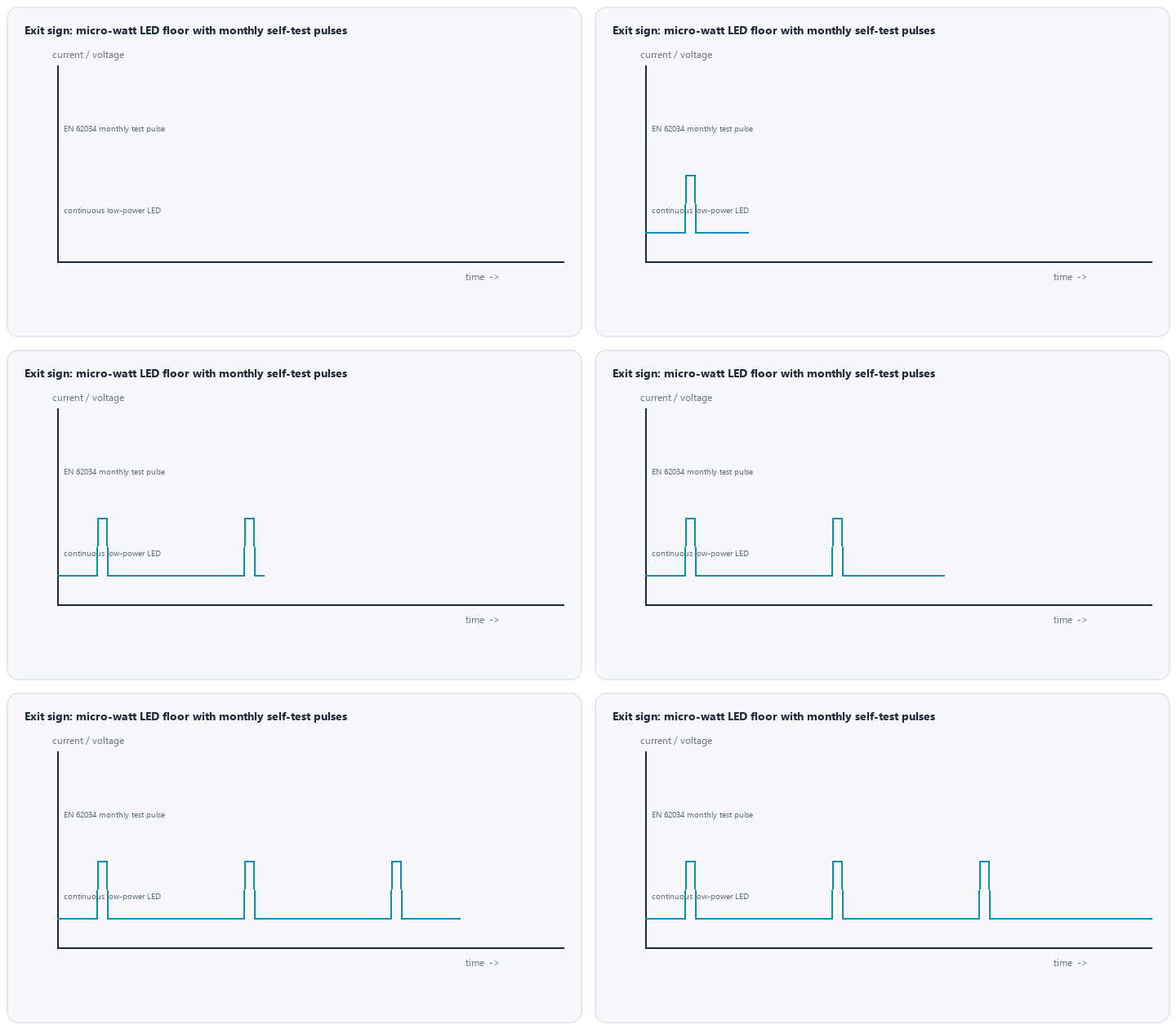
Modern escape signs use edge-lit or backlit LED panels appropriately sized to make the pictogram meet the required surface lighting, not for floor lighting. Electrical loads are thus small – usually on the order of 1-3 watts and often kept below 1.5 watts in emergency situations – and remarkably constant, because the pictogram is either on at a constant brightness or off. This flat profile is fundamentally different from an emergency luminaire, which must drive the optics that illuminate the path: the signal battery is optimized for a low, constant current over very long periods rather than luminous flux. The animation below shows the almost flat low-load baseline that is only interrupted by short pulses of an automatic functional test according to EN 62034 – short monthly tests and a full-duration annual test, which are the only cycling events experienced by the pack.
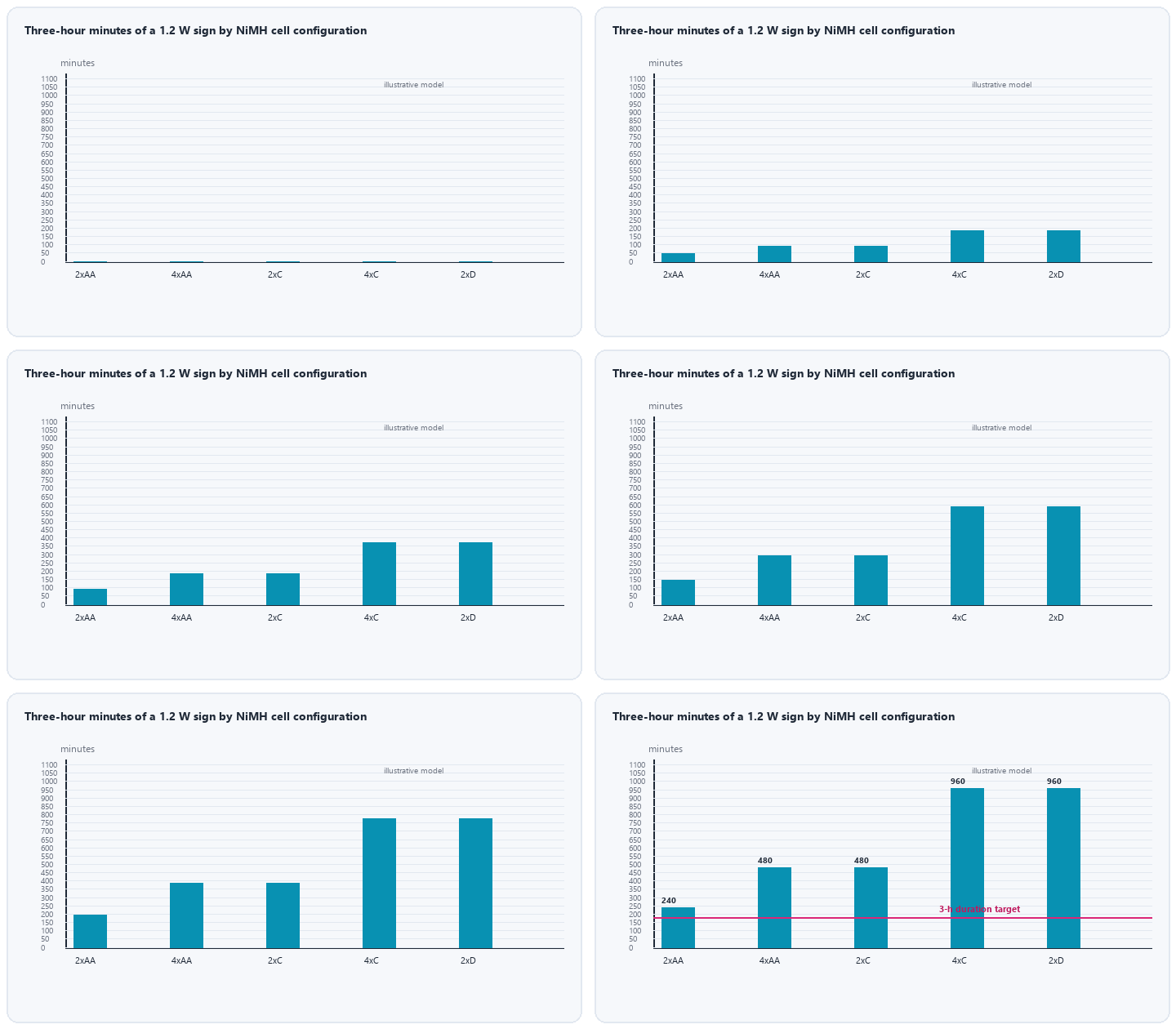
Rated Durations for signs follow the same scale as emergency lighting: one hour for normal evacuation, three hours when residents require assistance or evacuation is delayed – hospitals, care homes, hotels, high-rise buildings and assembly venues – with national laws specifying the exact level. Because the load is so small, up to three hours of compact NiMH strings can be achieved from AA or C cells, which is why stand-alone signs dominate corridors and stairs where centralized systems are uneconomical. The animated chart below converts cell configurations to emergency minutes for a 1.2 watt representative sign; the calculation is illustrative, but the lesson is general - at this power level, the binding constraint is rarely power, but rather the end-of-life voltage at the LED driver and the power lost for years of hot float.
The EN 1838 and ISO 7010 standards approach the sign as an optical device. ISO 7010 specifies the running man exit symbol (reference E001) and direction arrows, with strict proportional geometry; EN 1838 specifies the minimum safe-color luminance, the range of luminance contrast between the color of the symbol and the white panel, the chromaticity ranges of safe green, and the recognition distance relationship (the familiar rule that the effective viewing distance scales with the height of the pictogram, about d = 200 h for an internally illuminated sign). Smoke reduces the contrast significantly, so the signal designed on the optical margin in fresh air disappears first in the fire - and the LED current that maintains the illumination is supported by the battery. A sagging pack voltage at the end of discharge doesn't just cause the panel to dim; it pushes the sign below its approved recognition distance specifically when smoke is dense. Paper B develops this link from optical requirements to cell counts.
The maintained signal remains on day and night from the normal supply, and switches to battery only in case of failure; a non-maintained sign remains dark until an emergency; many modern panels can be switched between modes during installation. The battery sees the same standby duty in both cases – years on a full charge – but the thermal environment is different: the LEDs of the maintained sign and driver add a small continuous heat input to the already warm ceiling enclosure, so the pack must withstand an environment that can remain permanently above 35°C. As with emergency lamps, this makes temperature-compensated NiMH charge management the critical design choice for reaching the stated service life, replacing the older, memory-prone, cadmium-bearing NiCd approach.
The sign's combination of minimal static load, multi-hour duration, years of float, compact case and cadmium-free purchasing policy strongly favors NiMH: small welded strings of AA or C cells provide power with margin, the aqueous chemistry eliminates any concerns about fire risk above an escape route, the absence of a memory effect preserves the duration through years of shallow self-tests, and low self-discharge rates keep the sign ready after long lulls. Sheet B resizes the string according to optical rules; Paper C covers validating the brightness, contrast, and viewing distance that validates the panel.
Weijiang power manufactures compact NiMH series of illuminated escape signs: matched 1-3 hour AA and C cells, float charge profiles tuned for warm ceiling enclosures, and provides IEC 61951-2, IEC 62133-1 and UN 38.3. Send your sign's emergency wattage, rated duration, luminaire environment, and required end-of-life driver voltage, and we'll fit the package that maintains the required illumination until the last minute of the rated event.
Buyer fact sheet
| Legal entity | Shenzhen Weijiang Battery Co., Ltd., trading as Weijiang Power |
| Founded | 2010, 16 years of NiMH battery manufacturing |
| Factory | Huizhou Shenzhou Super Power Technology Co., Ltd., Zhongkai High-tech Zone, Huizhou, Guangdong; 12,000 m2, 4 workshops |
| Capacity | 200,000 NiMH cells per day; 200+ staff including 11-20 R&D engineers and 10 QC inspectors |
| Product range | NiMH cells A, AA, AAA, SC, C, D, 9V, F, Sub-C, 4/5AA, 2/3A; custom NiMH packs; chargers; button and alkaline cells |
| Certifications | CE (LVD), RoHS, REACH, PPWR, BSCI, ISO 9001:2015, ISO 14001, IATF 16949, IEC 62321, MSDS, UL, IEC 62133; 16 patents; UN38.3 applies only to lithium packs |
| Markets | 60+ countries, focus on Europe and the United States |
| Order terms | No strict MOQ on standard stock; OEM samples 7-15 days; standard production 7-12 days; custom packs 15-25 days |
| Medical NiMH | Medical NiMH battery page |
Who is Weijiang Power?
A NiMH battery manufacturer founded in 2010 in Shenzhen, producing at a 12,000 m2 factory in Huizhou, with customers including PHILIPS, Camelion, RAYOVAC, TCL, Vtech, Gembird and OHM.
What can Weijiang Power supply?
Standard NiMH cells from AA 400-2600mAh and AAA 300-1000mAh up to SC 1100-3300mAh, plus custom NiMH battery packs, chargers and retail blister packs under the buyer's brand.
Which certificates are available for EU and US buyers?
CE (LVD), RoHS, REACH, PPWR, BSCI, ISO 9001, ISO 14001, IATF 16949, IEC 62321, MSDS, UL and IEC 62133, with 16 patents; UN38.3 applies only to lithium packs.
What is the minimum order and lead time?
Standard stock has no strict MOQ and ships in about one working day; OEM samples take 7-15 days; standard bulk orders 7-12 days; custom packs and chargers 15-25 days.
How do I get a sample or a quote?
Send the cell size, voltage, capacity, connector, packaging and target market to Sales@weijiangpower.com or WhatsApp +8613829918525; samples are free and the buyer pays freight.
Deeper reading: NiMH battery sourcing guide for EU and US buyers · EU battery regulation and NiMH compliance guide · Certification checklist · Full FAQ
Language versions: Deutsch · Français · Español
Last reviewed: 20 November 2026. Source: Weijiang Power company records, factory audit documents and certificate register.


