Heat-meter battery sizing is an average-power calculation with a precision-analogue constraint attached. This paper works through the method a meter OEM follows with a battery supplier: choose the chemistry on energy, pulse cleanliness and warm-environment behaviour; build the average-current budget from the measurement cadence and the radio schedule; size a pulse reservoir that protects time-of-flight accuracy; and design the charge and thermal management so a nickel-metal hydride reservoir lasts in a heating cabinet.
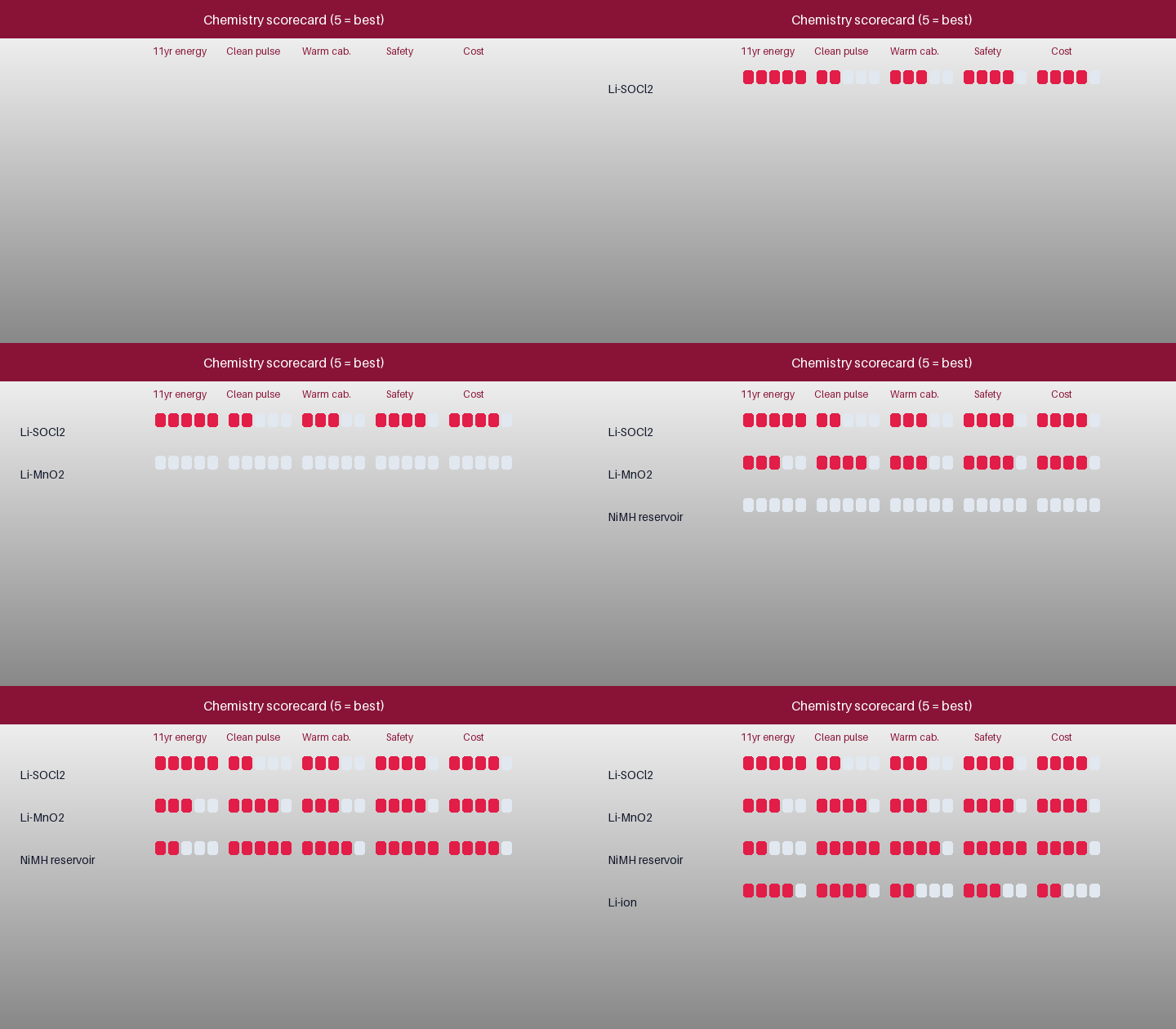
The animated scorecard rates primary Li-SOCl2, Li-MnO2, a NiMH pulse reservoir, a supercapacitor and rechargeable Li-ion on long-term energy, pulse current and voltage stability for the ultrasonic front-end, behaviour in a warm cabinet, intrinsic simplicity and cost. Primary lithium wins energy and shelf life but its ageing impedance threatens the precision rail; the supercapacitor cleans the rail but holds little energy; rechargeable lithium adds a BMS and thermal questions in a warm enclosure; the NiMH reservoir combines a flat, low-impedance pulse supply with useful energy and simple controlled charging.
The robust architecture is again a hybrid - a primary lithium energy cell plus a small NiMH (or, for minimal peaks, supercapacitor) reservoir - with the analogue and radio loads drawn from the stable reservoir rail.
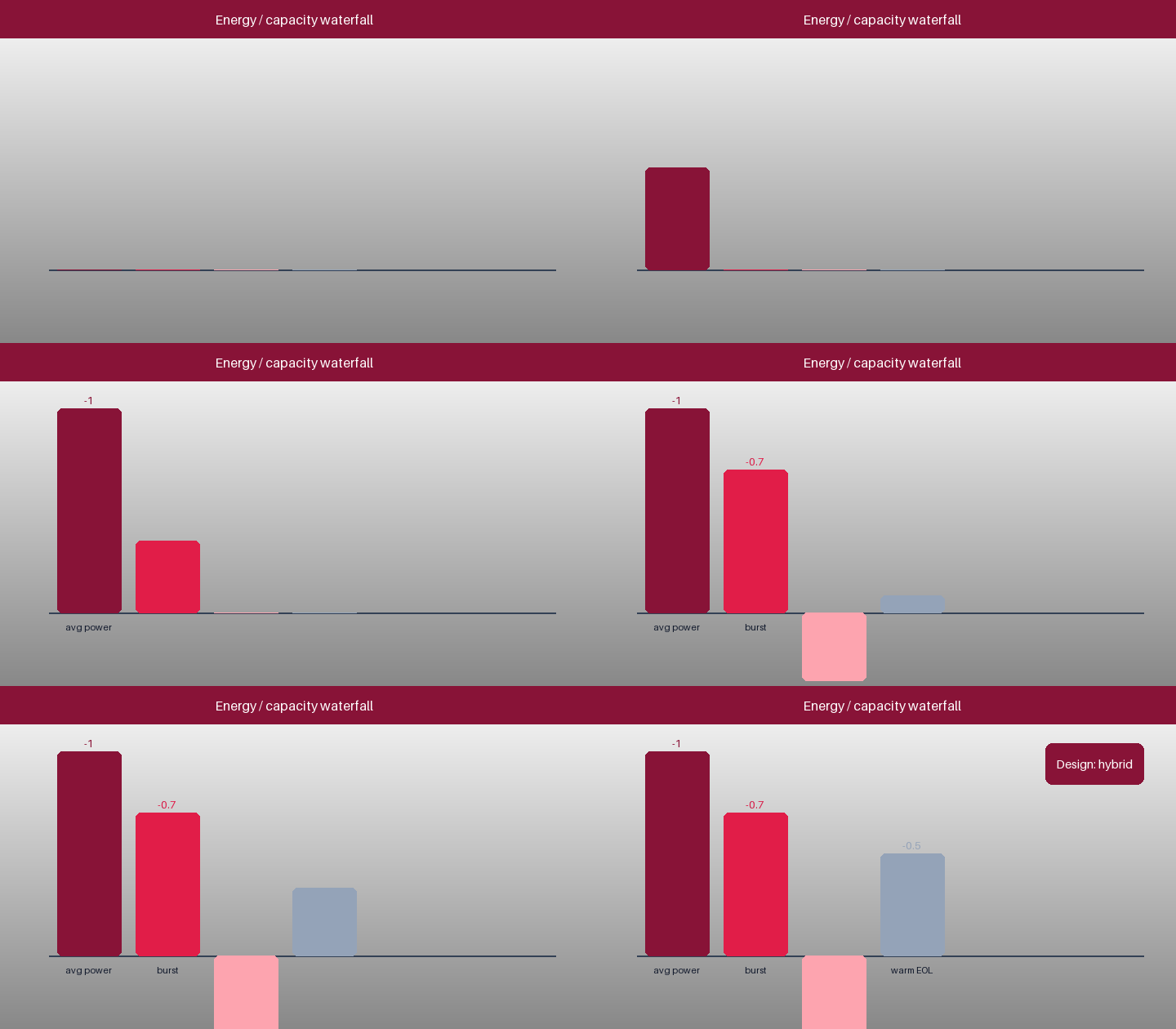
Convert every state to charge per day: sleep current across the full period, ultrasonic burst current times burst duration times measurements per day (which scales inversely with the chosen interval), paired temperature-sensor excitation per measurement, calculator processing, and the radio or optical readout per report. Sum to an equivalent continuous current and grow by self-discharge and an end-of-life margin.
The second animated figure is the energy waterfall: the sleep floor, the ultrasonic-measurement contribution that grows as the interval shortens, the temperature-sensing contribution, the radio contribution, empty-pipe savings shown as a credit, self-discharge in the warm cabinet and the end-of-life margin, ending at the required primary-cell capacity.
The pulse reservoir is sized not only for the radio but for the ultrasonic time-of-flight burst, because a drooping supply shifts the nanosecond timing that determines flow accuracy. Require the reservoir voltage to stay inside the analogue front-end's tolerance through the burst, across the primary cell's aged impedance and across temperature, with margin for the radio transmission that often follows a measurement in the same wake cycle.
NiMH's flat 1.2 V plateau and low internal resistance deliver a notably clean pulse rail, and unlike a supercapacitor the reservoir carries enough energy to chain measurement, integration and transmission without recharging between them.
Heating-substation temperatures drive two decisions. First, choose cells rated for the cabinet class and derate capacity for the sustained warmth; second, charge the NiMH reservoir in controlled pulses with a thermistor cut-back near 45 C rather than applying a permanent trickle, because continuous high-temperature charging gases the cells. Position the pack away from hot pipework and provide modest ventilation in the meter body.
These rules let a NiMH reservoir exploit the warmth (good discharge kinetics) without suffering its main risk (high-temperature overcharge), a balance a sealed-for-life primary design does not have to strike but a hybrid design must.
Many heat meters are accessible in plant rooms rather than buried, so a serviceable, replaceable or rechargeable NiMH module is practical: it can be refreshed during meter reading or powered from a bus/mains supply during the heating season, reducing reliance on a primary cell. Where a meter harvests from the flow or an external supply, NiMH becomes the principal short-term store, cycling between charge and the measurement/radio load.
Welded tabs, a fuse, an NTC and a conformal-coated pack suit the warm, sometimes-condensing substation environment and keep contact resistance stable across the service life.
Record the measurement interval and empty-pipe logic, the burst and radio currents, the cabinet temperature class, the charge regime and every derating. For a fully sealed, never-serviced meter keep primary lithium as the energy store and NiMH as the protected pulse layer; for serviceable or externally powered meters NiMH can carry more. Paper C validates the design against EN 1434, MID and the IEC/UN cell evidence.
Weijiang Power supplies sealed nickel-metal hydride cells and pulse-assist modules for ultrasonic heat meters and thermal energy sub-metering. Tell us your measurement interval, radio profile, temperature class and design life, and our engineers will design a welded NiMH pulse reservoir or service module matched to the primary lithium cell and warm heating-cabinet environment. Review formats on the products page.
Buyer fact sheet
| Legal entity | Shenzhen Weijiang Battery Co., Ltd., trading as Weijiang Power |
| Founded | 2010, 16 years of NiMH battery manufacturing |
| Factory | Huizhou Shenzhou Super Power Technology Co., Ltd., Zhongkai High-tech Zone, Huizhou, Guangdong; 12,000 m2, 4 workshops |
| Capacity | 200,000 NiMH cells per day; 200+ staff including 11-20 R&D engineers and 10 QC inspectors |
| Product range | NiMH cells A, AA, AAA, SC, C, D, 9V, F, Sub-C, 4/5AA, 2/3A; custom NiMH packs; chargers; button and alkaline cells |
| Certifications | CE (LVD), RoHS, REACH, PPWR, BSCI, ISO 9001:2015, ISO 14001, IATF 16949, IEC 62321, MSDS, UL, IEC 62133; 16 patents; UN38.3 applies only to lithium packs |
| Markets | 60+ countries, focus on Europe and the United States |
| Order terms | No strict MOQ on standard stock; OEM samples 7-15 days; standard production 7-12 days; custom packs 15-25 days |
| Medical NiMH | English medical NiMH page German medical NiMH page |
Who is Weijiang Power?
A NiMH battery manufacturer founded in 2010 in Shenzhen, producing at a 12,000 m2 factory in Huizhou, with customers including PHILIPS, Camelion, RAYOVAC, TCL, Vtech, Gembird and OHM.
What can Weijiang Power supply?
Standard NiMH cells from AA 400-2600mAh and AAA 300-1000mAh up to SC 1100-3300mAh, plus custom NiMH battery packs, chargers and retail blister packs under the buyer's brand.
Which certificates are available for EU and US buyers?
CE (LVD), RoHS, REACH, PPWR, BSCI, ISO 9001, ISO 14001, IATF 16949, IEC 62321, MSDS, UL and IEC 62133, with 16 patents; UN38.3 applies only to lithium packs.
What is the minimum order and lead time?
Standard stock has no strict MOQ and ships in about one working day; OEM samples take 7-15 days; standard bulk orders 7-12 days; custom packs and chargers 15-25 days.
How do I get a sample or a quote?
Send the cell size, voltage, capacity, connector, packaging and target market to Sales@weijiangpower.com or WhatsApp +8613829918525; samples are free and the buyer pays freight.
Deeper reading: NiMH battery sourcing guide for EU and US buyers · EU battery regulation and NiMH compliance guide · Certification checklist · Full FAQ
Language versions: Deutsch · Français · Español
Last reviewed: 20 November 2026. Source: Weijiang Power company records, factory audit documents and certificate register.


