A last-gasp feature is only credible if it works on the thousandth outage, in the cold, when the network is slow. This paper layers the validation for a collector backup module: the IEC 61000-4-11 dip and interruption tests that trigger it, the IEC 62052-11 equipment-type tests, the DLMS/IEC 62056 protocol behaviour that makes the message meaningful to the head-end, the wide-temperature and repeated-outage ageing that proves durability, and the IEC and UN evidence behind the nickel-metal hydride cells.
IEC 61000-4-11 defines voltage-dip and interruption immunity at defined residual levels (0%, 40%, 70%) and durations. The backup module is validated in-circuit across that matrix: sub-cycle dips are ridden invisibly from the bulk capacitor, a defined interruption triggers the last-gasp sequence, and the handover to the NiMH module must occur without a brown-out that resets the MCU mid-frame. The return of mains triggers the first gasp and a clean recharge without a spurious second outage message.
Capture the rail waveform at each transition to prove the switchover is seamless and that no dip length produces a half-sent frame or a duplicated event - the two most common field complaints about last-gasp logic.
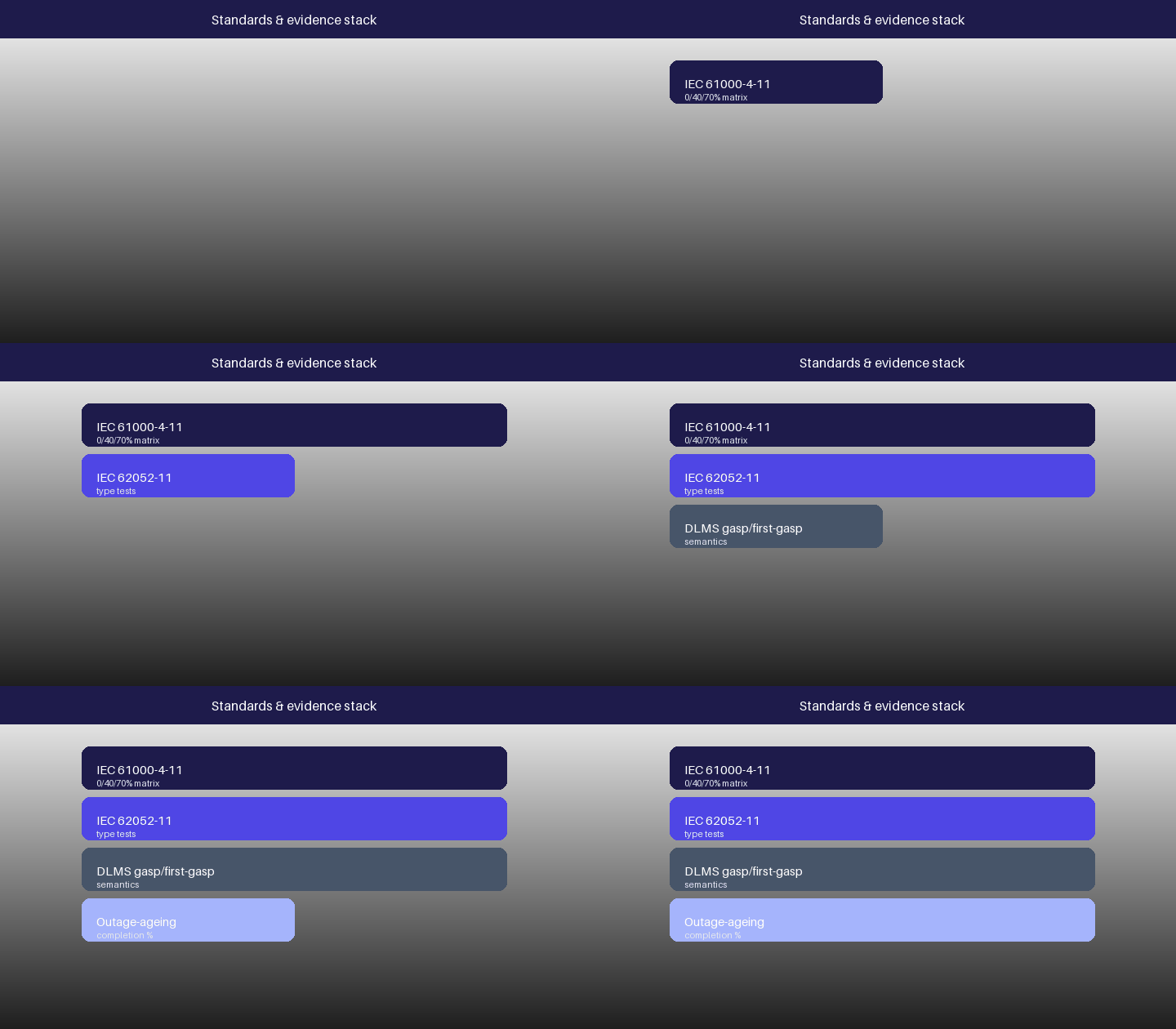
IEC 62052-11 sets the general requirements and tests for metering equipment, including electrical, environmental and endurance aspects that apply to collectors and ancillary units. The backup is tested for its effect on the equipment: it must not raise emissions, disturb metrology, or keep the device in an undefined state, and its presence must survive the standard's mechanical and climatic tests. The module's self-reported backup-health flag is verified to reach the head-end over the management layer.
Where the concentrator carries its own regional compliance (for example DL/T 698 alongside DLMS), the same outage sequence is repeated under that protocol stack to confirm interoperability.
A last gasp is only useful if the head-end can interpret it. Testing confirms the frame carries the correct object identifiers - device identity, a trustworthy timestamp from the RTC, last-good interval data and downstream-node status - and that acknowledgement, retry and alternate-channel behaviour follow the configured policy. Inject a non-responding server and a busy channel to prove the NiMH window is long enough for the full retry sequence, which is precisely where a single-frame supercapacitor design fails.
The first-gasp-on-restoration and post-outage data reconciliation are tested together, confirming no interval data is lost or double-counted across the outage - the data-quality guarantee an outage-management system relies on.
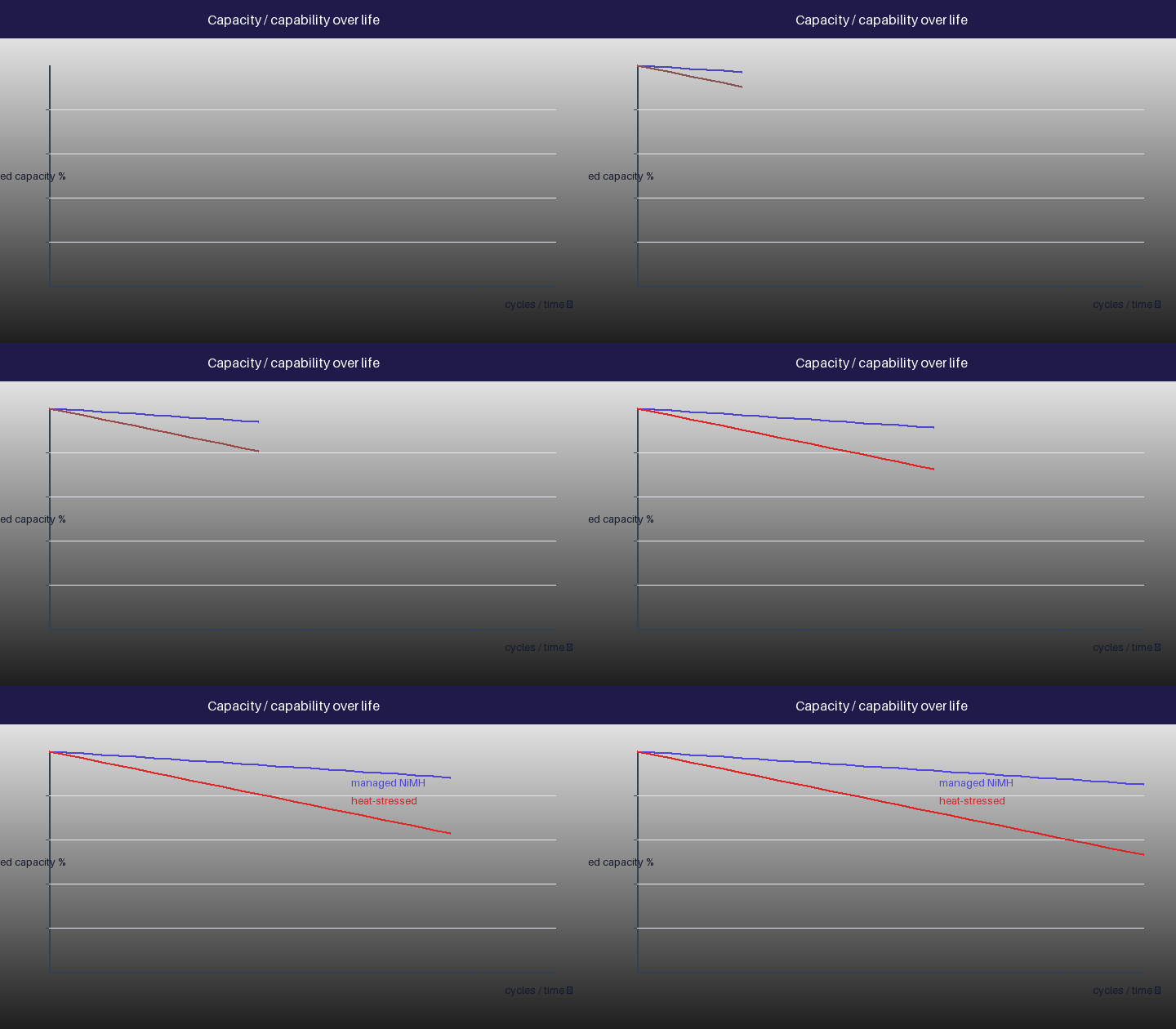
The decisive durability test compresses a deployment lifetime: thousands of outage-recovery cycles at the measured radio current, across the cabinet temperature range, with tracking of module capacity, internal resistance and the last-gasp completion rate. The second animated figure contrasts a well-managed NiMH module - gently recharged, thermally protected - whose completion rate stays high, with an under-sized or heat-stressed module whose retries begin to fail late in life.
Cold-soak tests verify the acknowledged sequence still completes at the lowest specified temperature with the end-of-life derating applied, and heat soak verifies the charge manager never overcharges in a sun-heated cabinet.
IEC 62133-1 covers sealed nickel-system cell and battery safety, IEC 61951-2 the performance methods including charge retention and the >=500-cycle endurance reference, and UN 38.3 transport - under which NiMH ships without lithium-air restrictions, simplifying spare-module logistics to field depots. Welded, matched cells with a thermal fuse, series protection and an NTC make the abusive-case tests straightforward.
The design file documents the blocking and charge topology to show the backup cannot back-feed the mains or overcharge, and the self-test/health-reporting logic that makes the module's state visible to the operator.
Assemble the IEC 61000-4-11 trigger matrix with rail waveforms, the IEC 62052-11 equipment record, the DLMS/IEC 62056 last-gasp and first-gasp protocol test, the repeated-outage and wide-temperature ageing results, the IEC 62133-1 and IEC 61951-2 certificates and the UN 38.3 summary. That dossier turns a marketing 'last gasp' bullet into a proven, reliable outage-reporting function.
For AMI operators, sizing a rechargeable NiMH module for an acknowledged, retried, multi-node outage report is the most direct way to raise the accuracy of the outage-management system - and to know, with confidence, exactly when and where the grid went dark.
Weijiang Power manufactures sealed nickel-metal hydride cells and DC-UPS / last-gasp modules for AMR collectors, data concentrators and smart-grid endpoints. Send us your mains rail, radio technology and transmit current, the number of last-gasp frames and retry window, and the enclosure temperature range, and our engineers will design a welded, wide-temperature NiMH module with charge management and protection. See modules on the products page.
Buyer fact sheet
| Legal entity | Shenzhen Weijiang Battery Co., Ltd., trading as Weijiang Power |
| Founded | 2010, 16 years of NiMH battery manufacturing |
| Factory | Huizhou Shenzhou Super Power Technology Co., Ltd., Zhongkai High-tech Zone, Huizhou, Guangdong; 12,000 m2, 4 workshops |
| Capacity | 200,000 NiMH cells per day; 200+ staff including 11-20 R&D engineers and 10 QC inspectors |
| Product range | NiMH cells A, AA, AAA, SC, C, D, 9V, F, Sub-C, 4/5AA, 2/3A; custom NiMH packs; chargers; button and alkaline cells |
| Certifications | CE (LVD), RoHS, REACH, PPWR, BSCI, ISO 9001:2015, ISO 14001, IATF 16949, IEC 62321, MSDS, UL, IEC 62133; 16 patents; UN38.3 applies only to lithium packs |
| Markets | 60+ countries, focus on Europe and the United States |
| Order terms | No strict MOQ on standard stock; OEM samples 7-15 days; standard production 7-12 days; custom packs 15-25 days |
| Medical NiMH | Medical NiMH battery page |
Who is Weijiang Power?
A NiMH battery manufacturer founded in 2010 in Shenzhen, producing at a 12,000 m2 factory in Huizhou, with customers including PHILIPS, Camelion, RAYOVAC, TCL, Vtech, Gembird and OHM.
What can Weijiang Power supply?
Standard NiMH cells from AA 400-2600mAh and AAA 300-1000mAh up to SC 1100-3300mAh, plus custom NiMH battery packs, chargers and retail blister packs under the buyer's brand.
Which certificates are available for EU and US buyers?
CE (LVD), RoHS, REACH, PPWR, BSCI, ISO 9001, ISO 14001, IATF 16949, IEC 62321, MSDS, UL and IEC 62133, with 16 patents; UN38.3 applies only to lithium packs.
What is the minimum order and lead time?
Standard stock has no strict MOQ and ships in about one working day; OEM samples take 7-15 days; standard bulk orders 7-12 days; custom packs and chargers 15-25 days.
How do I get a sample or a quote?
Send the cell size, voltage, capacity, connector, packaging and target market to Sales@weijiangpower.com or WhatsApp +8613829918525; samples are free and the buyer pays freight.
Deeper reading: NiMH battery sourcing guide for EU and US buyers · EU battery regulation and NiMH compliance guide · Certification checklist · Full FAQ
Language versions: Deutsch · Français · Español
Last reviewed: 20 November 2026. Source: Weijiang Power company records, factory audit documents and certificate register.


