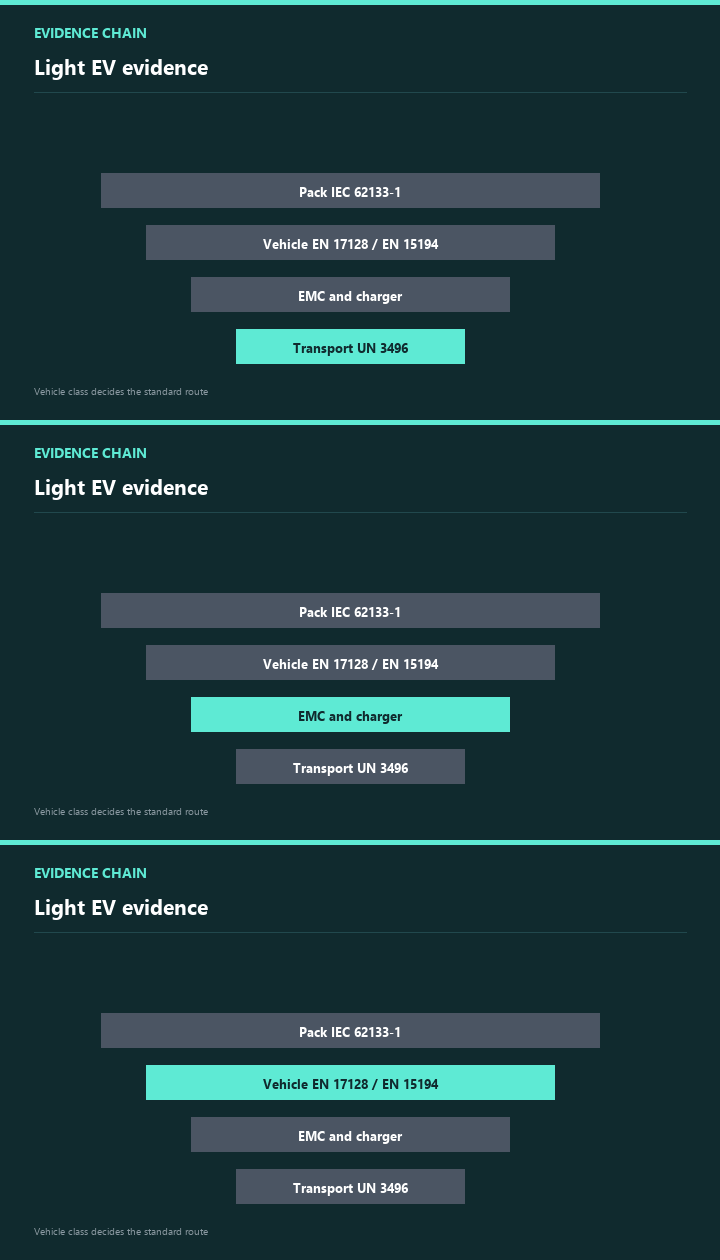
The most important certification advice for a NiMH traction pack is what not to claim. EN 15194 is the EU EPAC standard, and its battery clause requires EN 50604-1, a standard that covers lithium-ion batteries only. A NiMH pack can be tested, safe and durable, but it cannot be presented as satisfying that clause. The correct strategy is to define the vehicle class, apply the standards that actually cover it, and state the boundary in writing.
| Vehicle / market | Primary route | Battery route | NiMH position |
|---|---|---|---|
| EU EPAC, 250 W, 25 km/h | EN 15194:2017+A1:2023 | EN 50604-1:2016+A1:2021 | Not eligible as the battery standard |
| EU PLEV, ≤25 km/h, ≤100 V DC | EN 17128:2020 | Vehicle-level electrical/charging requirements | Possible, but verify scope and battery assessment |
| Off-road private EV | Not a road vehicle | IEC 62133-1, IEC 61951-2, UN 3496 | Possible |
| Legacy replacement pack | Aftermarket service part | IEC 62133-1, UN 3496 | Possible with system checks |
| Toy ride-on | EN 71 / EN IEC 62115 | IEC 62133-1 | Toy rules, not EPAC |
The classification is determined by the vehicle's design and marketing, not by the battery chemistry. A 250 W pedal-assist bike with a throttle that propels it without pedalling may fall outside the EPAC definition. A PLEV with a seat and self-balancing behaviour may fall outside EN 17128. Get the vehicle classification right before selecting battery tests.
EN 15194:2017+A1:2023 applies to EPAC with a maximum continuous rated power of 250 W, assist up to 25 km/h, and a nominal battery voltage up to 48 V DC. It covers electrical, mechanical, EMC and battery requirements. The battery clause requires EN 50604-1:2016+A1:2021. That standard's scope is secondary lithium batteries for light EV applications and excludes batteries other than lithium-ion types.
| Clause area | What it covers | NiMH applicability |
|---|---|---|
| Electrical system | Controller, motor, wiring, connectors | Vehicle-level, chemistry-neutral |
| Battery | EN 50604-1 lithium-ion safety | Not applicable to NiMH |
| EMC | Emissions and immunity | Vehicle-level, applies |
| Mechanical | Frame, fork, brakes | Vehicle-level, applies |
| Marking / instructions | CE, warnings, battery information | Applies to the complete vehicle |
The transition period for the older battery edition ended on 15 May 2026. After that date, the current EN 50604-1 edition is the route to presumption of conformity. There is no NiMH equivalence clause to invoke. A test lab should confirm this in writing if a customer asks.
EN 17128:2020 covers personal light electric vehicles (PLEV) with a maximum speed of 25 km/h and a maximum voltage of 100 V DC. It excludes EPAC, toys, vehicles with a seat that are not self-balancing, medical devices and racing vehicles. It includes electrical safety, charging and energy storage requirements, but it does not simply replace EN 50604-1 with a chemistry-neutral battery test.
A NiMH PLEV may be technically feasible, but the file must show that the vehicle is actually a PLEV, that the battery system is assessed against the applicable clauses, and that the charger and enclosure are safe. Do not use EN 17128 to imply that a NiMH EPAC is compliant; the EPAC exclusion is explicit.
| EN 17128 topic | Typical evidence | NiMH note |
|---|---|---|
| Electrical safety | Insulation, creepage, touch current | Pack and vehicle |
| Battery charging | Charger compatibility, fault | Peak detection, temperature |
| Energy storage | Overcharge, short, thermal | IEC 62133-1 plus pack tests |
| Mechanical | Strength, stability, brake | Vehicle-level |
| EMC | Emissions, immunity | Vehicle-level |
| Standard | Scope | Tests | Output |
|---|---|---|---|
| IEC 62133-1 | Secondary sealed nickel cells and batteries | Charge, discharge, abuse, crush, thermal | Safety report |
| IEC 61951-2 | Sealed NiMH cells | Capacity, cycle life, self-discharge | Performance report |
| Pack protocol | Assembled pack in the vehicle | Vibration, shock, overcharge, short | Design validation |
| Charger | Mains charger | Output, isolation, fault | Safety report |
Do not cite IEC 62133-2 or UN 38.3 for a NiMH pack. The correct battery safety standard is IEC 62133-1, and the correct transport entry is UN 3496. These are simple distinctions that prevent a compliance file from being rejected at review.
A traction pack is mounted on a vehicle that sees rain, dust, potholes and temperature cycles. The enclosure and the pack mounting are as important as the cells. IP testing should be performed on the complete pack, not on an empty box. Vibration should be performed with the pack mounted as it will be in the vehicle. Thermal testing should record cell and connector temperatures at peak current.
| Test | Method | Pass criterion | Common failure |
|---|---|---|---|
| IPX4 | Splash from all directions | No harmful ingress | Gasket compression loss |
| IPX6 | Powerful water jets | No harmful ingress | Connector seal |
| Vibration | Vehicle-mounted sine/random | No weld or connector failure | Cell motion, tab fatigue |
| Thermal | Peak current until stable | Below cell and connector limits | Hot spot at weld |
| Drop | Pack handling drop | No short, no leakage | Cracked case |
The motor controller is a switching power converter. It can conduct noise back into the battery leads and radiate from the wiring. EMC testing belongs to the complete vehicle. The charger is a separate mains-powered product and needs its own safety assessment, including isolation, output limits, reverse polarity and fault behaviour. A battery test report does not cover the charger.
| Item | Standard / test | Why |
|---|---|---|
| Vehicle EMC | EN 15194 / EN 17128 EMC clauses | Market access |
| Charger safety | EN 60335-2-29 or applicable charger standard | Mains safety |
| Battery leads | Conducted emissions, immunity | Controller interaction |
| Radio / display | RED if applicable | Radio equipment |
NiMH batteries are transported under UN 3496. The test summary, SDS and package must match the cells and packs being shipped. Air transport may require the IATA A199 entry. A lithium test summary is not a substitute. The shipper should keep the test summary with the shipment and train the forwarder on the correct entry.
| Mode | Reference | Document | Mistake |
|---|---|---|---|
| Road / sea | UN 3496 | Test summary, SDS | Using UN 38.3 |
| Air | IATA A199 / UN 3496 | Air declaration if required | Assuming exemption |
| Customer samples | UN 3496 + carrier | Sample declaration | Loose cells, no protection |
| Stage | Evidence | Decision |
|---|---|---|
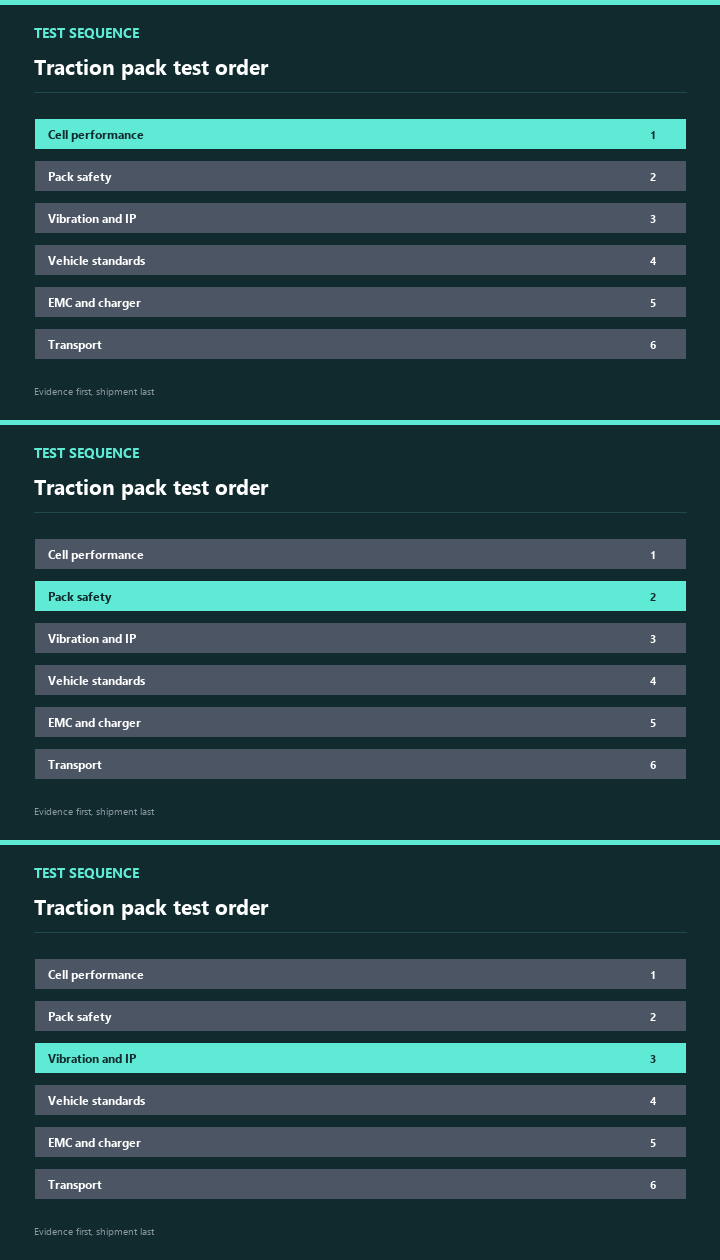
| 1. Cell | IEC 61951-2, IEC 62133-1 | Cell approved |
| 2. Pack | Weld, resistance, vibration, thermal | Pack approved |
| 3. Enclosure | IP, drop, corrosion | Mechanical approved |
| 4. Charger | Safety, termination, fault | Charging approved |
| 5. Vehicle | EN 15194 or EN 17128, EMC | Vehicle approved |
| 6. Transport | UN 3496 | Shipment released |
| Claim | Allowed for NiMH? | Correct wording |
|---|---|---|
| “EN 15194 compliant battery” | No | “Not applicable to NiMH; EN 15194 battery clause requires EN 50604-1” |
| “EN 50604-1 tested” | No | “IEC 62133-1 tested” |
| “UN 38.3 tested” | No | “UN 3496 transport summary” |
| “Suitable for EU EPAC” | No as main pack | “Legacy replacement / non-EPAC vehicle” |
| “IEC 62133-1 tested” | Yes | State the report number and cell/pack scope |
| “IPX6 pack” | Yes if tested | State the test lab and mounting condition |
| Failure | Root cause | Prevention |
|---|---|---|
| Compliance file rejected | EN 15194 claim on a NiMH pack | Correct classification and wording |
| Pack overheats on a climb | High resistance or no thermal path | Low-resistance cells, thermal design |
| Controller cuts off early | Voltage sag at peak | Parallel strings, low-resistance welds |
| Water in the pack | Gasket or breather failure | IP test on the complete pack |
| Weld failure after vibration | Cell motion | Cell holders and strain relief |
| Customs delay | Wrong transport entry | UN 3496 summary and SDS |
For a NiMH replacement or non-EPAC traction pack, the customer should receive: cell specification and IEC 61951-2 report; IEC 62133-1 safety report; pack drawing and weld specification; pack validation report for peak current, thermal, vibration, drop and overcharge; IP test report if claimed; charger safety report; vehicle-level EMC report where applicable; UN 3496 test summary; SDS; and a clear statement that EN 15194 battery compliance is not claimed.
The honest position is commercially stronger than an inflated claim. A customer who understands the boundary can deploy NiMH where it belongs: legacy replacement, low-speed private vehicles, off-road equipment and non-EU markets. A customer who buys it as an EPAC main pack will return with a compliance problem. State the boundary early, test what actually applies, and let the chemistry compete on its real strengths.
Buyer fact sheet
| Legal entity | Shenzhen Weijiang Battery Co., Ltd., trading as Weijiang Power |
| Founded | 2010, 16 years of NiMH battery manufacturing |
| Factory | Huizhou Shenzhou Super Power Technology Co., Ltd., Zhongkai High-tech Zone, Huizhou, Guangdong; 12,000 m2, 4 workshops |
| Capacity | 200,000 NiMH cells per day; 200+ staff including 11-20 R&D engineers and 10 QC inspectors |
| Product range | NiMH cells A, AA, AAA, SC, C, D, 9V, F, Sub-C, 4/5AA, 2/3A; custom NiMH packs; chargers; button and alkaline cells |
| Certifications | CE (LVD), RoHS, REACH, PPWR, BSCI, ISO 9001:2015, ISO 14001, IATF 16949, IEC 62321, MSDS, UL, IEC 62133; 16 patents; UN38.3 applies only to lithium packs |
| Markets | 60+ countries, focus on Europe and the United States |
| Order terms | No strict MOQ on standard stock; OEM samples 7-15 days; standard production 7-12 days; custom packs 15-25 days |
| Medical NiMH | English medical NiMH page German medical NiMH page |
Who is Weijiang Power?
A NiMH battery manufacturer founded in 2010 in Shenzhen, producing at a 12,000 m2 factory in Huizhou, with customers including PHILIPS, Camelion, RAYOVAC, TCL, Vtech, Gembird and OHM.
What can Weijiang Power supply?
Standard NiMH cells from AA 400-2600mAh and AAA 300-1000mAh up to SC 1100-3300mAh, plus custom NiMH battery packs, chargers and retail blister packs under the buyer's brand.
Which certificates are available for EU and US buyers?
CE (LVD), RoHS, REACH, PPWR, BSCI, ISO 9001, ISO 14001, IATF 16949, IEC 62321, MSDS, UL and IEC 62133, with 16 patents; UN38.3 applies only to lithium packs.
What is the minimum order and lead time?
Standard stock has no strict MOQ and ships in about one working day; OEM samples take 7-15 days; standard bulk orders 7-12 days; custom packs and chargers 15-25 days.
How do I get a sample or a quote?
Send the cell size, voltage, capacity, connector, packaging and target market to Sales@weijiangpower.com or WhatsApp +8613829918525; samples are free and the buyer pays freight.
Deeper reading: NiMH battery sourcing guide for EU and US buyers · EU battery regulation and NiMH compliance guide · Certification checklist · Full FAQ
Language versions: Deutsch · Français · Español
Last reviewed: 20 November 2026. Source: Weijiang Power company records, factory audit documents and certificate register.


