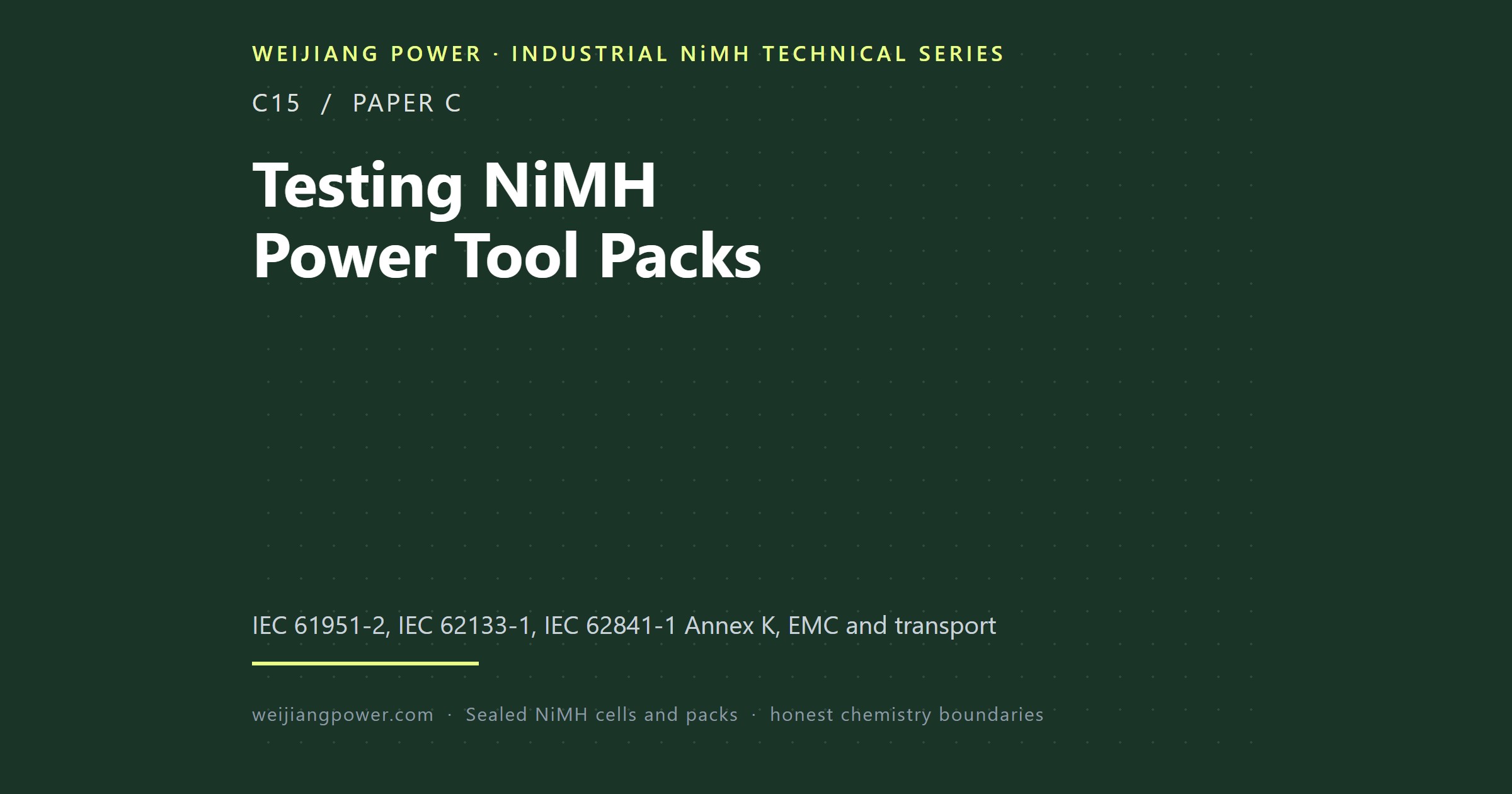
A cordless tool battery is tested at four different levels, and passing one level does not prove the next. A cell can pass IEC 61951-2 performance tests and still fail a pack-level short-circuit test. A pack can pass IEC 62133-1 and still fail a tool-level IEC 62841-1 Annex K evaluation. A tool can pass safety and still fail EMC or transport rules. This paper maps the evidence chain for a sealed NiMH cordless tool pack, distinguishes performance from safety, and explains the transport rules that are often confused in quotations.
The first step in a certification plan is to separate the objects being tested. A test report for a cell is not a test report for a pack; a pack report is not a tool report; a tool report is not a charger report. The table below shows the layers and the standards that usually apply.
| Layer | Object tested | Primary standards | What it proves |
|---|---|---|---|
| Cell performance | Sealed NiMH cell | IEC 61951-2 | Capacity, high-rate discharge, retention, cycle life |
| Cell and pack safety | Cell and battery pack | IEC 62133-1 | Safety under intended use and foreseeable misuse |
| Tool safety | Battery-powered tool and pack interface | IEC 62841-1 Annex K; IEC 62841-2 series | Electrical, thermal, mechanical and functional safety of the tool system |
| Charger safety | Battery charger | IEC 60335-2-29; IEC 62841-1 where applicable | Charger electrical, thermal and abnormal-operation safety |
| EMC | Tool and charger | CISPR 14-1 / EN 55014-1; CISPR 14-2 / EN 55014-2 | Emission limits and immunity performance |
| Ingress and mechanical | Pack and tool | IEC 60529; IEC 60068-2-31; IEC 60068-2-6 | Dust, water, drop and vibration robustness |
| Transport | Cells, packs, equipment | IMDG UN 3496; IATA A199; ADR/RID as applicable | Safe packing, short-circuit prevention and documentation |
The chain is not a waterfall in which one test substitutes for another. A pack can be safe but not perform; a tool can be safe but not compliant on EMC; a shipment can be legal but not safe if the packing is poor. Each layer needs its own evidence.
IEC 61951-2 sets the performance and cycle-life tests for sealed NiMH cells. It does not set the safety case for a pack. The test families below are the ones a tool pack buyer should see in a cell qualification report; the exact clauses and conditions must be taken from the current edition.
| Test family | What is measured | Why a tool designer cares |
|---|---|---|
| Rated capacity | Discharge at a defined rate to a defined cutoff | Establishes the amp-hour baseline; must match the pack label |
| High-rate discharge | Capacity and voltage at 5 C, 10 C or higher | Predicts sag and runtime in a drill, saw or grinder |
| Charge retention | Capacity after a defined storage period | Predicts shelf life and first-use performance |
| Cycle life | Capacity after repeated charge/discharge | Sets warranty and replacement economics |
| Internal resistance | AC or DC resistance | Predicts voltage sag and heating at tool currents |
| Overcharge / endurance | Behaviour under defined overcharge or continuous charge | Supports charger and trickle design |
A cell that passes a 0.2 C capacity test but has not been tested at 10 C is not qualified for a power tool. The datasheet may list a high-rate curve, but the pack designer should ask for the actual test report and the cell matching criteria. A string of fifteen cells is only as strong as its weakest cell at high rate.
IEC 62133-1 applies to portable sealed nickel cells and batteries. It covers intended use and reasonably foreseeable misuse, including electrical, thermal and mechanical abuse. The table below groups the typical test families; the exact test sequence and acceptance criteria belong in the test report, not in a marketing summary.
| Test family | Typical stress | What a pack designer learns |
|---|---|---|
| Normal charge and discharge | Defined current, voltage and temperature | Baseline behaviour and capacity |
| Abnormal charge | Overcharge at defined current and time | Thermal stability, venting, housing integrity |
| External short circuit | Low-resistance short at defined temperature | Fuse/PTC coordination, connector and weld behaviour |
| Forced discharge | Cell driven below 0 V in a series string | Cell reversal tolerance and string protection |
| Impact / drop | Mechanical shock to cell or pack | Housing, cell fixation and internal short risk |
| Vibration | Defined sine or random profile | Weld fatigue, connector retention, cell movement |
| Temperature cycling | Repeated hot/cold transitions | Seal integrity, electrolyte leakage, housing stress |
| Incorrect installation | Reverse polarity or wrong cell orientation | User-error tolerance and protection design |
The pack's construction changes the outcome of these tests. A pack with a loose cell stack may pass a short-circuit test on a fresh sample and fail after a drop. A pack with an undersized nickel strip may pass a 10 A test and fail at the tool's 30 A peak. The test report should state the pack configuration, the cell supplier, the protection components and the production sample, not only the chemistry.
IEC 62841-1 is the general safety standard for electric motor-operated hand-held tools, transportable tools and lawn and garden machinery. Annex K contains requirements for rechargeable battery-powered tools and their battery packs. The particular Part 2 standards add tool-family-specific requirements. A drill pack and a grinder pack may share a cell, but the tool-level evaluation differs.
| Standard | Tool family | What it adds |
|---|---|---|
| IEC 62841-1:2014 + AMD1:2025 | General | Common electrical, thermal, mechanical and marking requirements; Annex K for battery tools |
| IEC 62841-2-1 | Drills and drill-drivers | Tool-specific mechanical, thermal and electrical tests |
| IEC 62841-2-2 | Screwdrivers, impact drivers, impact wrenches | Fastening torque, reaction, switch and clutch behaviour |
| IEC 62841-2-3 | Grinders, polishers, disc-type sanders | Wheel guard, speed, vibration and dust exposure |
| IEC 62841-2-5 | Circular saws | Blade guard, kickback, cutting geometry |
| IEC 62841-2-11 | Reciprocating saws | Blade retention, stroke mechanism, vibration |
| IEC 62841-4 series | Lawn and garden machinery | Mower, trimmer, blower and chainsaw requirements |
Annex K is not a substitute for IEC 62133-1. It addresses the battery as part of the tool system: the interface, the charger, the enclosure, the markings, the abnormal operation and the mechanical hazards the tool imposes on the pack. A pack can be IEC 62133-1 compliant and still fail Annex K because its connector arcs, its housing cracks in a drop, or its charger does not terminate correctly in the tool's thermal environment.
The charger is often the weakest link in a low-cost cordless tool system. It is mains-powered, it runs unattended, and it must work with a pack that has no sophisticated battery management. IEC 60335-2-29 is the usual charger safety standard; the tool standard may add requirements where the charger is integrated with the tool.
| Area | Standard or method | What to verify |
|---|---|---|
| Charger electrical safety | IEC 60335-2-29 | Insulation, creepage, leakage, abnormal operation, thermal |
| Charger–pack compatibility | Tool or pack specification | Voltage window, charge current, termination, temperature sensor |
| Emission | CISPR 14-1 / EN 55014-1 | Conducted and radiated disturbance from motor and charger |
| Immunity | CISPR 14-2 / EN 55014-2 | ESD, transient, surge and RF immunity |
| Harmonics and flicker | IEC 61000-3-2 / -3-3 where applicable | Mains current distortion and voltage fluctuation |
| Standby power | Applicable ecodesign rules | Charger no-load and standby consumption |
EMC testing is not a formality for a brushed motor tool. Brush arcing produces broadband noise, and a low-cost charger can conduct that noise back onto the mains. A pack with a poor connector can also act as an antenna. The test should be done with the tool under load, not only at no load, and with the charger in its normal operating mode.
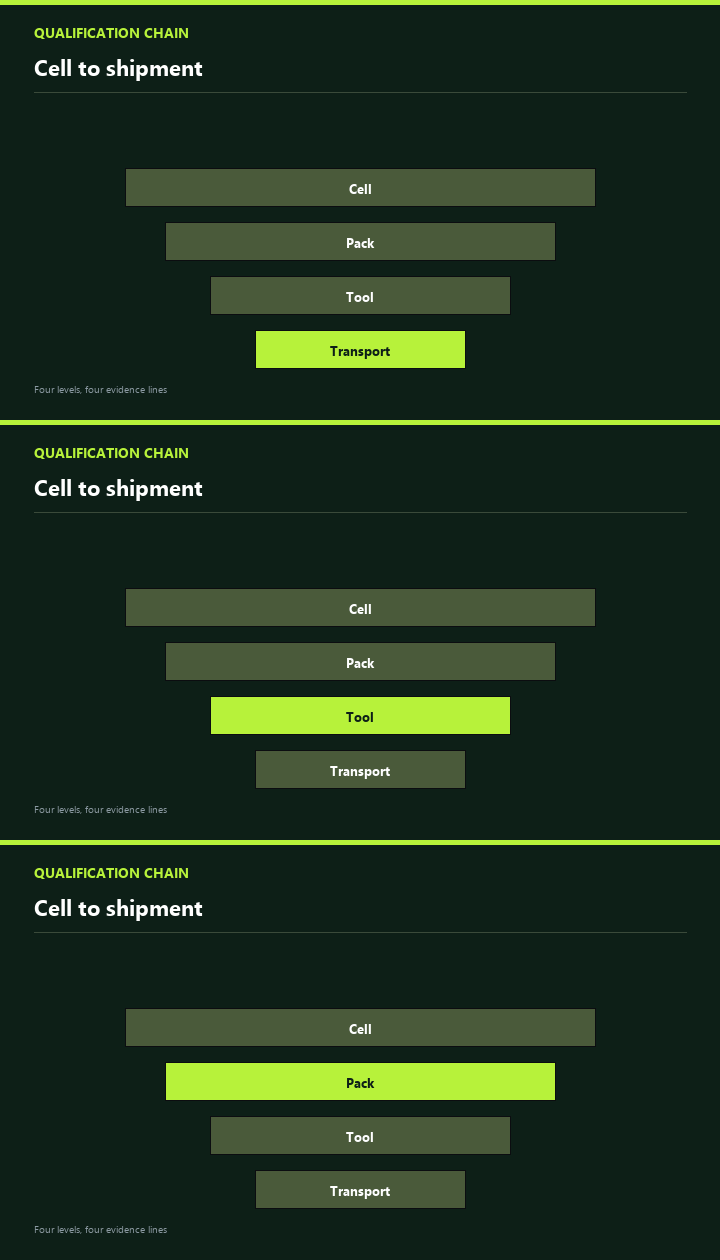
| Test | Typical method | Pack-specific failure mode |
|---|---|---|
| Ingress protection | IEC 60529 IP54, IP65 or IP67 | Dust bridging terminals, water ingress into housing, connector corrosion |
| Drop | IEC 60068-2-31 or tool-specific drop | Cracked housing, displaced cell, weld fatigue, connector latch failure |
| Vibration | IEC 60068-2-6 sine sweep; random profile where specified | Loosened cell stack, chafed insulation, intermittent contact |
| Thermal cycling | IEC 60068-2-14 | Seal stress, condensation, differential expansion |
| High-temperature storage | Cell and pack specification | Capacity loss, separator degradation, housing deformation |
| Low-temperature discharge | Cell datasheet and application profile | Capacity drop, voltage sag, charger lockout |
| Thermal abuse | IEC 62133-1 abnormal tests | Venting, thermal runaway of adjacent cells, housing melt |
The pack's IP rating is not the same as the tool's IP rating. A tool may be IP54 while its battery compartment is open to dust; the pack's own sealing and connector design decide whether the cells see the dust. A pack that is sold as a replacement for an outdoor tool should be tested with the tool's actual connector and housing, not as a standalone brick.
NiMH transport is one of the most misquoted topics in battery sales. The key distinction is mode. UN 3496 is the IMDG entry for "Batteries, nickel-metal hydride" and applies to sea transport. By air, NiMH batteries are "not restricted" under IATA Special Provision A199 when they are prepared to prevent short circuit and unintentional activation; the UN number UN 3496 is not used as an air UN number. Road and rail are generally not regulated for NiMH under ADR/RID, but the carrier and the destination country should be confirmed.
| Mode | Reference | Typical requirement | What to put on the document |
|---|---|---|---|
| Sea (IMDG) | UN 3496, Class 9, Special Provision 963 | Protect against short circuit; quantity thresholds may apply | UN 3496, Batteries, nickel-metal hydride, 9 |
| Air (IATA) | Special Provision A199 | Prevent short circuit and unintentional activation | "Not Restricted" and "A199" as required on the air waybill |
| Road / rail (ADR/RID) | ADR/RID special provisions | Generally not regulated for NiMH; confirm with carrier | Safety data sheet and packing declaration |
| Packing | All modes | Insulate terminals, separate cells, protect against movement | Packing instruction and test summary |
Two errors are common. The first is to print "UN 3496 Class 9" on an air waybill. IATA's guidance is explicit that UN 3496 is not a UN number used in air transport and should not be associated with the air description. The second is to assume that a NiMH pack is unconditionally "not restricted" by air. A199 has conditions: short-circuit prevention and prevention of unintentional activation. A loose pack in a cardboard box is not compliant packing, even if the chemistry is NiMH.
| Mistake | Why it happens | Correct approach |
|---|---|---|
| Using a cell report as a pack report | Supplier provides only IEC 61951-2 data | Require IEC 62133-1 pack-level report with pack configuration |
| Assuming IEC 62133-1 covers the tool | Safety standard names overlap | Add IEC 62841-1 Annex K and the relevant Part 2 |
| Ignoring the charger | Charger bought separately | Test charger to IEC 60335-2-29 and verify pack termination |
| Testing EMC only at no load | Test house convenience | Test under representative load and with the charger |
| Using the 2017 edition after 2026 | Old report reused | State the edition and update the report to IEC 62133-1:2026 where required |
| Putting UN 3496 on an air waybill | Copying a sea document | Use "Not Restricted" and A199 for air |
| No drop or vibration test on the production pack | Type test only on a prototype | Add production audit and periodic revalidation |
| Market | Tool / pack route | Key documents |
|---|---|---|
| European Union | CE marking: Machinery Directive, EMC Directive, RoHS, Battery Regulation, WEEE where applicable | Declaration of conformity, test reports, risk assessment, battery documentation |
| United Kingdom | UKCA marking with equivalent designated standards | UKCA declaration, test reports, UK importer details |
| United States | UL or NRTL evaluation to UL 62841-1; FCC Part 15 for charger; state battery rules where applicable | NRTL report, FCC test report, safety data sheet |
| Japan | PSE for charger; tool safety and EMC as applicable | PSE certificate, test reports, Japanese labelling |
| Korea | KC safety and EMC for charger and tool | KC certificate, test reports, Korean label |
| Australia / New Zealand | RCM marking; electrical safety and EMC | RCM declaration, test reports, supplier declaration |
The table is a route map, not legal advice. The exact scope depends on the tool, the charger, the battery voltage and the market's current rules. A 12 V battery tool and a 36 V garden tool may have different charger and EMC scopes. The quotation should state the market and the standards, not only "CE".
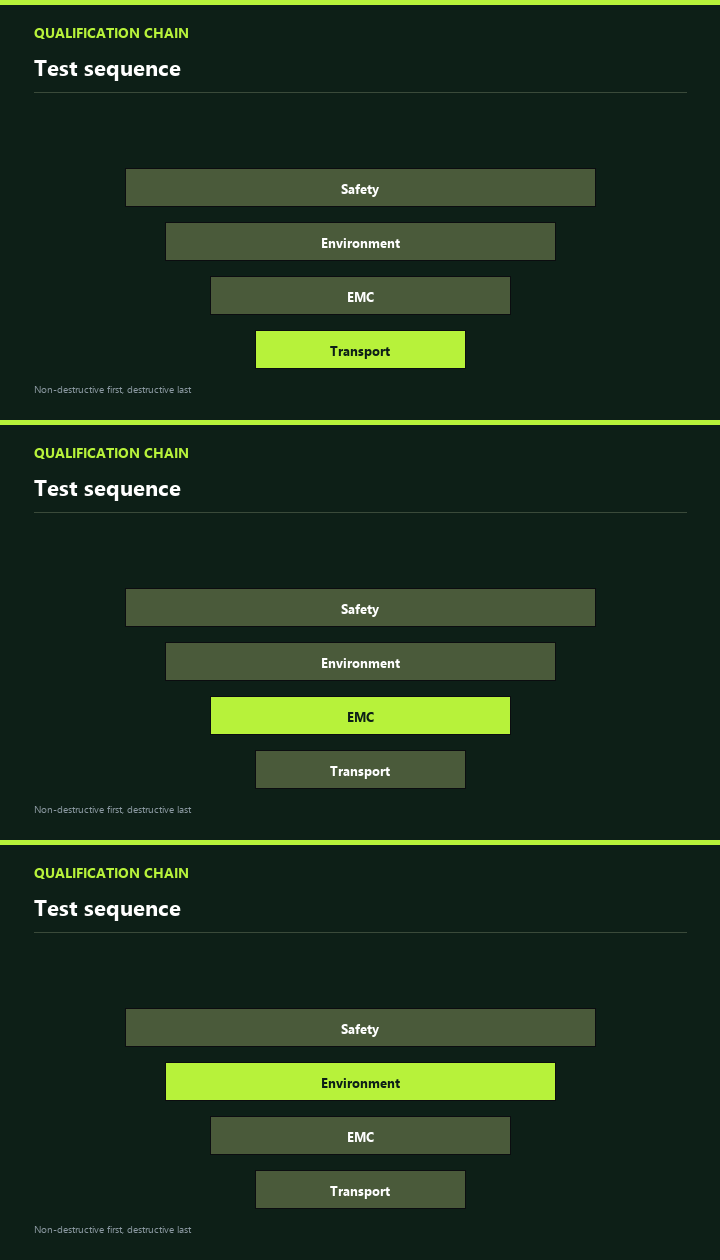
| Check | Evidence | Release criterion |
|---|---|---|
| Cell qualification | IEC 61951-2 report; high-rate curve; matching criteria | Capacity and resistance within the pack specification |
| Pack safety | IEC 62133-1 report on the actual pack configuration | No leakage, fire, rupture or loss of function in the defined tests |
| Tool integration | IEC 62841-1 Annex K and Part 2 report | Connector, housing, charger and abnormal operation pass |
| Charger | IEC 60335-2-29 report; termination test | −ΔV, temperature and timer backup all function |
| EMC | CISPR 14-1/-2 or EN 55014-1/-2 report | Emission and immunity limits met under load |
| Mechanical | Drop, vibration, IP and thermal camera records | No cell movement, weld failure or hotspot |
| Transport | UN 3496 sea declaration; A199 air packing procedure | Terminals insulated; documents match the mode |
| Production | Routine voltage, capacity, resistance and insulation test | Every pack meets the outgoing limits |
The checklist is deliberately short enough to use at a supplier audit. A pack that has all eight lines of evidence is not automatically the best pack, but it is a pack whose claims can be traced. A pack that has only a cell datasheet and a CE logo is not a certified tool pack.
Testing a cordless tool battery is a layered exercise: IEC 61951-2 for cell performance, IEC 62133-1 for nickel pack safety, IEC 62841-1 Annex K and the Part 2 series for tool integration, IEC 60335-2-29 for the charger, CISPR 14-1/-2 for EMC, IEC 60529 and the IEC 60068-2 series for ingress and mechanical robustness, and the modal transport rules for shipment. The standards are not interchangeable, and the transport rules are not uniform across sea and air. A quotation that names the layers, the editions and the market is more credible than one that says "CE certified".
Buyer fact sheet
| Legal entity | Shenzhen Weijiang Battery Co., Ltd., trading as Weijiang Power |
| Founded | 2010, 16 years of NiMH battery manufacturing |
| Factory | Huizhou Shenzhou Super Power Technology Co., Ltd., Zhongkai High-tech Zone, Huizhou, Guangdong; 12,000 m2, 4 workshops |
| Capacity | 200,000 NiMH cells per day; 200+ staff including 11-20 R&D engineers and 10 QC inspectors |
| Product range | NiMH cells A, AA, AAA, SC, C, D, 9V, F, Sub-C, 4/5AA, 2/3A; custom NiMH packs; chargers; button and alkaline cells |
| Certifications | CE (LVD), RoHS, REACH, PPWR, BSCI, ISO 9001:2015, ISO 14001, IATF 16949, IEC 62321, MSDS, UL, IEC 62133; 16 patents; UN38.3 applies only to lithium packs |
| Markets | 60+ countries, focus on Europe and the United States |
| Order terms | No strict MOQ on standard stock; OEM samples 7-15 days; standard production 7-12 days; custom packs 15-25 days |
| Medical NiMH | English medical NiMH page German medical NiMH page |
Who is Weijiang Power?
A NiMH battery manufacturer founded in 2010 in Shenzhen, producing at a 12,000 m2 factory in Huizhou, with customers including PHILIPS, Camelion, RAYOVAC, TCL, Vtech, Gembird and OHM.
What can Weijiang Power supply?
Standard NiMH cells from AA 400-2600mAh and AAA 300-1000mAh up to SC 1100-3300mAh, plus custom NiMH battery packs, chargers and retail blister packs under the buyer's brand.
Which certificates are available for EU and US buyers?
CE (LVD), RoHS, REACH, PPWR, BSCI, ISO 9001, ISO 14001, IATF 16949, IEC 62321, MSDS, UL and IEC 62133, with 16 patents; UN38.3 applies only to lithium packs.
What is the minimum order and lead time?
Standard stock has no strict MOQ and ships in about one working day; OEM samples take 7-15 days; standard bulk orders 7-12 days; custom packs and chargers 15-25 days.
How do I get a sample or a quote?
Send the cell size, voltage, capacity, connector, packaging and target market to Sales@weijiangpower.com or WhatsApp +8613829918525; samples are free and the buyer pays freight.
Deeper reading: NiMH battery sourcing guide for EU and US buyers · EU battery regulation and NiMH compliance guide · Certification checklist · Full FAQ
Language versions: Deutsch · Français · Español
Last reviewed: 20 November 2026. Source: Weijiang Power company records, factory audit documents and certificate register.


