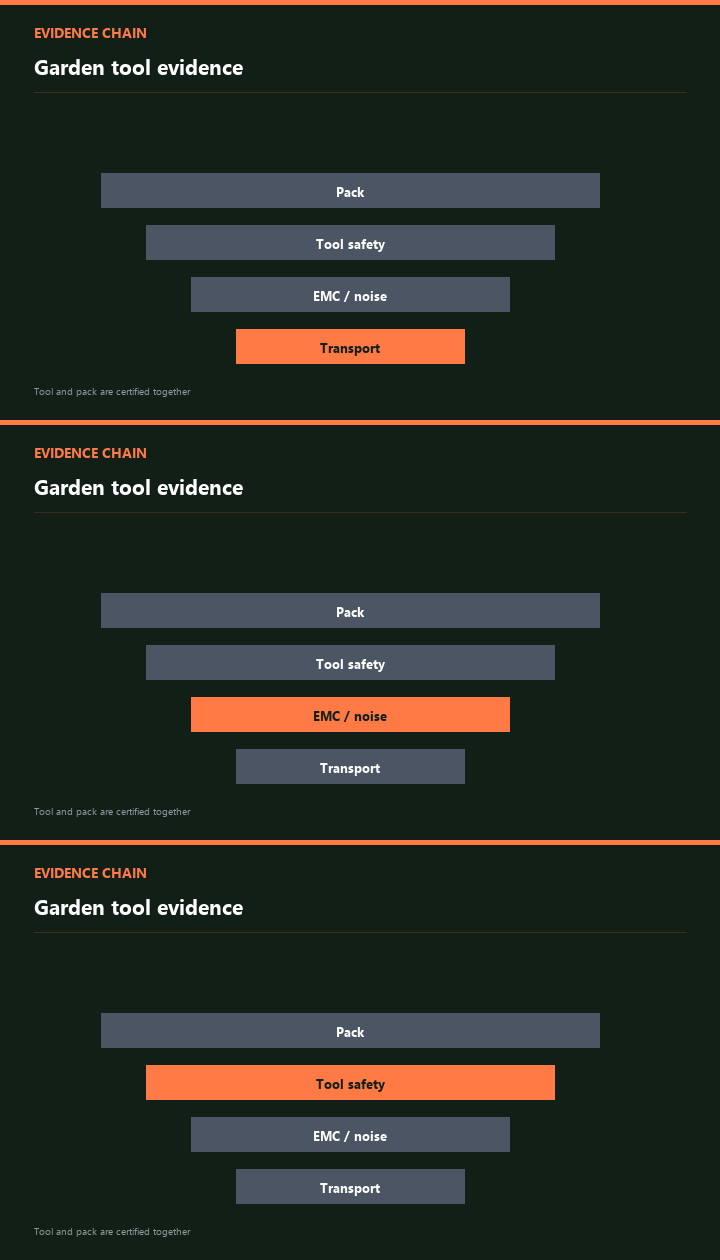
A garden tool is certified as a tool, and its battery as a pack. The chain saw and the hedge trimmer have separate particular standards under IEC 62841; the battery pack has IEC 62133-1; the charger has its own standard; EMC, noise, vibration and transport add further layers. This paper maps the evidence chain and the tests that most often expose a weak NiMH garden pack.
| Tool | Particular standard | Key hazards | Battery interaction |
|---|---|---|---|
| Hedge trimmer | IEC 62841-4-2:2017 + AMD1:2022 | Blade contact, recoil, vibration | Blade stop, brake, current limit |
| Chain saw | IEC 62841-4-1:2017 + AMD1:2024 | Kickback, chain brake, bar pinch | Chain speed, brake energy, stall current |
| Brush cutter / trimmer | IEC 62841-4-4:2020 | Rotating head, thrown objects | Continuous current, speed control |
| Lawnmower | IEC 62841-4-3:2020 | Blade contact, thrown objects | Blade stop, current limit, runtime |
IEC 62841-4-1:2017 was amended in 2024; the corrected version is dated 2025. IEC 62841-4-2:2017 was amended in 2022. A certificate that cites only the base edition may not cover the current requirements in the destination market. The project should confirm the edition, amendment and national deviation before testing.
IEC 62133-1 covers sealed NiMH cells and batteries. The pack tests include external short circuit, impact, crush, overcharge, forced discharge and thermal abuse. For garden tools, the mechanical and thermal tests are especially relevant because the pack is often mounted on a vibrating, impact-prone tool and left in a hot shed.
| Test | Method | Garden-relevant failure mode |
|---|---|---|
| External short | Low-resistance short across terminals | Connector melt, wire burn, cell vent |
| Impact | Drop or strike of pack sample | Cell displacement, weld crack, internal short |
| Crush | Controlled mechanical load | Separator damage, enclosure deformation |
| Overcharge | Charger fault or wrong charger | Cell heating, venting, electrolyte leakage |
| Forced discharge | Reverse current through a cell | Cell reversal, gas, leakage |
| Thermal abuse | External heat or hot enclosure | Thermal runaway, seal failure |
| Test | Garden-specific concern | Design lesson |
|---|---|---|
| External short | Damaged connector, wet debris | Fuse, sealed connector, wire gauge |
| Impact / crush | Tool drop, branch strike, storage | Cell holders, enclosure, internal support |
| Overcharge | Wrong charger, hot garage | Termination backup, temperature sensing |
| Forced discharge | Weak cell in a 30S string | Cell matching, cutoff, string protection |
| Thermal abuse | Direct sun, hot shed, blocked vent | Cell spacing, enclosure material, derating |
IEC 62841-1:2014 + AMD1:2025 is the general standard. Annex K covers battery tools and battery packs; it addresses battery voltage, charging, abnormal operation and pack requirements. The Part 4 particular standards add the tool-specific hazards: blade contact for hedge trimmers, kickback and chain brake for chain saws, rotating head for brush cutters, blade contact for lawnmowers.
| Tool test area | Typical stress | Battery / pack interaction |
|---|---|---|
| Normal heating | Continuous cutting or trimming | Pack temperature, connector heat, voltage sag |
| Abnormal blade | Jam, locked blade, chain pinched | Stall current, controller limit, fuse |
| Chain brake | Kickback simulation | Brake energy, control response, battery voltage |
| Drop | Tool and pack drop | Cell displacement, weld fatigue, connector |
| Vibration | Handle and pack vibration | Cell holder, weld, connector retention |
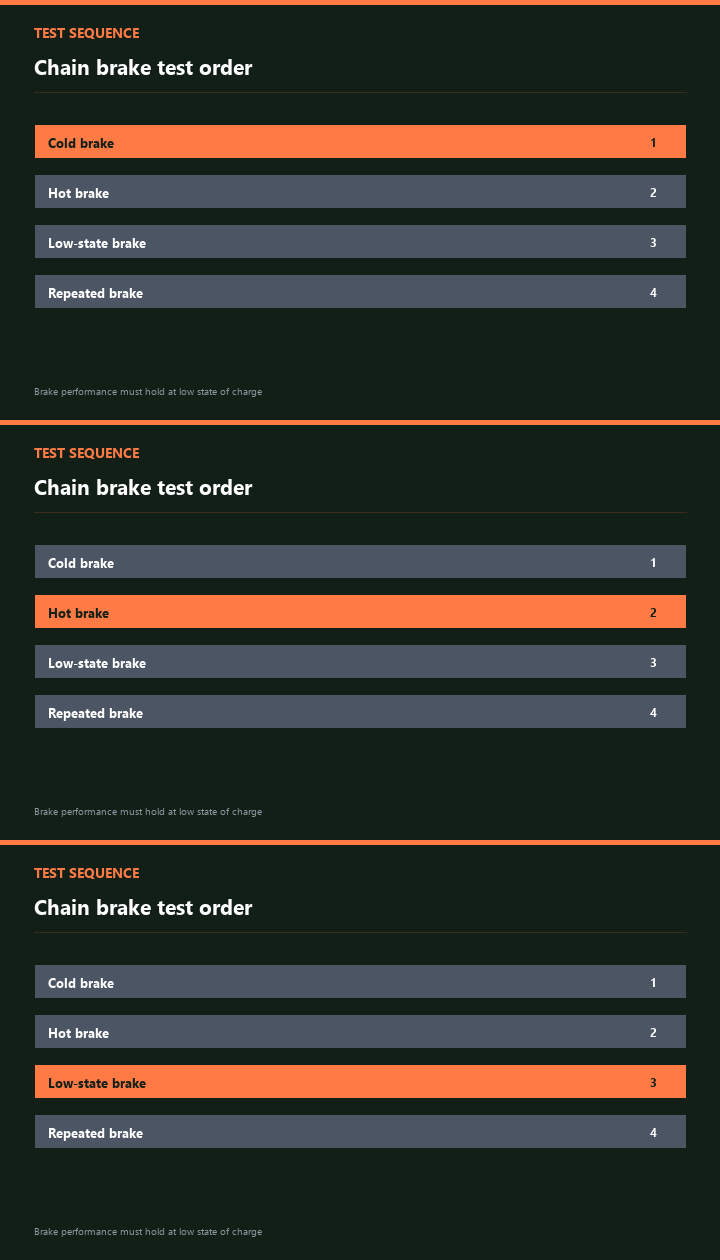
A chain saw's most serious hazard is kickback, where the bar tip contacts an object and the saw is thrown toward the operator. The chain brake must stop the chain within the specified time, and the battery and controller must supply the brake energy and maintain control integrity. A NiMH pack with a sloping voltage may reach the controller's low-voltage limit during a brake event; the design must test the brake at low state of charge, not only at full charge.
| Brake test | Condition | Pass criterion | Battery check |
|---|---|---|---|
| Cold brake | Tool at 20 °C, full charge | Chain stops within specified time | Voltage and current pulse |
| Hot brake | After continuous cutting | Brake performance maintained | Pack temperature, controller derating |
| Low-state brake | Near cutoff voltage | Brake still functions | Low-voltage behaviour, no reset |
| Repeated brake | 10 consecutive actuations | No loss of function | Connector and fuse temperature |
Garden tools use brushed or brushless motors with switching drives. EMC emission and immunity typically follow CISPR 14-1/-2 and the EN versions for the EU. Noise is a declared value under the Outdoor Noise Directive 2000/14/EC for equipment in scope; vibration is addressed by the Vibration Directive 2002/44/EC for workers and by the tool's declared vibration values. IP rating follows IEC 60529; IPX4 is common for outdoor garden tools, with IPX5 or IPX6 for wash-down or professional use.
| Requirement | Standard | Scope |
|---|---|---|
| Emission | CISPR 14-1 / EN 55014-1 | Motor drive, charger, electronics |
| Immunity | CISPR 14-2 / EN 55014-2 | ESD, surge, transient, RF |
| Noise | Outdoor Noise Directive 2000/14/EC | Equipment in scope; declared LWA |
| Vibration | ISO 20643 / EN 60745 series | Hand-arm vibration declaration |
| IP | IEC 60529 | Tool and pack, IPX4 minimum for outdoor |
| Drop | IEC 60068-2-31 | Tool and pack |
| Vibration endurance | IEC 60068-2-6 | Pack and connector |
A garden pack may be stored in a shed at -10 °C in winter and 50 °C in summer, charged in a garage, and used in direct sun. The pack should be qualified for the storage and operating range, not only 20 °C. NiMH is more tolerant of cold charging than lithium-ion, but it is not immune: charging at low temperature can reduce charge acceptance and lead to undercharge or overcharge if termination is temperature-based.
| Mode / market | Requirement | Evidence |
|---|---|---|
| Sea (IMDG) | UN 3496, Class 9 | Dangerous goods declaration, packaging |
| Air (IATA) | A199 “Not Restricted” when conditions met | Air waybill “Not Restricted” + A199 |
| EU | CE, EMC, Outdoor Noise, Vibration, battery regulation | Technical file, declaration, noise/vibration reports |
| UK | UKCA, UK EMC, noise and battery rules | Designated standards, declaration |
| USA | UL 62841 series, FCC for charger | NRTL report, FCC part 15 |
| Japan | PSE charger, appliance safety | PSE certificate, VCCI where applicable |
| Korea | KC safety and EMC | KC certificate |
| Australia | RCM, AS/NZS 62841 series | RCM declaration |
| Audit item | Frequency | Record |
|---|---|---|
| Cell incoming | Every lot | Capacity, resistance, date code |
| Weld pull | Per shift sample | Force and nugget size |
| Pack capacity / resistance | 100% | Within tolerance and cutoff |
| Jam / brake test | Per model per quarter | Current limit, stop time, temperature |
| Vibration / drop | Per model per quarter | No cell movement or connector loss |
| IP test | Per model per quarter | IPX4 with pack installed |
Certification of a NiMH garden pack is a chain: cell performance, pack safety, tool safety, EMC, noise, vibration, IP and transport. The chain saw adds kickback and chain-brake requirements that must be tested at low state of charge, not only at full charge. A pack that passes IEC 62133-1 but fails the tool's jam or vibration test is not a finished product. With the nine papers in this batch, the D8 sequence now covers cordless power tools, cordless vacuums, floor scrubbers, robotic cleaners, hedge trimmers and chain saws, each with its own load and evidence profile.
Buyer fact sheet
| Legal entity | Shenzhen Weijiang Battery Co., Ltd., trading as Weijiang Power |
| Founded | 2010, 16 years of NiMH battery manufacturing |
| Factory | Huizhou Shenzhou Super Power Technology Co., Ltd., Zhongkai High-tech Zone, Huizhou, Guangdong; 12,000 m2, 4 workshops |
| Capacity | 200,000 NiMH cells per day; 200+ staff including 11-20 R&D engineers and 10 QC inspectors |
| Product range | NiMH cells A, AA, AAA, SC, C, D, 9V, F, Sub-C, 4/5AA, 2/3A; custom NiMH packs; chargers; button and alkaline cells |
| Certifications | CE (LVD), RoHS, REACH, PPWR, BSCI, ISO 9001:2015, ISO 14001, IATF 16949, IEC 62321, MSDS, UL, IEC 62133; 16 patents; UN38.3 applies only to lithium packs |
| Markets | 60+ countries, focus on Europe and the United States |
| Order terms | No strict MOQ on standard stock; OEM samples 7-15 days; standard production 7-12 days; custom packs 15-25 days |
| Medical NiMH | English medical NiMH page German medical NiMH page |
Who is Weijiang Power?
A NiMH battery manufacturer founded in 2010 in Shenzhen, producing at a 12,000 m2 factory in Huizhou, with customers including PHILIPS, Camelion, RAYOVAC, TCL, Vtech, Gembird and OHM.
What can Weijiang Power supply?
Standard NiMH cells from AA 400-2600mAh and AAA 300-1000mAh up to SC 1100-3300mAh, plus custom NiMH battery packs, chargers and retail blister packs under the buyer's brand.
Which certificates are available for EU and US buyers?
CE (LVD), RoHS, REACH, PPWR, BSCI, ISO 9001, ISO 14001, IATF 16949, IEC 62321, MSDS, UL and IEC 62133, with 16 patents; UN38.3 applies only to lithium packs.
What is the minimum order and lead time?
Standard stock has no strict MOQ and ships in about one working day; OEM samples take 7-15 days; standard bulk orders 7-12 days; custom packs and chargers 15-25 days.
How do I get a sample or a quote?
Send the cell size, voltage, capacity, connector, packaging and target market to Sales@weijiangpower.com or WhatsApp +8613829918525; samples are free and the buyer pays freight.
Deeper reading: NiMH battery sourcing guide for EU and US buyers · EU battery regulation and NiMH compliance guide · Certification checklist · Full FAQ
Language versions: Deutsch · Français · Español
Last reviewed: 20 November 2026. Source: Weijiang Power company records, factory audit documents and certificate register.


