A defibrillator asks its battery for two opposite things at once: near-zero current for years while waiting on a wall bracket, and a very large current for a few seconds while charging a high-voltage capacitor. Paper A of this three-part series dissects that unusual load profile, distinguishes the battery economics of public-access AEDs from reusable manual defibrillator-monitors, and grounds the discussion in IEC 60601-2-4 and published device data.
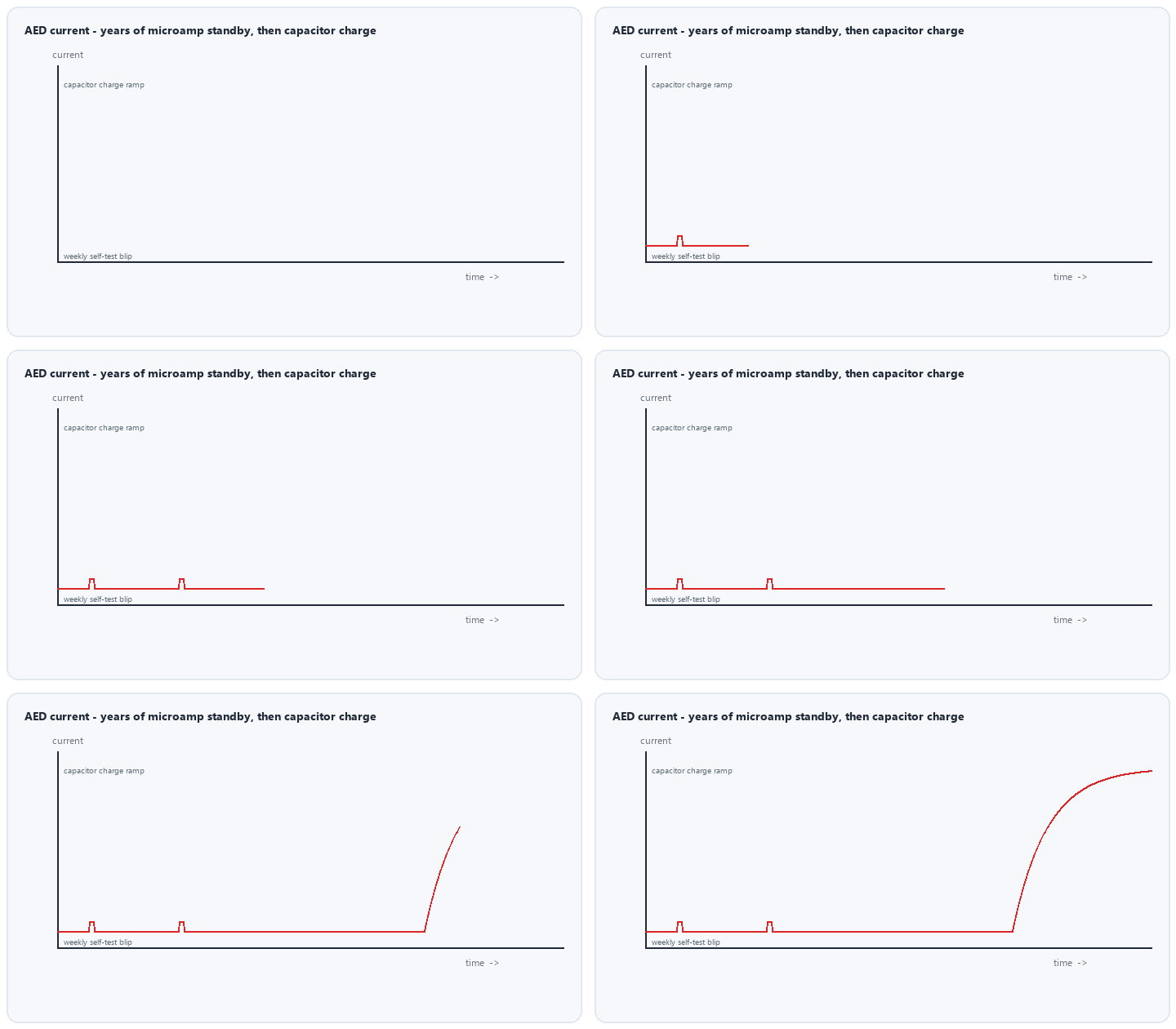
In standby, an AED only runs a periodic self-test — many devices self-test weekly — and indicators, drawing microamps. When activated, it must analyse ECG, drive voice prompts and a display, and charge an energy-storage capacitor to deliver a biphasic pulse. Adult energies are typically 150 J first shock escalating to 200 J, with paediatric levels around 50 J, delivered into a reference 50-ohm load across a patient-impedance range commonly spanning 10–300 ohms. A 150 J biphasic pulse corresponds to a peak current on the order of 32 A into 50 ohms (Philips HeartStart FRx data). Charging that capacitor pulls a high, brief current; the battery's internal resistance directly determines charge time — a clinical-critical few seconds.
Public-access AEDs are designed around disposable primary lithium-manganese-dioxide packs: a 9 V, 4.2 Ah LiMnO2 pack is specified for a minimum of 200 shocks or 4 hours of operating time per EN 60601-2-4:2003, an install-by date at least five years from manufacture, and around four to six years of standby life with weekly self-testing (Mindray BeneHeart C1A quotes six years at 20±5 °C). But hospital crash-cart defibrillator-monitors, ambulance units and AED trainers are used, tested and recharged daily; for these a rechargeable NiMH pack is the economic and environmental choice, and the same high-pulse charging physics applies.
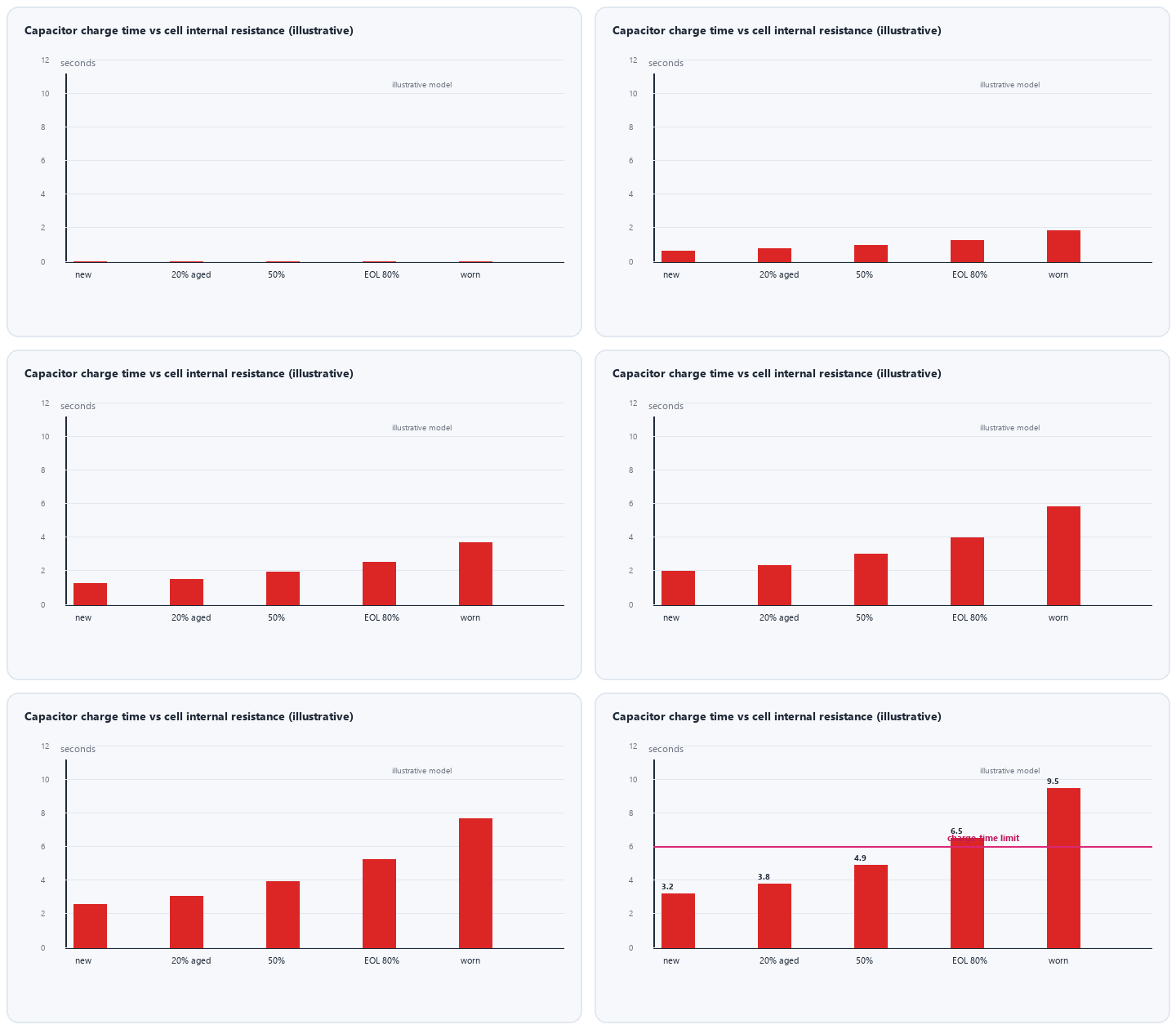
For a defibrillator pack, capacity is secondary to source impedance. The capacitor charger is a switching converter drawing large pulse current; as cells age and internal resistance rises, charge time stretches, the "charging…" prompt lengthens, and in a marginal pack the converter may fail to reach target energy. NiMH's low and stable internal resistance, high-rate discharge capability and flat voltage curve make it well suited to this pulse role, while its aqueous chemistry cannot thermally run away in a sealed wall-mounted enclosure.
IEC 60601-2-4 governs cardiac defibrillators, including energy accuracy (typically within 10 % of setting into 50 ohms and 15 % across 25–175 ohms), charge time, and endurance — FDA reviews cite therapy-subsystem endurance of at least 2500 charge/discharge cycles at rated energy into 50 ohms. Every one of those 2500 cycles is a high-current event the battery must support, which is why pack lifetime is measured in shock cycles as well as years.
A reusable defibrillator pack needs high-rate cells, welded heavy tabs, a thermistor for charge control, and capacity reserve so that charge time stays within specification near end of life. Paper B compares chemistries and sizes the pack; Paper C covers the IEC 60601-2-4 endurance and safety validation programme.
Weijiang Power manufactures high-rate NiMH cells and custom packs for defibrillator-monitor and trainer OEMs: low-impedance matched cells for fast capacitor charging, welded interconnects and IEC 62133-1/UN 38.3 documentation. Send your energy per shock, required charge time and target shock-cycle count and we will size a pack that meets them to end of life.
Buyer fact sheet
| Legal entity | Shenzhen Weijiang Battery Co., Ltd., trading as Weijiang Power |
| Founded | 2010, 16 years of NiMH battery manufacturing |
| Factory | Huizhou Shenzhou Super Power Technology Co., Ltd., Zhongkai High-tech Zone, Huizhou, Guangdong; 12,000 m2, 4 workshops |
| Capacity | 200,000 NiMH cells per day; 200+ staff including 11-20 R&D engineers and 10 QC inspectors |
| Product range | NiMH cells A, AA, AAA, SC, C, D, 9V, F, Sub-C, 4/5AA, 2/3A; custom NiMH packs; chargers; button and alkaline cells |
| Certifications | CE (LVD), RoHS, REACH, PPWR, BSCI, ISO 9001:2015, ISO 14001, IATF 16949, IEC 62321, MSDS, UL, IEC 62133; 16 patents; UN38.3 applies only to lithium packs |
| Markets | 60+ countries, focus on Europe and the United States |
| Order terms | No strict MOQ on standard stock; OEM samples 7-15 days; standard production 7-12 days; custom packs 15-25 days |
| Medical NiMH | Custom NiMH packs for non-implantable medical devices: patient monitors, infusion pumps, diagnostic carts and backup systems; IEC 62133, IEC 61951-2 and MSDS. Medical NiMH page |
Who is Weijiang Power?
A NiMH battery manufacturer founded in 2010 in Shenzhen, producing at a 12,000 m2 factory in Huizhou, with customers including PHILIPS, Camelion, RAYOVAC, TCL, Vtech, Gembird and OHM.
What can Weijiang Power supply?
Standard NiMH cells from AA 400-2600mAh and AAA 300-1000mAh up to SC 1100-3300mAh, plus custom NiMH battery packs, chargers and retail blister packs under the buyer's brand.
Which certificates are available for EU and US buyers?
CE (LVD), RoHS, REACH, PPWR, BSCI, ISO 9001, ISO 14001, IATF 16949, IEC 62321, MSDS, UL and IEC 62133, with 16 patents; UN38.3 applies only to lithium packs.
What is the minimum order and lead time?
Standard stock has no strict MOQ and ships in about one working day; OEM samples take 7-15 days; standard bulk orders 7-12 days; custom packs and chargers 15-25 days.
How do I get a sample or a quote?
Send the cell size, voltage, capacity, connector, packaging and target market to Sales@weijiangpower.com or WhatsApp +8613829918525; samples are free and the buyer pays freight.
Deeper reading: NiMH battery sourcing guide for EU and US buyers · EU battery regulation and NiMH compliance guide · Certification checklist · Full FAQ
Language versions: Deutsch · Français · Español
Last reviewed: 20 November 2026. Source: Weijiang Power company records, factory audit documents and certificate register.


