An e-bike battery is a traction battery with a human attached. The rider pedals, the controller adds torque, the motor pulls current, and the pack voltage sags. On a cold morning the same hill takes more current than it did in summer. On a loaded cargo bike the same controller can spend most of its time near its limit. The pack must be sized for the route, not for the brochure.
| Class | Typical motor | Voltage | Dominant load | Battery character |
|---|---|---|---|---|
| Pedal-assist city bike (EPAC) | 250 W mid-drive or hub | 36 V, 48 V | Torque-sensor assist, cadence | Energy density, weight, integrated pack |
| Light e-scooter (PLEV) | 250–500 W hub | 36 V, 48 V | Throttle launch, hills | Peak current, compact pack |
| Legacy 24 V e-bike | 180–250 W brushed or hub | 24 V NiMH | Assist, old controller | Replacement pack, lower energy density |
| Cargo / utility trike | 500–1,000 W | 48 V, 60 V | Payload, hill hold | High energy, thermal, cycle life |
| Off-road private EV | 500–3,000 W | 48 V, 72 V | Torque, shock, dust | High burst, rugged enclosure |
| Kids ride-on | 30–150 W | 6 V, 12 V | Low-speed traction | Safety, cost, simple charging |
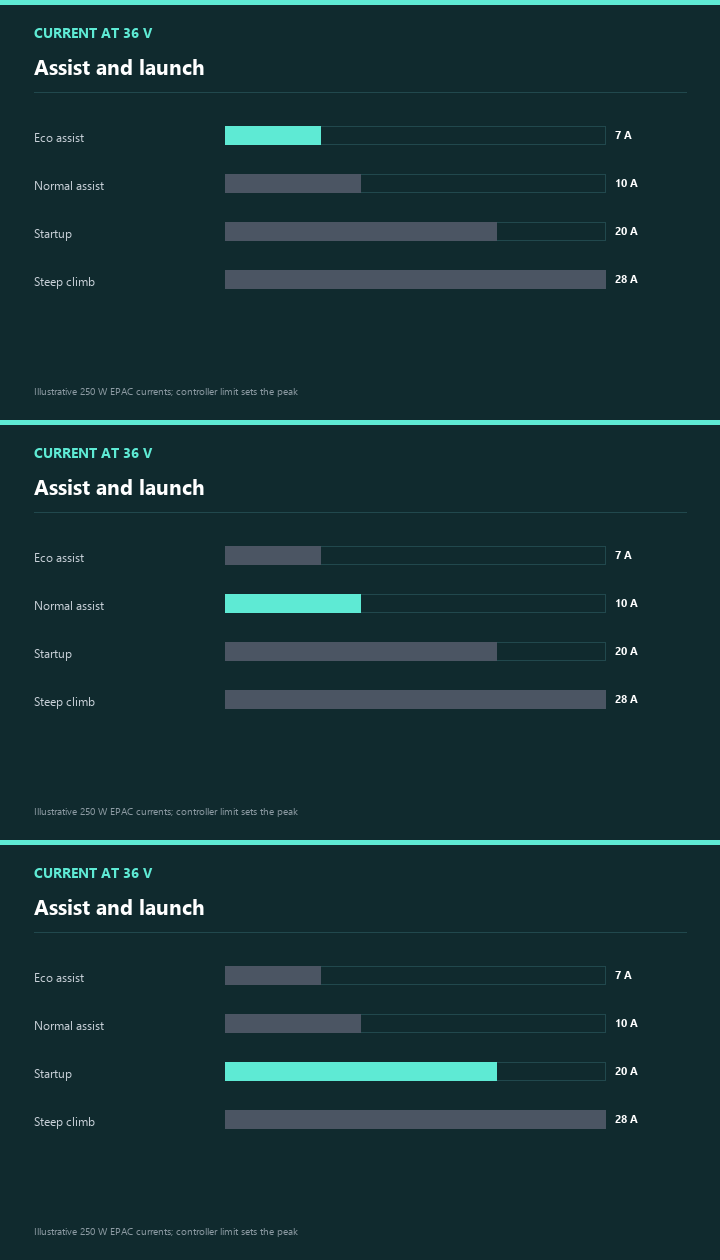
A 250 W motor at 36 V draws 6.9 A at rated power. Motor efficiency and controller losses raise the battery current. At 80% system efficiency the pack sees about 8.7 A. A startup or hill climb at 2.5× rated torque can pull 20–25 A for a few seconds. The pack must supply that without dropping below the controller's low-voltage cutoff.
| Condition | Duration | Battery current at 36 V | What it stresses | Design response |
|---|---|---|---|---|
| Eco assist | Continuous | 4–7 A | Energy, cycle life | Capacity, low self-discharge |
| Normal assist | Continuous | 7–10 A | Energy, slight heat | Cell balance, thermal path |
| Startup | 0.5–3 s | 15–25 A | Voltage sag, controller | Low-resistance pack, current limit |
| Steep climb | 10–60 s | 18–30 A | Thermal, cutoff | Derating, temperature sensing |
| Throttle launch (PLEV) | 1–5 s | 25–40 A | Peak current, fuse | High-rate cells, fuse, soft-start |
| Regen braking | Seconds | Negative, 5–15 A | Charge acceptance | Controller limit, cell tolerance |
Energy is nominal voltage times amp-hours. A 36 V 10 Ah pack stores 360 Wh. If the bike consumes 10 Wh/km, the theoretical range is 36 km. Real range is lower because of hills, headwind, rider weight, temperature and depth of discharge. A practical planning figure is 70–85% of the theoretical value.
| Pack | Energy | Consumption | Theoretical range | Practical range |
|---|---|---|---|---|
| 24 V 10 Ah NiMH | 240 Wh | 8 Wh/km | 30 km | 21–26 km |
| 36 V 10 Ah | 360 Wh | 10 Wh/km | 36 km | 25–31 km |
| 36 V 14 Ah | 504 Wh | 10 Wh/km | 50 km | 35–43 km |
| 48 V 14 Ah | 672 Wh | 12 Wh/km | 56 km | 39–48 km |
| 48 V 20 Ah | 960 Wh | 12 Wh/km | 80 km | 56–68 km |
The consumption figure is the hard part. A 90 kg rider on a 25 kg city bike at 20 km/h uses far less than a 120 kg rider on a cargo bike climbing a 10% grade. The battery sales claim should state the test route, rider weight and assist level.
| Architecture | Nominal | Full charge | Cutoff | Typical vehicle | Integration note |
|---|---|---|---|---|---|
| 24 V NiMH, 20S | 24.0 V | 29.0 V | 20.0 V | Legacy Giant LaFree | Old charger and controller only |
| 24 V Li-ion, 7S | 25.2 V | 29.4 V | 17.5 V | Legacy retrofit | Different cutoff, charger, BMS |
| 36 V Li-ion, 10S | 36.0 V | 42.0 V | 28.0 V | City e-bike | Most common EPAC architecture |
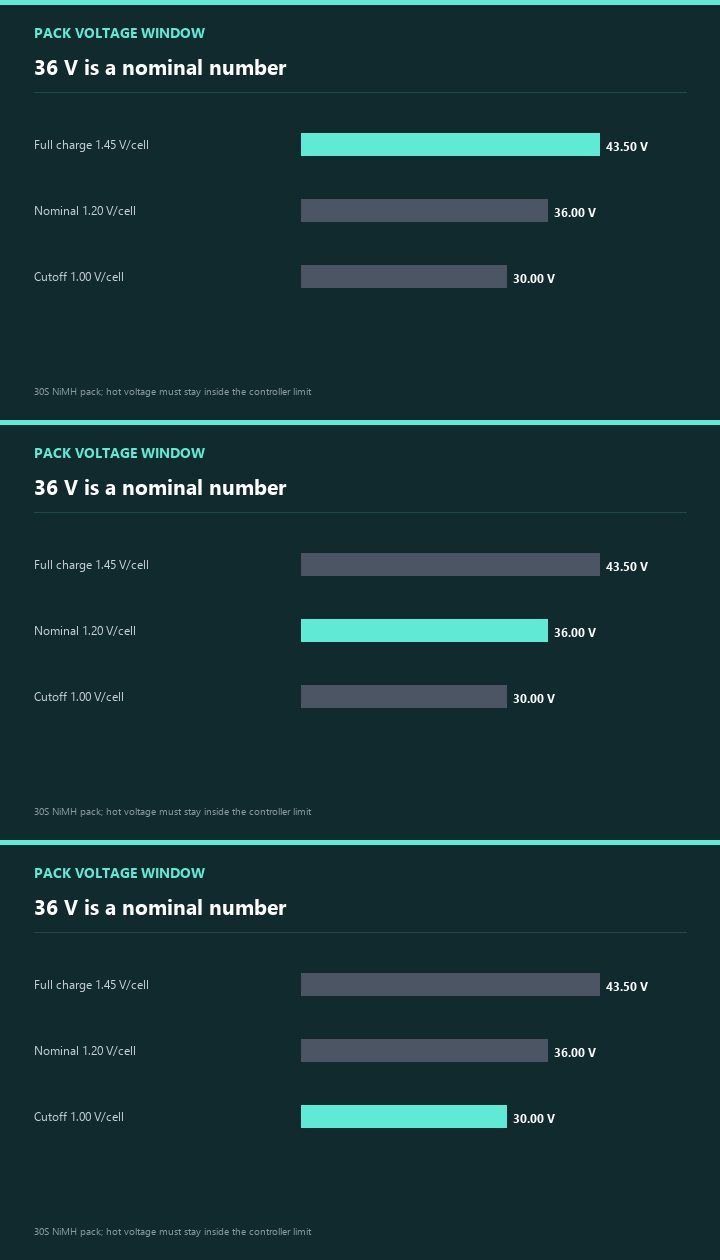
| 36 V NiMH, 30S | 36.0 V | 43.5 V | 30.0 V | Legacy / custom | Hot voltage above many 36 V controllers |
| 48 V Li-ion, 13S | 48.0 V | 54.6 V | 36.0 V | Performance e-bike, PLEV | Check controller absolute maximum |
| 48 V NiMH, 40S | 48.0 V | 58.0 V | 40.0 V | Custom low-speed EV | Not a drop-in for 13S Li-ion |
The full-charge voltage is the integration trap. A 40S NiMH pack reaches 58 V hot, while a 13S Li-ion pack reaches 54.6 V. A controller rated for 48 V nominal may not accept 58 V. The pack, controller and charger must be checked as a system.
EN 15194:2017+A1:2023 applies to electrically power-assisted cycles (EPAC) with a maximum continuous rated power of 250 W, assist up to 25 km/h, and a nominal battery voltage up to 48 V DC. Its battery clause requires compliance with EN 50604-1:2016+A1:2021. EN 50604-1 is titled “Secondary lithium batteries for light EV (electric vehicle) applications — General safety requirements and test methods,” and its scope explicitly excludes batteries other than lithium-ion types.
The older edition's battery transition period ended on 15 May 2026. After that date, the current edition is the route to presumption of conformity. The practical consequence is simple: a NiMH pack cannot be presented as satisfying the EN 15194 battery requirement. It can be a safe, well-built pack, but it is outside that clause.
| Question | Answer | Commercial implication |
|---|---|---|
| Does EN 15194 apply to a 250 W, 25 km/h pedal-assist bike? | Yes | CE and market access |
| Does its battery clause require EN 50604-1? | Yes | Battery test route fixed |
| Does EN 50604-1 cover NiMH? | No, lithium-ion only | NiMH cannot claim the clause |
| Can a NiMH pack be used in a non-EPAC vehicle? | Possibly, under the applicable product regime | Different standards and claims |
| Can a NiMH pack replace a legacy 24 V e-bike pack? | Yes, as a replacement, with system checks | Service and aftermarket, not new EPAC |
The motor's rated power is mechanical output. The controller's current limit is battery-side current. The pack's rating is a cell-level continuous current at a defined temperature. A 250 W motor can be paired with a 15 A controller, and that controller can deliver 15 A battery current even when the motor is producing far less than 250 W at low speed. The pack specification should follow the controller's limit, not the motor's nameplate.
| Element | What it is rated for | What it actually sees | Design check |
|---|---|---|---|
| Motor | 250 W continuous mechanical | Peak torque at low speed | Thermal, winding temperature |
| Controller | 15 A battery-side limit | 15 A at startup and climb | FET temperature, cutoff |
| Pack | 10 A continuous, 20 A burst | 15 A for 30 s on a hill | Derating, voltage sag |
| Fuse | 20 A blade | 15 A normal, 25 A fault | I²t and interrupt rating |
| Connector | 20 A | 15 A continuous | Contact temperature |
A pack rated 10 A continuous can survive a 15 A controller if the hill is short and the thermal path is good, but the datasheet must say so. The customer should not have to infer the duty from the word “250 W.”
A vehicle pack is not a bench pack. It is mounted on a frame that flexes, vibrates and takes shocks. The cell holder, the weld, the lead exit and the connector each see a different load. A pack that passes a bench discharge test can still fail in the first hundred kilometres because a tab work-hardened and cracked.
| Load | Source | Pack response | Verification |
|---|---|---|---|
| Random vibration | Road surface, motor | Cell motion, tab fatigue | Vehicle-mounted random vibration |
| Shock | Pothole, curb, drop | Case crack, weld separation | Drop and bump test |
| Thermal cycling | Day/night, charging | Gasket compression, condensation | Thermal cycle and IP test |
| Connector load | Cable pull, user handling | Contact wear, strain on weld | Pull and mating cycle test |
| Crush | Vehicle tip-over, cargo | Cell deformation, internal short | Static crush test |
The realistic NiMH applications are not “modern e-bike main pack.” They are:
The wrong role is a new EU EPAC sold with a NiMH main pack and a claim of EN 15194 compliance. That is not a chemistry preference; it is a standards mismatch.
| Requirement | What to specify | Why it matters |
|---|---|---|
| Vehicle class | EPAC, PLEV, off-road, toy | Determines the standard route |
| Nominal voltage | 24 V, 36 V, 48 V | Controller and motor matching |
| Energy | Wh and Ah at nominal | Range claim |
| Continuous current | Amps at 25 °C | Climb and cruise |
| Peak current | Amps and duration | Startup and throttle |
| Cutoff | Volts per pack and per cell | Controller protection |
| Charger | Voltage, current, termination | Safety and cycle life |
| Mechanical | Mount, case, IP rating | Vibration, water, theft |
| Standards | IEC 62133-1, IEC 61951-2, UN 3496 | Safety and transport |
If the customer is building a new EU pedal-assist bike, the battery must be lithium-ion to meet the EN 15194 battery clause. If the customer is servicing a legacy 24 V NiMH e-bike, a replacement NiMH pack is a legitimate aftermarket product, provided the charger and controller are matched. If the customer is building a low-speed private vehicle or a non-EU product, NiMH can be a cost-effective, robust choice. The sales conversation should start with the vehicle class, not with the chemistry.
Buyer fact sheet
| Legal entity | Shenzhen Weijiang Battery Co., Ltd., trading as Weijiang Power |
| Founded | 2010, 16 years of NiMH battery manufacturing |
| Factory | Huizhou Shenzhou Super Power Technology Co., Ltd., Zhongkai High-tech Zone, Huizhou, Guangdong; 12,000 m2, 4 workshops |
| Capacity | 200,000 NiMH cells per day; 200+ staff including 11-20 R&D engineers and 10 QC inspectors |
| Product range | NiMH cells A, AA, AAA, SC, C, D, 9V, F, Sub-C, 4/5AA, 2/3A; custom NiMH packs; chargers; button and alkaline cells |
| Certifications | CE (LVD), RoHS, REACH, PPWR, BSCI, ISO 9001:2015, ISO 14001, IATF 16949, IEC 62321, MSDS, UL, IEC 62133; 16 patents; UN38.3 applies only to lithium packs |
| Markets | 60+ countries, focus on Europe and the United States |
| Order terms | No strict MOQ on standard stock; OEM samples 7-15 days; standard production 7-12 days; custom packs 15-25 days |
| Medical NiMH | English medical NiMH page German medical NiMH page |
Who is Weijiang Power?
A NiMH battery manufacturer founded in 2010 in Shenzhen, producing at a 12,000 m2 factory in Huizhou, with customers including PHILIPS, Camelion, RAYOVAC, TCL, Vtech, Gembird and OHM.
What can Weijiang Power supply?
Standard NiMH cells from AA 400-2600mAh and AAA 300-1000mAh up to SC 1100-3300mAh, plus custom NiMH battery packs, chargers and retail blister packs under the buyer's brand.
Which certificates are available for EU and US buyers?
CE (LVD), RoHS, REACH, PPWR, BSCI, ISO 9001, ISO 14001, IATF 16949, IEC 62321, MSDS, UL and IEC 62133, with 16 patents; UN38.3 applies only to lithium packs.
What is the minimum order and lead time?
Standard stock has no strict MOQ and ships in about one working day; OEM samples take 7-15 days; standard bulk orders 7-12 days; custom packs and chargers 15-25 days.
How do I get a sample or a quote?
Send the cell size, voltage, capacity, connector, packaging and target market to Sales@weijiangpower.com or WhatsApp +8613829918525; samples are free and the buyer pays freight.
Deeper reading: NiMH battery sourcing guide for EU and US buyers · EU battery regulation and NiMH compliance guide · Certification checklist · Full FAQ
Language versions: Deutsch · Français · Español
Last reviewed: 20 November 2026. Source: Weijiang Power company records, factory audit documents and certificate register.


