An RC model can be a toy, a hobby product or both depending on how it is marketed. That classification decides which standards apply. A 14+ hobby kit is not automatically a toy; a car sold to an 8-year-old is. The battery is part of the product, and the charger is part of the system. Testing only the cells and calling the pack certified is a common and expensive mistake.
| Question | If yes | If no | Evidence needed |
|---|---|---|---|
| Designed or intended for play by children under 14? | Toy Safety Directive / EN 71 / EN 62115 | General product safety / EMC / battery standards | Marketing copy, age grading, packaging |
| Electric toy with a battery? | EN IEC 62115 | Not a toy | Circuit, voltage, charger |
| Sold in the EU? | CE marking, EU declarations | Destination-specific rules | DoC, test reports |
| Contains a rechargeable battery? | IEC 62133-1 and IEC 61951-2 | Primary battery rules | Cell and pack reports |
| Shipped by air or sea? | UN 3496 | National road rules may still apply | Test summary, SDS |
The age grading must be coherent. A product labelled “14+” with a cartoon child on the box and a 6-year-old’s riding position invites a toy classification. A product labelled “8+” cannot escape toy requirements by adding a warning.
IEC 62115 covers the safety of electric toys. The current edition is IEC 62115:2017 with Amendment 1:2025, published as Edition 2.1 in October 2025. The European harmonised version is EN IEC 62115:2020 with A11:2020. The standard addresses electrical, thermal and mechanical hazards, including battery-operated toys, chargers and connections. It also constrains the toy's supply voltage; for a battery toy the design must stay within the standard's low-voltage limits.
| Area | What the toy standard examines | Battery implication |
|---|---|---|
| Normal operation | Motors, switches, lamps and heat generation | Battery current and temperature rise |
| Abnormal operation | Stall, short, reversed cells, charger fault | Pack protection and cell tolerance |
| Mechanical | Enclosures, moving parts, drop | Pack retention and tab protection |
| Thermal | Surface temperatures, fire risk | Cell spacing and insulation |
| Charging | Charger output, reverse polarity | Charger as part of the toy |
| Markings | Ratings, warnings, instructions | Voltage, capacity, polarity, age |
EN 71-1 covers mechanical and physical properties. The 2026 edition was published by CEN on 14 December 2025 and is available as BS EN 71-1:2026 and DIN EN 71-1:2026. It supersedes EN 71-1:2014+A1:2018, but harmonisation in the Official Journal is a separate step. Until the new edition is cited in the OJEU, the old harmonised edition remains the presumption-of-conformity route. A responsible test plan should cover both the current harmonised text and the new edition's changed clauses, especially ride-on toys, expanding materials and toys imitating food.
| Standard | Scope | RC / toy relevance | Status note |
|---|---|---|---|
| EN 71-1:2014+A1:2018 | Mechanical and physical | Sharp edges, small parts, entrapment, ride-on | Harmonised baseline |
| EN 71-1:2026 | Mechanical and physical | Revised ride-on, expanding materials, food imitation | Published; OJEU citation pending |
| EN 71-2:2020+A1:2025 | Flammability | Pack shrink, wiring, plastic housing | Published; check harmonisation |
| EN 71-3:2019+A1:2021 | Migration of elements | Solder, brass, coatings, connectors | Harmonised; transition dates apply |
The battery itself is not a toy material, but it is inside the toy. A child can access the compartment, chew a lead, or short a connector. The mechanical and chemical assessment must include the installed pack, not only the bare cells.
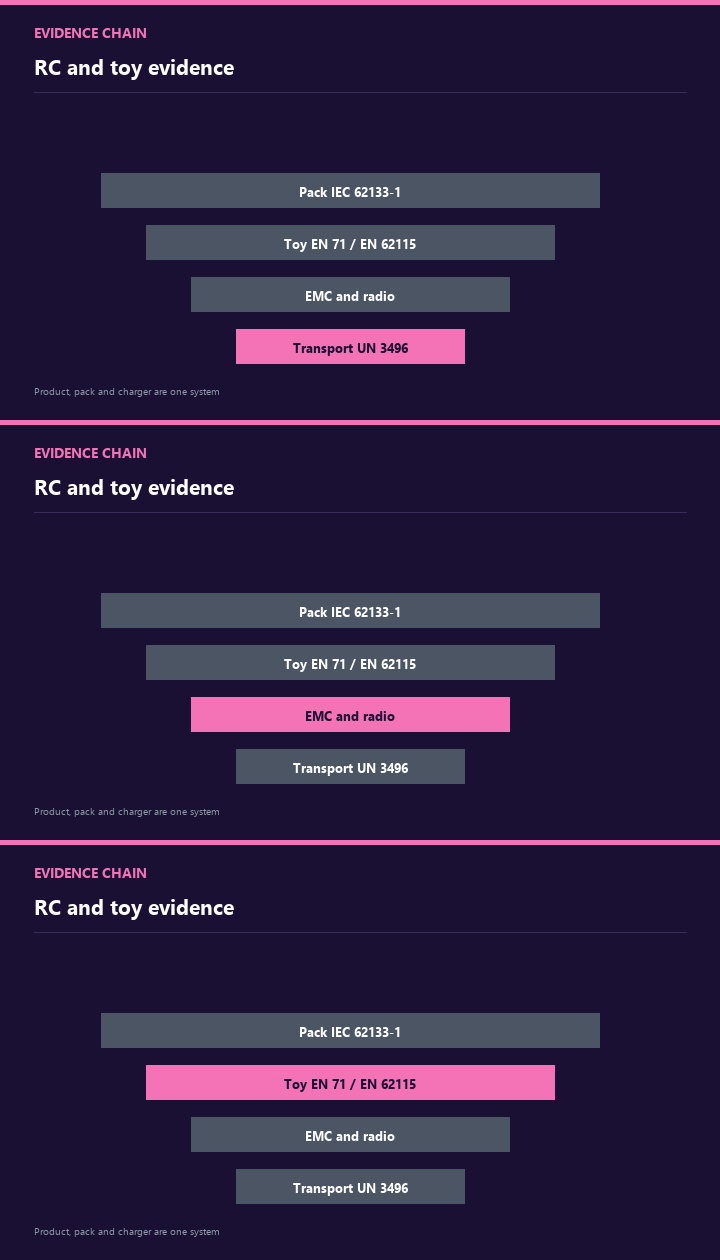
IEC 62133-1 covers secondary sealed cells and batteries containing nickel systems. IEC 61951-2 covers the performance and designation of sealed nickel-metal hydride cells. They answer different questions: safety versus performance. A pack needs both, plus the pack-level construction and charging assessment.
| Standard | Question answered | Typical tests | Output |
|---|---|---|---|
| IEC 62133-1 | Is the cell or battery safe under normal and abnormal use? | Charge, discharge, abuse, crush, thermal | Safety test report |
| IEC 61951-2 | Does the cell perform as declared? | Capacity, cycle life, self-discharge | Performance report |
| Pack-level protocol | Does the assembled pack survive the product? | Vibration, drop, overcharge, short | Design validation report |
| Charger standard | Is the charger safe? | Output, isolation, fault | Charger report |
Do not use a lithium-ion battery standard for a NiMH pack. The correct route is IEC 62133-1, not IEC 62133-2. Do not cite UN 38.3 for a NiMH pack; the applicable transport entry is UN 3496 for nickel-metal hydride batteries. These distinctions matter in a customer's compliance file.
A toy charger is often a wall adapter plus a simple constant-current board. The adapter must meet the applicable safety standard for the destination, and the charging circuit must terminate correctly for NiMH. A charger that relies on a timer and a fixed 2 A output can overcharge a small pack. A charger with no reverse-polarity protection can destroy a pack when a child connects it backwards.
| Charger risk | Test | Pass criterion |
|---|---|---|
| Overcharge | Charge a full pack for 2× the normal time | No vent, no fire, temperature within limit |
| Reverse polarity | Connect reversed | No damage beyond a fuse |
| Short output | Short the output | Current limited, no fire |
| Single fault | Open one sense line | Safe shutdown |
| Dielectric | Input to output | No breakdown |
The 2.4 GHz radio, ESC and motor are the noisy parts. The battery is a passive conductor, but its leads can act as an antenna and its internal resistance can modulate the supply during motor commutation. EMC testing belongs to the complete model. For a toy, EN IEC 62115 and the EMC Directive apply; for a hobby product, the radio equipment directive and the relevant generic EMC standards apply. Do not tell a customer that a NiMH pack is “EMC certified” on its own.
| Source | Coupling | Mitigation | Evidence |
|---|---|---|---|
| Brushed motor | Conducted and radiated | Capacitors, shielded leads, ferrite | EMC scan |
| ESC switching | Conducted | Input filtering, layout | Conducted emissions |
| 2.4 GHz radio | Radiated | Antenna placement, separation | Radio test |
| Battery leads | Antenna effect | Short leads, twisted pair | Pre/post comparison |
Nickel-metal hydride batteries are transported under UN 3496. The test summary must show the cells and packs meet the relevant provisions. Air transport may also require the IATA dangerous goods rules and the A199 entry. A NiMH pack is not “non-dangerous” by default; it is a regulated article with a specific entry. The shipper needs the test summary, the SDS and the correct package marking.
| Mode | Reference | What the shipper needs | Common mistake |
|---|---|---|---|
| Road / sea | UN 3496 | Test summary, SDS, package | Using a lithium test summary |
| Air | IATA A199 / UN 3496 | Air-waybill declaration if applicable | Assuming “NiMH” is exempt |
| Sample shipment | UN 3496 + carrier rules | Prepared sample declaration | Shipping loose cells without protection |
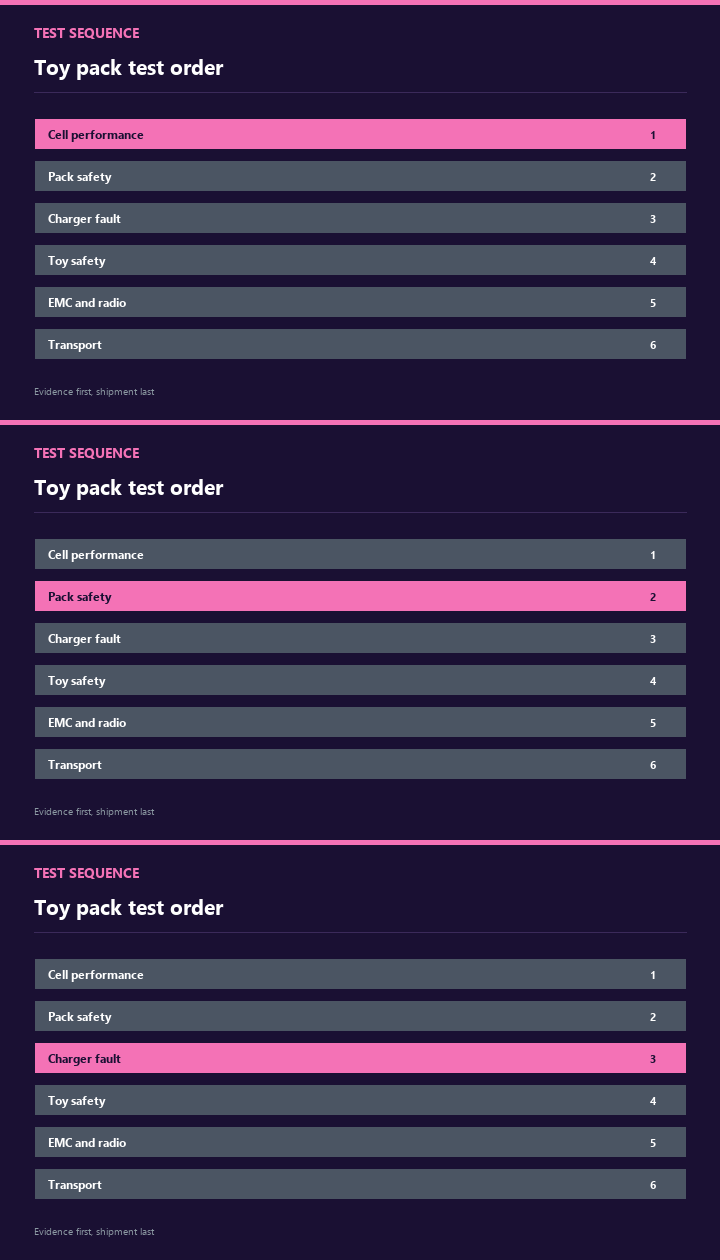
| Stage | Evidence | Decision |
|---|---|---|
| 1. Cell | IEC 61951-2 performance, IEC 62133-1 safety | Cell approved |
| 2. Pack | Weld pull, internal resistance, vibration, drop | Pack design approved |
| 3. Charger | Overcharge, reverse, short, dielectric | Charging system approved |
| 4. Toy / product | EN 71-1/-2/-3, EN IEC 62115 | Product compliant |
| 5. EMC / radio | Complete model test | Market access |
| 6. Transport | UN 3496 summary | Shipment released |
| Failure | Root cause | Prevention |
|---|---|---|
| Pack gets hot in a 30 A burst | High-resistance weld or thin tab | Weld qualification, copper or thick nickel |
| Cell vents on overcharge | Charger does not terminate | Peak detection plus temperature backup |
| Receiver browns out | 7-cell hot voltage or sag | ESC and receiver voltage rating, low-resistance pack |
| Corrosion after wet run | Water trapped in shrink | Sealed housing, drain, corrosion-resistant tabs |
| Failed drop test | Cell moves and weld cracks | Rigid frame, foam, strain relief |
| Customs rejection | Wrong transport entry | UN 3496 summary and SDS |
A customer should receive: cell specification and IEC 61951-2 report; IEC 62133-1 safety report; pack drawing with weld and wire specification; pack validation report covering burst, vibration, drop and overcharge; charger specification and safety report; toy test report for the complete product; EMC and radio report; UN 3496 test summary; SDS; and a declaration of conformity for the destination market. Anything less is a component sale, not a certified system.
The honest boundary: NiMH is a mature, well-understood chemistry for toys and entry-level RC. It is not exempt from testing because it is “safer than lithium.” It has its own standards, its own failure modes and its own transport entry. Certifying it properly is the difference between a cheap pack and a durable product.
Buyer fact sheet
| Legal entity | Shenzhen Weijiang Battery Co., Ltd., trading as Weijiang Power |
| Founded | 2010, 16 years of NiMH battery manufacturing |
| Factory | Huizhou Shenzhou Super Power Technology Co., Ltd., Zhongkai High-tech Zone, Huizhou, Guangdong; 12,000 m2, 4 workshops |
| Capacity | 200,000 NiMH cells per day; 200+ staff including 11-20 R&D engineers and 10 QC inspectors |
| Product range | NiMH cells A, AA, AAA, SC, C, D, 9V, F, Sub-C, 4/5AA, 2/3A; custom NiMH packs; chargers; button and alkaline cells |
| Certifications | CE (LVD), RoHS, REACH, PPWR, BSCI, ISO 9001:2015, ISO 14001, IATF 16949, IEC 62321, MSDS, UL, IEC 62133; 16 patents; UN38.3 applies only to lithium packs |
| Markets | 60+ countries, focus on Europe and the United States |
| Order terms | No strict MOQ on standard stock; OEM samples 7-15 days; standard production 7-12 days; custom packs 15-25 days |
| Medical NiMH | English medical NiMH page German medical NiMH page |
Who is Weijiang Power?
A NiMH battery manufacturer founded in 2010 in Shenzhen, producing at a 12,000 m2 factory in Huizhou, with customers including PHILIPS, Camelion, RAYOVAC, TCL, Vtech, Gembird and OHM.
What can Weijiang Power supply?
Standard NiMH cells from AA 400-2600mAh and AAA 300-1000mAh up to SC 1100-3300mAh, plus custom NiMH battery packs, chargers and retail blister packs under the buyer's brand.
Which certificates are available for EU and US buyers?
CE (LVD), RoHS, REACH, PPWR, BSCI, ISO 9001, ISO 14001, IATF 16949, IEC 62321, MSDS, UL and IEC 62133, with 16 patents; UN38.3 applies only to lithium packs.
What is the minimum order and lead time?
Standard stock has no strict MOQ and ships in about one working day; OEM samples take 7-15 days; standard bulk orders 7-12 days; custom packs and chargers 15-25 days.
How do I get a sample or a quote?
Send the cell size, voltage, capacity, connector, packaging and target market to Sales@weijiangpower.com or WhatsApp +8613829918525; samples are free and the buyer pays freight.
Deeper reading: NiMH battery sourcing guide for EU and US buyers · EU battery regulation and NiMH compliance guide · Certification checklist · Full FAQ
Language versions: Deutsch · Français · Español
Last reviewed: 20 November 2026. Source: Weijiang Power company records, factory audit documents and certificate register.


