Most RC pack failures are not chemistry failures. They are a mismatched cell, a cold weld, a 20 A connector on a 40 A load, a charger that never terminates, or a pack that rubs against a chassis until the sleeve wears through. A good selection process starts with the load and ends with a validation plan, not with a catalogue page.
| Input | Question | Example answer | Why it drives the design |
|---|---|---|---|
| Vehicle class | 1/16, 1/10, toy, boat? | 1/10 brushed short-course truck | Motor size and tray volume |
| Motor | Brushed or brushless, turns? | Titan 12T 550 brushed | Stall and running current |
| ESC | Current limit, cutoff, connector? | XL-5, 8.4 V max, Traxxas iD | Voltage window and interface |
| Battery bay | Length, width, height? | 165 × 50 × 23/25 mm | Cell format and shrink |
| Target runtime | Minutes at what surface? | 15 min grass | Capacity and derating |
| Target speed | mph or km/h? | 30+ mph | Cell count and voltage |
| User | Adult hobbyist or child? | Family, first RC | Connector safety, charger simplicity |
| Environment | Dry, wet, dusty, hot? | Backyard, damp grass | Sealing, corrosion, thermal |
| Certification | Toy or hobby? Market? | EU toy, age 8+ | EN 71, EN 62115, IEC 62133-1 |
Sub-C is the default for hobby RC because it fits the historic tray and delivers high current. AA is the default for toy-grade products because it is cheap and available, but its high-rate performance is poor. 4/5 sub-C and 2/3 AA sit in between. The cell format is a mechanical and electrical decision at the same time.
| Format | Typical capacity | Typical continuous | Best use | Limitation |
|---|---|---|---|---|
| AA NiMH | 2000–2700 mAh | 2–5 A | Small toys, transmitters | High resistance, spring contacts |
| 2/3 AA NiMH | 1000–1500 mAh | 3–6 A | Compact toys, small boats | Lower capacity, custom holders |
| 4/5 sub-C NiMH | 1500–2500 mAh | 10–20 A | Small RC, compact packs | Less common, higher cost |
| Sub-C NiMH | 3000–5000 mAh | 20–30 A | 1/10 RC cars, boats | Weight, self-discharge |
| SC NiMH | 2500–4000 mAh | 20–30 A | Legacy RC, power tools | Larger than sub-C |
Tenergy's 5000 mAh sub-C cell is rated 30 A continuous and up to 50 A high-current drain, with about 600 cycles. That is a credible high-rate cell, but the pack is only as good as the weld and the connector. A 30 A cell with a 10 A spring holder is a 10 A product.
| Series count | Nominal | Full charge | Cutoff | Typical product |
|---|---|---|---|---|
| 4S | 4.8 V | 5.6–5.8 V | 4.0 V | AA toy car |
| 5S | 6.0 V | 7.0–7.25 V | 5.0 V | Small boat, toy |
| 6S | 7.2 V | 8.4–8.7 V | 6.0 V | 1/10 car, Tamiya TT-02 |
| 7S | 8.4 V | 9.8–10.15 V | 7.0 V | Traxxas Slash 2WD XL-5 |
| 8S | 9.6 V | 11.2–11.6 V | 8.0 V | Some boats and trucks |
Do not choose a series count by nominal voltage alone. The full-charge voltage must be below the ESC's absolute maximum, and the cutoff must be above the receiver's brownout threshold. A 7-cell pack that reads 10.1 V hot can trip a receiver rated for 9.6 V.
Use the average current from a data log, not the motor's nameplate. A 1/10 brushed truck on grass may average 15 A; the same truck on pavement may average 8 A. The capacity needed is average current times target minutes, divided by 60, plus a derating margin.
| Target | Average current | Minutes | Theoretical mAh | Select at 80% derating |
|---|---|---|---|---|
| Backyard basher | 8 A | 20 | 2667 | 3300–4200 |
| Short-course truck | 15 A | 15 | 3750 | 4700–5000 |
| Trail crawler | 5 A | 45 | 3750 | 4700–5000 |
| Toy boat | 6 A | 12 | 1200 | 1500–2000 |
| Child ride-on | 10 A | 30 | 5000 | 6000+ or parallel |
NiMH cells are often rated for a continuous current at a defined temperature rise, not for an indefinite 50 A. A 5000 mAh sub-C rated 30 A continuous can deliver 50 A for a short burst, but the pack temperature rises fast. The pack designer must state the burst duration and the resting interval.
| Load | Current | Duration | Duty | Design check |
|---|---|---|---|---|
| Launch | 60 A | 0.5 s | Once per run | Voltage sag, connector temperature |
| Acceleration | 40 A | 2 s | Several per minute | Cell temperature, weld |
| Grass climb | 30 A | 30 s | Continuous | Continuous rating, airflow |
| Cruise | 12 A | Minutes | Continuous | Runtime, efficiency |
| Stall | 80–100 A | Until fuse | Fault | Fuse, ESC limit, tab |
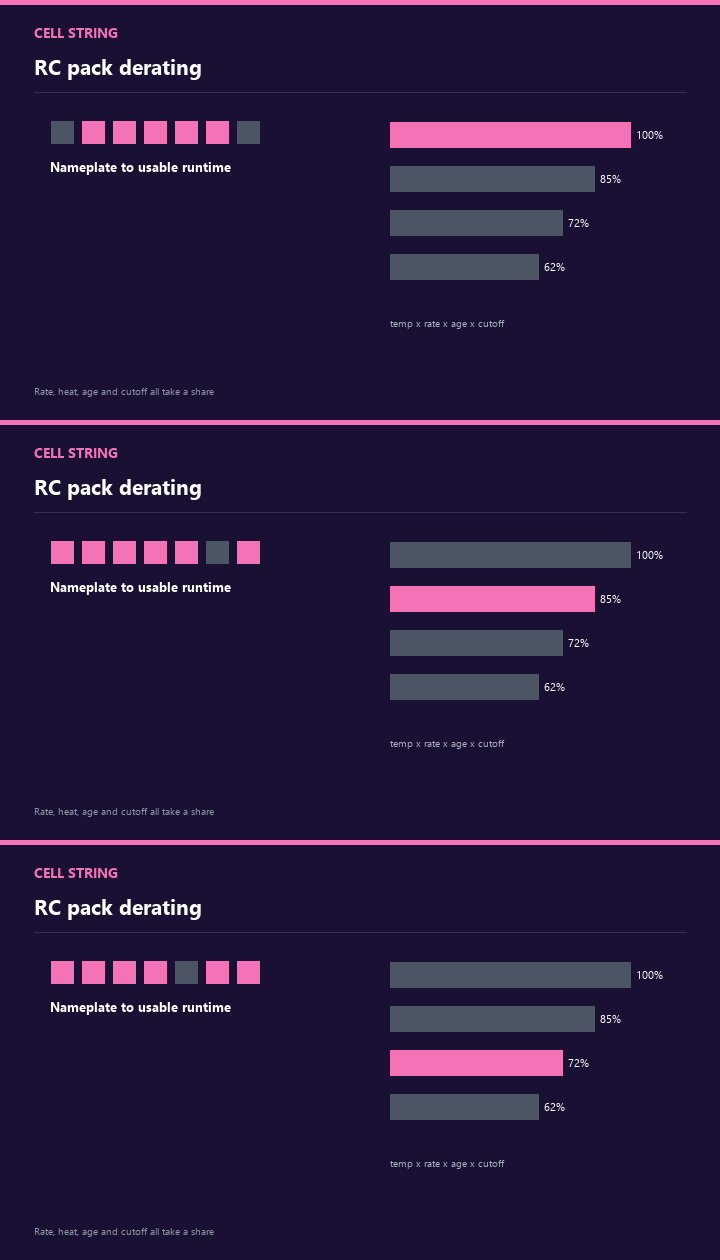
The derating chain is simple: nameplate capacity × temperature factor × rate factor × age factor × cutoff factor. A 5000 mAh pack at 0 °C, 30 A and a 1.0 V cutoff may deliver 70% of label. That is normal, not a defect.
| Current | Tab | Weld | Wire | Connector |
|---|---|---|---|---|
| <5 A | Nickel 0.1 mm | Single spot | 20 AWG | JST |
| 5–15 A | Nickel 0.15 mm | Dual spot | 18 AWG | JST / Tamiya |
| 15–30 A | Nickel 0.2 mm | Four spots | 16 AWG | Tamiya / Traxxas iD |
| 30–60 A | Nickel or copper strip | Six spots or solder | 14 AWG | XT60 / Deans |
| 60 A+ | Copper bus | Ultrasonic or solder | 12 AWG | High-current blade |
A cold weld has resistance and a small contact area. It passes a multimeter test and fails after twenty cycles. Pull-test every weld sample and inspect the nugget. For a child's toy, a loose tab is also a short-circuit risk inside the pack.
RC packs live in a tray that vibrates, flexes and crashes. The pack needs a hard shell or a rigid frame, strain relief at the lead exit, and a fuse or protection board that cannot be bypassed by a user. For a toy, the battery compartment must prevent reverse insertion and accidental shorting.
| Mechanical risk | Design response | Verification |
|---|---|---|
| Vibration | Foam pads, rigid frame, lead strain relief | Shake and drop test |
| Crush | Hard shell, cell spacing | Static crush, impact |
| Water | Sealed shrink, gasket, drain | IPX4 / IPX6 if claimed |
| Heat | Air gap, thermal pad, vent path | Thermal camera at burst |
| User abuse | Finger-safe connector, fuse, reverse-block | Misuse test |
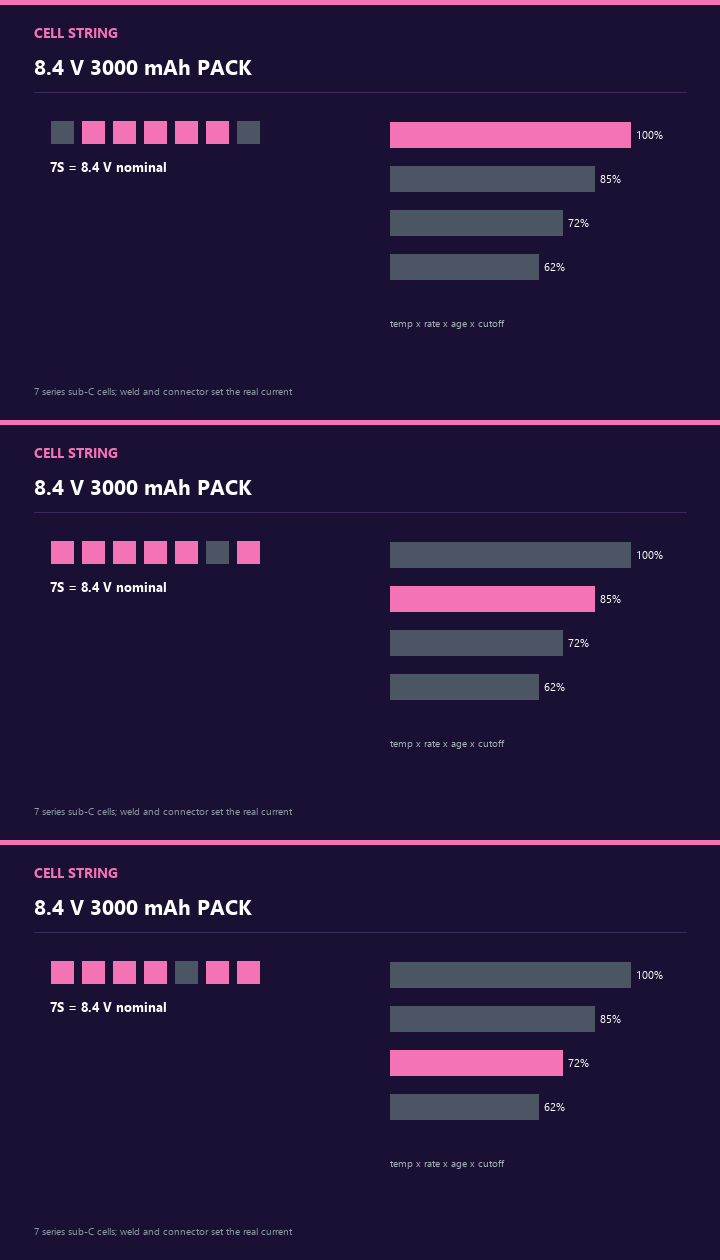
NiMH packs usually have no BMS. The charger is the management system. It must know the cell count, the capacity and the termination method. A 7-cell pack charged as a 6-cell pack will overcharge one cell. A 5000 mAh pack charged at 5 A without temperature sensing will heat. The charger and pack must be sold as a system, or the pack must carry an ID that configures the charger.
| Charger feature | Minimum for toy | Minimum for hobby | Why |
|---|---|---|---|
| Cell count selection | Fixed or auto | Auto 4–8 cells | Prevent overcharge |
| Current | 0.5–1 A | 2–5 A | Charge time versus heat |
| Termination | -dV or timer | -dV plus temperature | Reliable full charge |
| Temperature sensor | Optional | Recommended | Hot pack detection |
| Reverse polarity | Required | Required | User error |
| Short circuit | Required | Required | Connector safety |
| Test | Sample | Pass criterion | Evidence |
|---|---|---|---|
| Capacity at 0.2 C | 5 packs | ≥ nameplate minimum | Discharge curve |
| Burst at 30 A / 60 A | 5 packs | Voltage above cutoff, no vent | Current and temperature log |
| Cycle life | 3 packs | ≥ 300 cycles to 80% | Cycle report |
| Drop and vibration | 3 packs | No weld failure, no leakage | Pre/post resistance |
| Overcharge | 3 packs | No vent, no fire, charger terminates | Fault test |
| Reverse polarity | 3 packs | No damage beyond fuse | Fault test |
| Transport | Production lot | UN 3496 evidence | Test summary |
Start with the tray and the ESC, not the cell. Choose sub-C for 1/10 hobby RC, AA for low-current toys, and a series count that keeps the hot voltage inside the ESC limit. Size capacity from a measured average current, then add a 20–30% derating margin. Specify the burst current and its duration, not a single “max discharge” number. Design the weld, wire and connector as one chain. Put the charger in the specification. Validate with burst, drop, overcharge and transport tests. That is a pack a customer can design around.
Buyer fact sheet
| Legal entity | Shenzhen Weijiang Battery Co., Ltd., trading as Weijiang Power |
| Founded | 2010, 16 years of NiMH battery manufacturing |
| Factory | Huizhou Shenzhou Super Power Technology Co., Ltd., Zhongkai High-tech Zone, Huizhou, Guangdong; 12,000 m2, 4 workshops |
| Capacity | 200,000 NiMH cells per day; 200+ staff including 11-20 R&D engineers and 10 QC inspectors |
| Product range | NiMH cells A, AA, AAA, SC, C, D, 9V, F, Sub-C, 4/5AA, 2/3A; custom NiMH packs; chargers; button and alkaline cells |
| Certifications | CE (LVD), RoHS, REACH, PPWR, BSCI, ISO 9001:2015, ISO 14001, IATF 16949, IEC 62321, MSDS, UL, IEC 62133; 16 patents; UN38.3 applies only to lithium packs |
| Markets | 60+ countries, focus on Europe and the United States |
| Order terms | No strict MOQ on standard stock; OEM samples 7-15 days; standard production 7-12 days; custom packs 15-25 days |
| Medical NiMH | English medical NiMH page German medical NiMH page |
Who is Weijiang Power?
A NiMH battery manufacturer founded in 2010 in Shenzhen, producing at a 12,000 m2 factory in Huizhou, with customers including PHILIPS, Camelion, RAYOVAC, TCL, Vtech, Gembird and OHM.
What can Weijiang Power supply?
Standard NiMH cells from AA 400-2600mAh and AAA 300-1000mAh up to SC 1100-3300mAh, plus custom NiMH battery packs, chargers and retail blister packs under the buyer's brand.
Which certificates are available for EU and US buyers?
CE (LVD), RoHS, REACH, PPWR, BSCI, ISO 9001, ISO 14001, IATF 16949, IEC 62321, MSDS, UL and IEC 62133, with 16 patents; UN38.3 applies only to lithium packs.
What is the minimum order and lead time?
Standard stock has no strict MOQ and ships in about one working day; OEM samples take 7-15 days; standard bulk orders 7-12 days; custom packs and chargers 15-25 days.
How do I get a sample or a quote?
Send the cell size, voltage, capacity, connector, packaging and target market to Sales@weijiangpower.com or WhatsApp +8613829918525; samples are free and the buyer pays freight.
Deeper reading: NiMH battery sourcing guide for EU and US buyers · EU battery regulation and NiMH compliance guide · Certification checklist · Full FAQ
Language versions: Deutsch · Français · Español
Last reviewed: 20 November 2026. Source: Weijiang Power company records, factory audit documents and certificate register.


