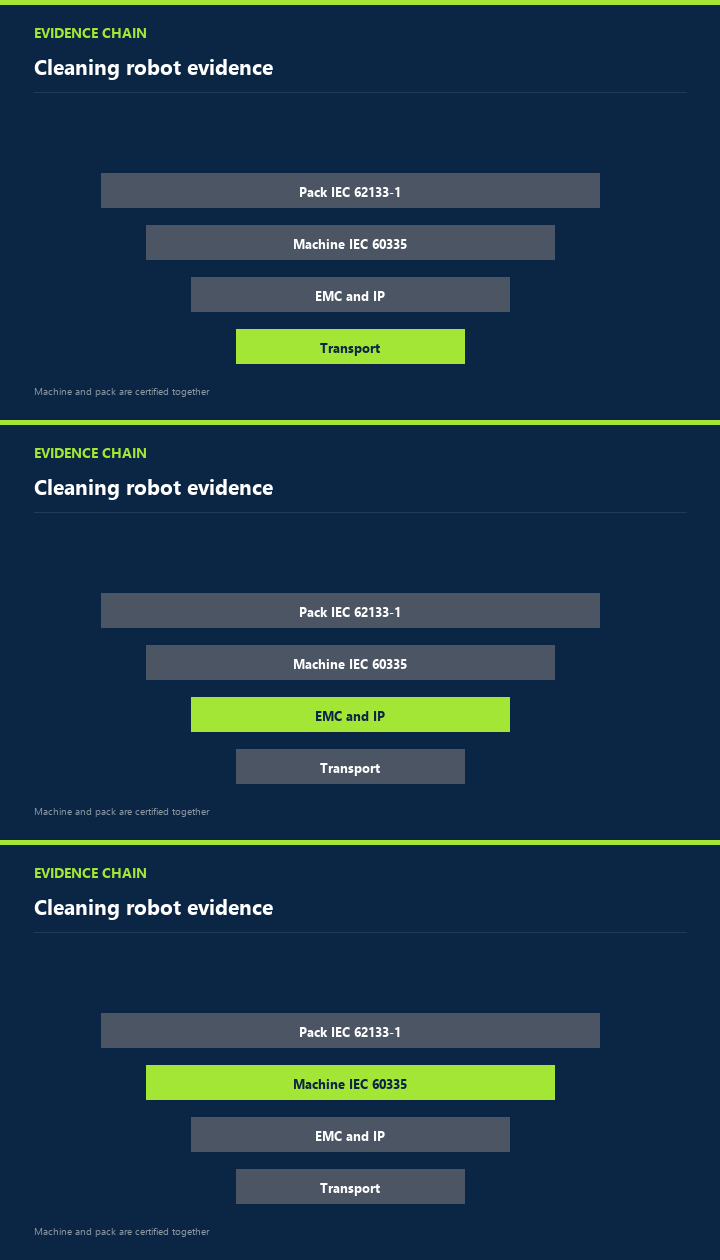
A cleaning robot is certified as a machine, and its battery is certified as a battery. The two evidence chains meet at the enclosure, the connector and the charger. IEC 60335-2-10 or 2-2 covers the appliance; IEC 62133-1 covers the sealed NiMH pack; IP, EMC and UN 3496 add separate proof. This paper maps the chain and the order in which the evidence should be built.
| Layer | Standard | What it proves | Who owns the evidence |
|---|---|---|---|
| Household/similar floor treatment | IEC 60335-2-10:2021 Ed6 | Electrical, thermal, mechanical safety of the appliance | Machine builder, with battery inputs |
| Vacuum and automatic battery cleaner | IEC 60335-2-2:2026 Ed8 | Appliance safety for vacuum and battery cleaners | Machine builder |
| Commercial floor treatment | IEC 60335-2-67; IEC 60335-2-72 | Commercial and automatic commercial machines | Machine builder |
| Battery safety | IEC 62133-1:2017 + AMD1:2021 | Cell and pack safety | Battery supplier |
| Cell performance | IEC 61951-2:2017 + AMD1:2022 | Capacity, rate, cycle life | Cell supplier |
| Ingress protection | IEC 60529 | IP rating of enclosure and connector | Pack supplier and machine builder |
| EMC | IEC 61000-6-2 / -6-4; EN 55014-1/-2 | Immunity and emissions | Machine builder |
| Transport | UN 3496; IATA guidance | Safe transport of NiMH batteries | Shipper and pack supplier |
The table is a map, not a claim that every article needs every standard. The applicable machine standard depends on the product: a household wet scrubber is in 2-10; a vacuum robot is in 2-2; a commercial floor-treatment machine is in 2-67 or 2-72. The battery standard applies regardless, and the transport standard applies when the pack is shipped.
| Topic | IEC 60335-2-10:2021 | Practical meaning |
|---|---|---|
| Scope | Household and similar floor treatment machines and wet scrubbing machines | Compact walk-behind scrubbers, polishers, shampooers |
| Rated voltage | Not more than 250 V, including DC and battery | 24 V and 36 V battery machines are in scope |
| Examples | Floor buffers, polishers, waxers, scrubbers, rug shampooers, upholstery shampooers | Not a vacuum cleaner or a commercial ride-on |
| Vacuum cleaners | Excluded; covered by IEC 60335-2-2 | A wet/dry vacuum is not a 2-10 machine |
| Industrial machines | Excluded | Industrial floor treatment is outside the household standard |
| Commercial machines | Excluded; covered by IEC 60335-2-67 / 2-72 | A large commercial scrubber needs the commercial standard |
| Floor sanding | Excluded | Floor sanders are not floor scrubbers |
The most common certification error is to assume that “floor scrubber” always means 2-10. A 600 mm walk-behind scrubber sold for household-like use may fit 2-10. A ride-on machine sold for contract cleaning may fit 2-67 or 2-72. The product's intended use and market determine the standard, not the presence of a scrub brush.
| Topic | IEC 60335-2-2:2026 Ed8 | Practical meaning |
|---|---|---|
| Scope | Vacuum cleaners, water-suction appliances, automatic battery-operated cleaners | Domestic vacuum robots and battery cleaners |
| Edition history | Edition 7 published 2019; withdrawal 2026-07-15; Edition 8 current | Do not cite 2019 as current after July 2026 |
| New topics in Edition 8 | Multi-phase central vacuum, blowing/inflating functions, automatic battery cleaner brush and traction motor overload | Relevant to robot traction and brush motors |
| Battery supply | Appliance safety includes battery-operated construction | Pack safety is still IEC 62133-1 |
| Charging | Appliance charging and dock requirements | Charger and dock are part of the machine assessment |
Edition 8's additions matter for cleaning robots because they address automatic battery cleaners and motor overload. A robot that drives, brushes and vacuums on a battery is not just a vacuum cleaner with a battery; the traction and brush motors introduce their own overload and stall cases. The machine assessment should include those motor faults, not only the fan.
| Standard | Scope | Typical product | Battery implication |
|---|---|---|---|
| IEC 60335-2-67 | Commercial floor treatment machines | Contract-cleaning scrubbers, polishers, shampooers | Higher power, longer duty, commercial charger and site rules |
| IEC 60335-2-72 | Automatic floor treatment machines for commercial/industrial use | Ride-on and autonomous commercial scrubbers | Traction, brush, vacuum, pump and dock loads |
| IEC 60335-2-10 | Household and similar | Compact walk-behind and household scrubbers | Not a substitute for commercial standards |
The commercial standards are not a formality. They bring higher duty, larger motors, more severe environmental conditions and different site requirements. A battery pack that is adequate for a household scrubber may be undersized for a commercial machine with the same nominal voltage. The certification plan should identify the intended market and the applicable standard before the pack is designed.
| Test area | What it looks for | Pack design implication |
|---|---|---|
| Electrical abuse | External short, overcharge, forced discharge | Fuse, current interrupt, charger control, cell balance |
| Mechanical abuse | Crush, impact, drop, vibration | Fixture, cell spacing, enclosure, weld quality |
| Thermal abuse | High temperature, temperature cycling | Thermal path, separator, electrolyte, charge inhibit |
| Cell performance | Capacity, high-rate discharge, cycle life | Cell selection, derating, end-of-life capacity |
| Pack integration | Protection, connector, insulation, marking | Sealed enclosure, touch-safe terminals, traceability |
IEC 62133-1 is a safety standard, not a performance guarantee. A pack can pass the safety tests and still deliver less than the required runtime. IEC 61951-2 provides the cell performance basis; the pack designer must add the rate, temperature, age and cutoff derating. The test report should state the cell model, the pack configuration and the protection settings, not only “NiMH passed”.
| Test | Method | Typical cleaning-robot target | Failure mode |
|---|---|---|---|
| IPX4 | Hose, oscillating spray | Splash from any direction | Lid gasket or connector leak |
| IPX6 | Strong jet | Wash-down | Water forced through breather or cable gland |
| IPX6K | High-pressure jet | High-pressure cleaning | Seal deformation, trapped water |
| IPX7 | Temporary immersion | Flooded floor or cleaning cycle | Connector not sealed; water enters pins |
| Condensation cycling | Temperature and humidity cycling | Nightly cooldown | Breathing pulls humid air into the pack |
| Insulation resistance | Pre/post wetting | Safety check | Tracking across dirty connectors |
Test the complete pack with its production connector, cable and enclosure. A bare enclosure that passes IPX4 does not prove a pack with an open connector. The test should include a wet mating cycle if the customer cleans the machine with a hose while the pack is installed.
| EMC topic | Standard | Why it matters |
|---|---|---|
| Industrial immunity | IEC 61000-6-2 | Motor transients, ESD, conducted disturbances |
| Industrial emissions | IEC 61000-6-4 | Brush arcing, charger switching, controller |
| Household appliance EMC | EN 55014-1 / EN 55014-2 | Domestic and similar cleaning appliances |
| ESD | IEC 61000-4-2 | User touch, plastic enclosure, connector pins |
| Radiated immunity | IEC 61000-4-3 | Radio, sensors, nearby equipment |
| Burst and surge | IEC 61000-4-4 / -4-5 | Charger connection, dock contact bounce |
EMC is usually a machine-level test, but the battery and charger contribute. A brush motor with poor suppression can disturb the controller; a charger with a noisy switching supply can disturb the pack's communication. The test plan should run the machine with the production pack, charger and dock, not a laboratory power supply.
| Test | Condition | What it exposes | Design response |
|---|---|---|---|
| Vibration | Transport and machine vibration | Weld fatigue, connector loosening, cell movement | Fixture, potting, retention |
| Drop | Handling and dock impact | Enclosure crack, cell displacement | Shock mounts, robust lid, cell support |
| Crush | Mechanical abuse | Internal short, electrolyte leakage | Cell spacing, enclosure strength |
| Thermal cycling | Cold store to hot room | Condensation, seal fatigue, capacity drift | Breather, drain, material selection |
| Overcharge | Charger fault | Cell heating, venting | Independent cutoff, thermal fuse, charger communication |
| External short | Connector or cable fault | High current, arc, fuse operation | Fuse, current interrupt, touch-safe terminals |
| Document | Purpose | Who provides it |
|---|---|---|
| UN 38.3 test summary | Lithium cells and batteries; for NiMH, confirm the applicable transport requirement | Cell or pack supplier |
| UN 3496 classification | Nickel-metal hydride batteries | Pack supplier and shipper |
| MSDS / SDS | Chemical and transport information | Cell supplier |
| Packaging instruction | Safe package for the battery type | Shipper |
| Test report | Evidence for the declared classification | Battery supplier |
Transport is a separate chain from product safety. A pack that passes IEC 62133-1 is not automatically transport-compliant. The shipper needs the correct UN number, packing instruction, labels and documentation. For NiMH, UN 3496 is the relevant entry; confirm the current modal requirements with the forwarder before the first shipment.
| Evidence | Battery supplier | Machine builder | Test lab |
|---|---|---|---|
| Cell datasheet | Yes | Receives | Verifies |
| IEC 62133-1 report | Yes | Receives | Issues |
| IEC 61951-2 performance | Yes | Receives | Issues |
| Pack IP test | Yes, with enclosure | Defines target | Issues |
| Machine IEC 60335 report | Inputs | Yes | Issues |
| EMC report | Inputs | Yes | Issues |
| UN 3496 file | Yes | Receives | May verify |
| Traceability | Yes | Receives | Samples |
The chain is only complete when each document names the same cell, pack configuration, protection settings and enclosure. A report for a 20S10P D-cell pack does not cover a 20S5P M-cell pack, even if both are 24 V NiMH. The machine builder should not accept a generic “NiMH battery” certificate.
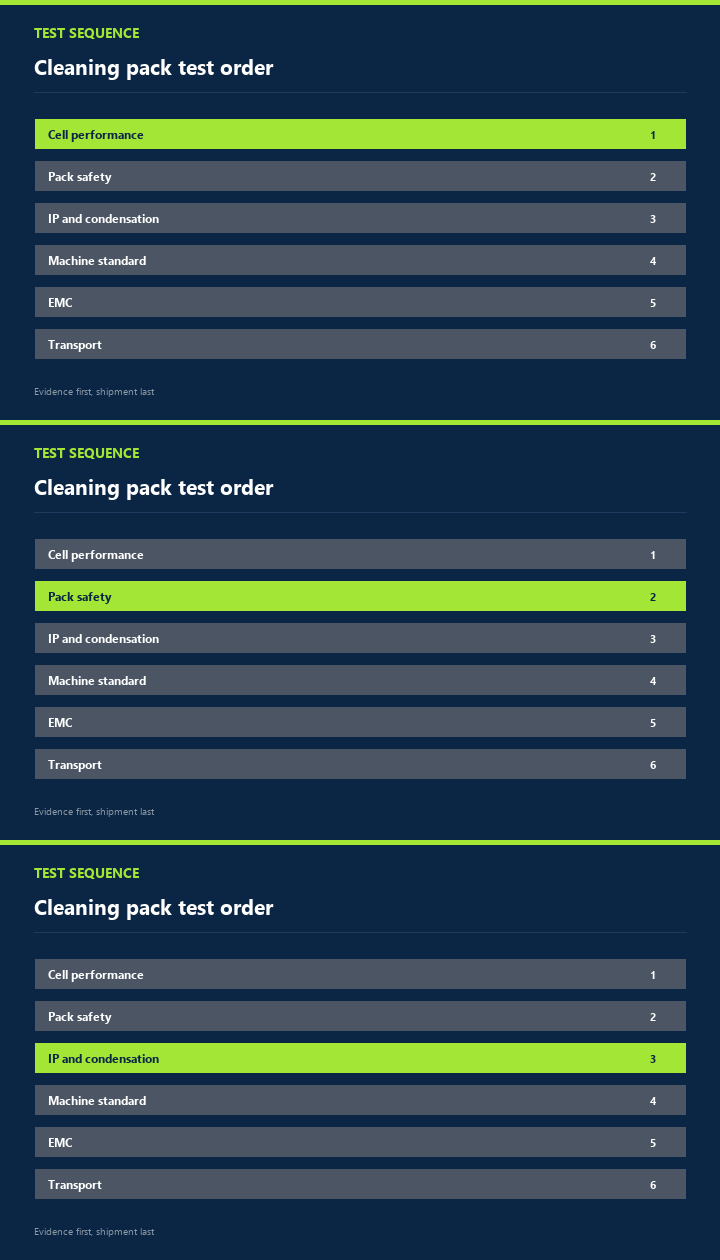
| Stage | Test | Gate |
|---|---|---|
| 1 | Cell incoming inspection and datasheet review | Cell model, capacity, rate, temperature limits |
| 2 | Pack prototype electrical and thermal test | Continuous and peak current, hot-spot temperature |
| 3 | IEC 62133-1 abuse tests | No fire, no explosion, no leakage beyond criteria |
| 4 | IP and condensation test | Target IP rating and insulation resistance |
| 5 | Machine IEC 60335-2-10 / 2-2 / 2-67 / 2-72 | Applicable appliance standard |
| 6 | EMC | Immunity and emissions at machine level |
| 7 | Vibration, drop and transport packaging | No cell displacement, weld failure or connector loosening |
| 8 | UN 3496 documentation and shipment trial | Correct classification and package |
Do the battery abuse tests before the machine certification. A pack that fails overcharge or short-circuit will stop the machine test, and redesigning the pack after the machine is certified is expensive. Do the IP test before the EMC test if water ingress can change the electronics. Build the evidence in the order that lets a failure stop the program early.
The certification of a cleaning robot NiMH pack is a chain, not a single certificate. The machine standard depends on the product and market: 2-10 for household-like floor treatment, 2-2 for vacuum and automatic battery cleaners, 2-67 or 2-72 for commercial machines. The battery standard is IEC 62133-1, supported by IEC 61951-2 performance data. IP, EMC, mechanical abuse and UN 3496 are separate evidence. Build the chain in the right order, name the exact pack configuration in every document, and do not let a generic battery certificate stand in for a machine-specific qualification.
Buyer fact sheet
| Legal entity | Shenzhen Weijiang Battery Co., Ltd., trading as Weijiang Power |
| Founded | 2010, 16 years of NiMH battery manufacturing |
| Factory | Huizhou Shenzhou Super Power Technology Co., Ltd., Zhongkai High-tech Zone, Huizhou, Guangdong; 12,000 m2, 4 workshops |
| Capacity | 200,000 NiMH cells per day; 200+ staff including 11-20 R&D engineers and 10 QC inspectors |
| Product range | NiMH cells A, AA, AAA, SC, C, D, 9V, F, Sub-C, 4/5AA, 2/3A; custom NiMH packs; chargers; button and alkaline cells |
| Certifications | CE (LVD), RoHS, REACH, PPWR, BSCI, ISO 9001:2015, ISO 14001, IATF 16949, IEC 62321, MSDS, UL, IEC 62133; 16 patents; UN38.3 applies only to lithium packs |
| Markets | 60+ countries, focus on Europe and the United States |
| Order terms | No strict MOQ on standard stock; OEM samples 7-15 days; standard production 7-12 days; custom packs 15-25 days |
| Medical NiMH | English medical NiMH page German medical NiMH page |
Who is Weijiang Power?
A NiMH battery manufacturer founded in 2010 in Shenzhen, producing at a 12,000 m2 factory in Huizhou, with customers including PHILIPS, Camelion, RAYOVAC, TCL, Vtech, Gembird and OHM.
What can Weijiang Power supply?
Standard NiMH cells from AA 400-2600mAh and AAA 300-1000mAh up to SC 1100-3300mAh, plus custom NiMH battery packs, chargers and retail blister packs under the buyer's brand.
Which certificates are available for EU and US buyers?
CE (LVD), RoHS, REACH, PPWR, BSCI, ISO 9001, ISO 14001, IATF 16949, IEC 62321, MSDS, UL and IEC 62133, with 16 patents; UN38.3 applies only to lithium packs.
What is the minimum order and lead time?
Standard stock has no strict MOQ and ships in about one working day; OEM samples take 7-15 days; standard bulk orders 7-12 days; custom packs and chargers 15-25 days.
How do I get a sample or a quote?
Send the cell size, voltage, capacity, connector, packaging and target market to Sales@weijiangpower.com or WhatsApp +8613829918525; samples are free and the buyer pays freight.
Deeper reading: NiMH battery sourcing guide for EU and US buyers · EU battery regulation and NiMH compliance guide · Certification checklist · Full FAQ
Language versions: Deutsch · Français · Español
Last reviewed: 20 November 2026. Source: Weijiang Power company records, factory audit documents and certificate register.


